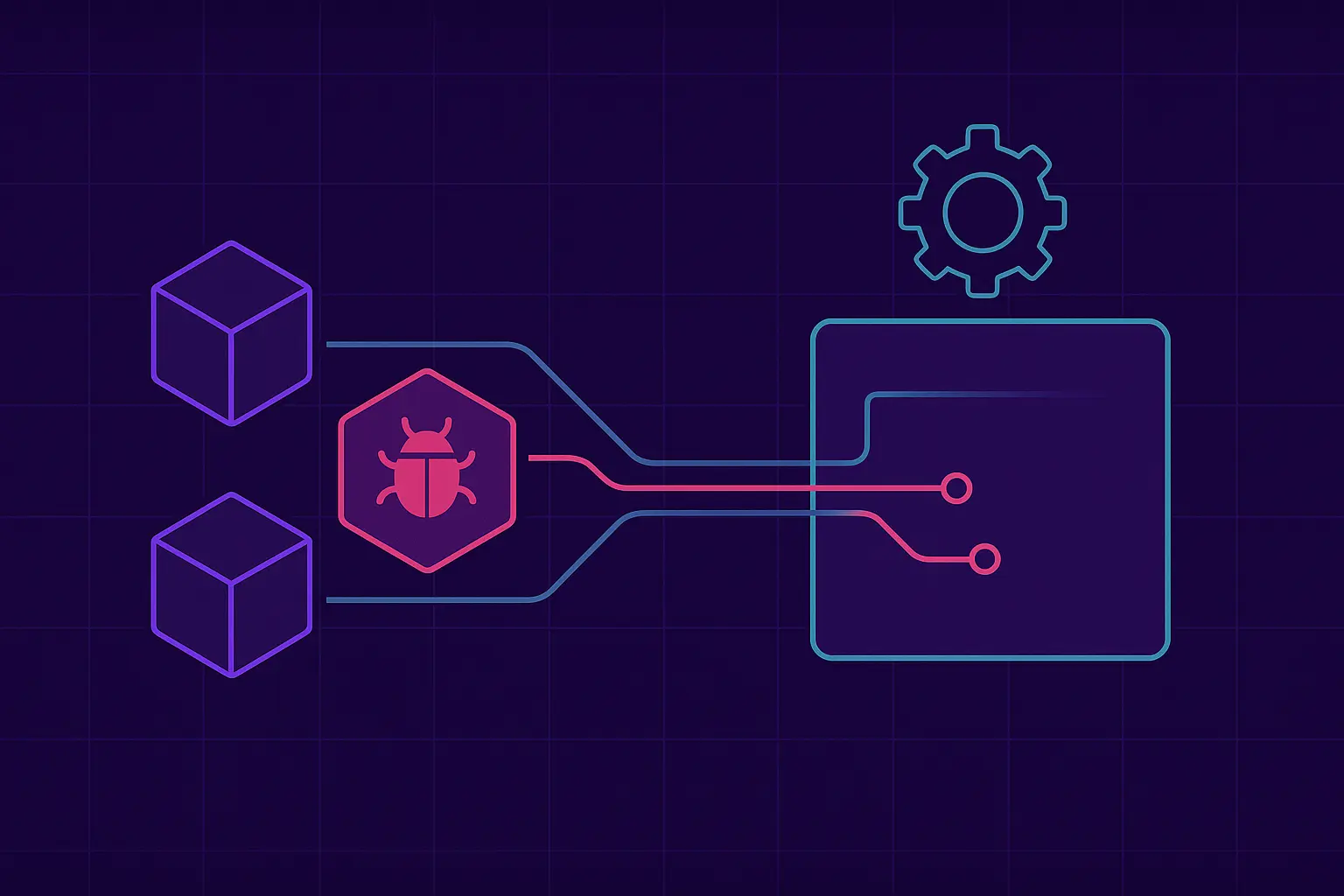

Open-source software is the foundation of modern application development. But while developers rely on open-source packages to speed development, attackers are increasingly weaponizing that trust via malicious open-source packages (MPs).
Unlike traditional vulnerabilities, MPs are not theoretical risks or misconfigurations with the potential to be exploited. They are actual malware, intentionally embedded in open-source packages, designed to execute automatically when installed.
These packages can steal credentials, install backdoors, compromise build pipelines, exfiltrate sensitive data, and pilfer computer resources – often before traditional AppSec tools even begin scanning them.
Malicious packages affect every stage of modern development, including:
- Developer workstations containing sensitive credentials and intellectual property
- CI/CD pipelines with access to secrets and production systems
- Production environments that handle business-critical and customer data
Yet, despite this risk, 67% of respondents in Checkmarx’s recent Future of AppSec survey report that, “half or more of their organization’s application code consists of open-source software,” reflecting the prevalence of modular development and heavy reliance on open-source components.
Despite this massive exposure, only 49% stated they have any protection in place against malicious packages.
What Makes Malicious Packages Uniquely Dangerous
Malicious open-source packages aren’t misconfigurations or dormant vulnerabilities – they are intentional malware ready to attack immediately.
While typical vulnerabilities require a trigger or exploit, malicious packages often execute immediately upon installation, before any code using them is written, scanned, or deployed.
This timing renders most traditional AppSec tools ineffective:
- SAST and SCA run too late, after packages are installed
- Endpoint protection rarely covers developer or CI environments
- Package managers are implicitly trusted, and attackers exploit that trust
The Growing Scale of the Threat
The problem of malicious packages is accelerating rapidly. Repositories like npm and PyPI, as well as widely used packages, are being actively and increasingly targeted. Attackers are leveraging automation, social engineering, and AI to increase reach and sophistication.
Recent high-profile cases – including the qix ecosystem compromise and the Shai-Hulud self-replicating supply chain attack – show how devastating these attacks can be.
Checkmarx has identified and verified over 550,000+ malicious and suspicious packages across multiple OSS ecosystems – and that number is growing rapidly.
As mentioned above, 67% of orgs say that more than half of their code bases comprise OSS (with nearly all enterprises utilizing OSS in their code bases). Yet, only 49% are actively protecting themselves against MPs (Future of AppSec, p.19).
Required Now: Comprehensive Enterprise Defense
Effective enterprise protection requires proactive, multi-layered defense at every point where open-source packages are installed or used:
- Pre-installation screening using automated checks against a comprehensive malicious package database before downloads occur
- Artifact registry defense via plugins that block malicious packages from entering private repositories or being installed from them
- Developer workstation protection through package manager wrappers and IDE integrations
- CI/CD pipeline security with fast API-based checks that block malicious installs in seconds, and don’t slow builds
- Enhanced SCA scanning that identifies open-source malicious packages alongside vulnerabilities
- Continuous monitoring to detect previously installed packages that are later discovered to be compromised
Know the Threat and How to Defend Against it – Download the eBook
Checkmarx’s new eBook is the industry’s first comprehensive deep dive into the world of malicious packages, how they are deployed, the damage they can inflict, and how to defend against them. Written by a team of experts, including members of the Checkmarx Zero research team, it is the product of deep expertise, meticulous analysis, and real-world threat intelligence.
It goes beyond basic awareness by delivering a detailed, actionable strategy to help enterprises detect and block malicious package attacks across the entire SDLC.
Download this eBook to learn:
- A deep understanding of how malicious packages work – with over a dozen detailed real-world examples
- How to deploy a full-stack defense strategy across the SDLC
- Hands-on integration examples of protecting dev and build workflows, regardless of AppSec stack
- ROI insights and business case justification for security leaders
Introducing the MPIAPI: A Game-Changer for Malicious Package Defense
To address growing threat of malicious packages, Checkmarx developed the Malicious Package Identification API (MPIAPI) – a powerful solution designed for real-time MP detection across your SDLC.
MPIAPI offers:
- Real-time identification of malicious and suspicious OSS packages via simple API calls
- Coverage across numerous OSS ecosystems, powered by the world’s largest database of malicious packages
- Human-validated threat intelligence from the Checkmarx Zero research team
- Seamless integration with IDEs, CI/CD pipelines, artifact registries, and research workflows
- Compatibility with any AppSec stack
- Lightning-fast response times and enterprise-grade reliability

Summary
Malicious packages are not theoretical. They are executing inside enterprise environments today.
Most AppSec tools are insufficient or too late to help. Defending against malicious packages requires a proactive strategy and real-time threat intelligence that integrates across every stage of the SDLC.
Want to see it in action, with hands-on examples relevant for your particular tools and environment?
AppSec
Malicious Packages
MPIAPI
Open-Source Security
SSCS