
Modern development teams are already balancing feature work, code reviews, production issues, and release deadlines. When a security finding lands without clear context, it doesn’t feel like a simple task. It feels like another investigation.
Before you can fix anything, you need answers: Is this code actually reachable? Can an attacker exploit it? Is it exposed to a real application path? Are there controls already in place? Is this worth interrupting sprint work right now?
Most alerts don’t answer any of those questions. They tell you a vulnerability exists – not if it matters. That’s largely a scanning problem: one practitioner calls static scanning an “alert factory that nobody uses.” When 80–90% of findings are irrelevant, the result is a cycle no team wants. AppSec has to justify urgency, developers must reconstruct missing context, and everyone loses time that could have gone toward fixing the issues that matter.
The bigger problem is not that security findings exist. It is that many findings arrive without the evidence developers need to make a confident engineering decision. Traditional scanners can identify patterns that may be risky, but they rarely answer the questions that determine whether a fix should interrupt current work.
A function may be reachable but protected by authentication, input validation, network controls, or other safeguards. Another issue may look less severe on paper but become urgent because it sits in a public-facing workflow or touches sensitive data. A low-severity finding in a public-facing workflow can be far more dangerous than a critical bug buried in an internal module.
Without context, reachability alone is not enough. Modern risk is compositional, shaped by deployment, exposure, identity, and data, not by code patterns.
Without that context, the work falls to whoever picked up the ticket. Someone must trace the path, check exposure, review controls, assess impact, and determine whether the issue is exploitable in this application, not just theoretically possible in code.
Smarter Triage: Context-Driven, Data-Driven Decisions
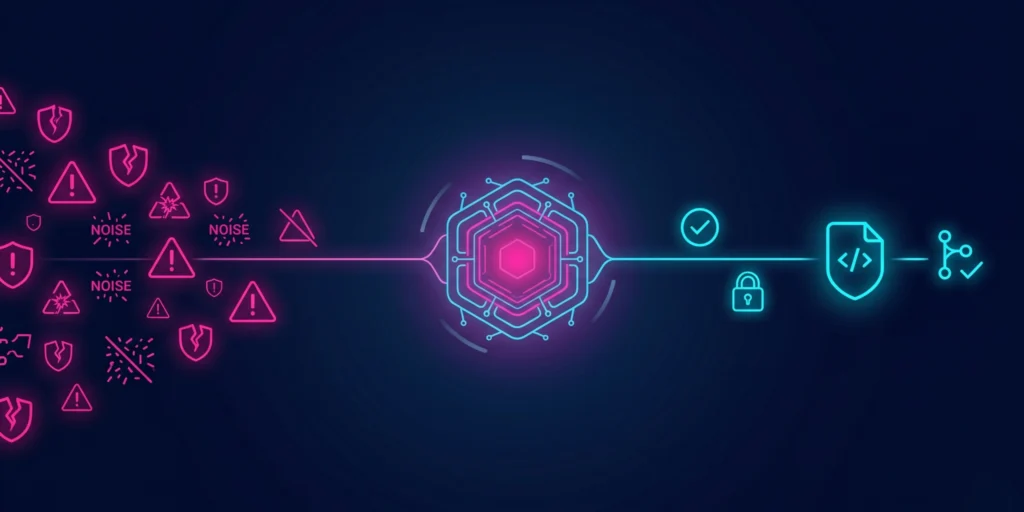
A better triage process should answer the obvious engineering questions before a finding reaches the backlog. Instead of asking developers to investigate every possible issue from scratch, modern triage tools use AI and execution context to validate which findings are actually exploitable in the application.
In practice, a smart triage layer correlates scan results with runtime data, permissions, architecture, and policies. The output is not just another severity label. It’s evidence: the relevant path through the code, the attacker-controlled input, the potential impact, and whether existing controls prevent exploitation.
Checkmarx’s Attackability analysis is designed to provide evidence by tracing attacker-controlled inputs from real ingress points through the code to potential impact, then verifying which security controls are in place. The result is a verdict of demonstrated exploitability or not, with code-level evidence attached.
That shifts the conversation from “maybe it’s exploitable” to a clear yes or no question. By validating findings with facts, teams stop arguing in the abstract. The report shows precisely how an issue is or isn’t reachable and exploitable, so you can align with security on facts, not time-consuming assumptions. With Attackability data, AppSec can confidently say “this vulnerability is exploitable under these conditions, and here’s the proof” (or alternatively, “we can mark this issue low risk, because x, y, z controls make exploitation infeasible”).
Analysts put it plainly that “a finding without context is a tax,” because it forces a human to ask the only question that matters: “Is this exploitable here and now? If not, why bother fix it at this point?” Front-loading that context and verification means only high-fidelity, relevant alerts reach the backlog.
Automated Remediation: Turning Decisions Into Fixes
Triage helps teams agree on what matters. But you still need a practical path from validated risk to working code. Too often, even agreed-upon issues stall in handoffs or ticket threads. The fix is to automate “closing of the loop.”
Enter remediation assistants that live in your developer workflow. These tools generate context-aware, merge-ready fixes for validated findings, usually as pull requests. For example, Checkmarx’s Remediation Assist uses safe-refactoring principles to produce minimally invasive patches right where you already work. You can review the diff, run tests, inspect the logic, adjust the code if needed, and merge when it meets your standards.
When remediation shows up as a pull request, you do not have to stop what you are doing to interpret a vague ticket, chase down context, or debate whether the finding is worth fixing. You can review the diff like any other code change, run your tests, adjust the code if needed, and merge when it meets your standards.
Decisions become code almost instantly without any lag.
That matters because the old model of manually reviewing, debating, assigning, fixing, and rechecking vulnerabilities isn’t keeping up with the speed of exploitation. A 2026 Qualys Threat Research analysis of more than one billion CISA KEV remediation records across 10,000 organizations found that manual remediation processes failed to keep pace with attackers 88% of the time across the most critical actively weaponized vulnerabilities studied. Organizations that performed better had operationalized remediation pipelines, giving their teams a faster way to move from validated risk to completed fix.
The cost in developer time is just as significant. Checkmarx’s DevSecOps Evolution 2025 research found that 72% of devs spend more than 17 hours each week on security-related tasks, and one in four spends more than 25 hours. Automated triage and remediation reduces that burden by turning validated security decisions into reviewable code changes, so teams stay focused on building while still moving real risk to resolution.
Results: Fewer Arguments, Faster Fixes
The outcome of this triage-and-remediation workflow is clear: fewer debates and far more fixes. With objective analysis in hand, security and engineering reach consensus faster. With remediation automation in place, vulnerabilities are closed before they linger.
Teams that add automated remediation report mean-time-to-remediate shrinking from weeks to hours. Instead of arguing over false positives, teams ask “how do we fix this fastest?” Workflow-integrated triage eliminates the guesswork in risk evaluation and, paired with agentic remediation, it ensures that decision leads to a patch. The result is fewer vague tickets, clearer priorities, and more vulnerabilities resolved instead of debated.
Agentic AI
Agentic AppSec
AI Agents
AppSec