

Summary
Application Security Posture Management (ASPM) is a centralized approach to unifying and managing application security across the software development lifecycle. It consolidates findings from tools like SAST, DAST, SCA, and others into a single dashboard.
“ASPM correlates and unifies AppSec security findings in a unified dashboard and provides a single-source-of-truth for developing and maintaining secure applications.”
ASPM (Application Security Posture Management) is an end-to-end approach for managing and improving the security posture of applications throughout their lifecycle, from development to deployment and from code to cloud. ASPM correlates and unifies AppSec security findings in a unified dashboard and provides a single-source-of-truth for developing and maintaining secure applications.
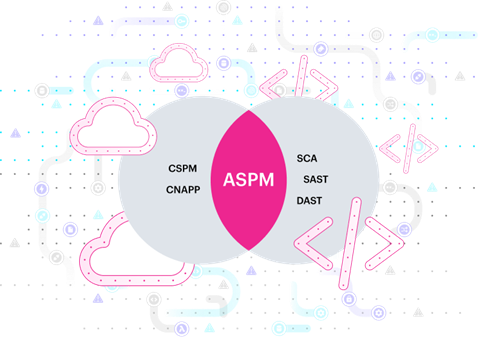
With ASPM, enterprises can mitigate security threats and vulnerabilities, meet compliance requirements, streamline and automate application security workflows and increase visibility into the security posture of applications.
Why is ASPM Security Important?
Enterprises are largely dependent on corporate applications for business operations. But these applications are becoming increasingly complex and interconnected, making them harder to secure. In addition, low-code and no-code platforms allow employees to develop their own shadow IT applications, creating new types of risk for the enterprise.
Finally, AI is disrupting workflows, and developers and security are not excluded.
Modern ASPM solutions ensure protection against AI-related risks, with AI.
ASPM helps protect the enterprise while allowing business continuity and productivity.
ASPM solutions:
- Protect against data breaches that could compromise sensitive data, such as personal information, financial details and proprietary business data.
- Ensure organizations comply with regulations like GDPR, HIPAA, FINRA and CCPA.
- Minimize vulnerabilities in applications, reducing the attack surface that cybercriminals can exploit.
- Proactively detect and mitigate threats with continuous monitoring and vulnerability management.
- Reduce false positives to ensure fast time-to-value.
- Allow business continuity by ensuring applications run smoothly and securely.
- Leverage AI to protect against all risks, including AI-generated ones, and create a seamless developer experience.
- Creates a future-proof solution for application security.
From an organizational and DevSec perspective, ASPM:
- Integrates security into the development cycle, allowing organizations to remain agile and building trust between AppSec teams and developers.
- Provides detailed insights into the security posture of applications, enabling informed decision-making and risk-based prioritization.
- Allows for simplified, centralized management of security policies and controls across all applications, reducing TCO.
- Streamlines the remediation process and makes it more efficient and automated.
- Helps incorporate AI into the developer and security workflows.
How Does ASPM Work?
An ASPM process covers the ASPM tools and processes for protecting applications against vulnerabilities. Main capabilities include:
- Continuous Monitoring of the network, systems, and user activities and providing unified reports and dashboards of the findings.
- DevSecOps Integrations – Making ASPM part of the developer ecosystem and workflows to streamlining the process, enhance security and build DevSec trust.
- Dynamic Risk Assessment of the potential impact of threats. This involves using ML and AI for analyzing data, identifying anomalies and predicting potential security incidents before they occur.
- Automated Remediation Mechanisms to mitigate identified risks. This can include adjusting firewall rules, modifying access controls, isolating compromised systems, or deploying patches and updates.
- Policy Adaptation based on the ongoing assessment of risks and operational needs. Policies are automatically updated to address new vulnerabilities, emerging threats and changes in the operational environment.
- Feedback Loop Mechanism – The outcomes of security actions are continuously analyzed to refine and improve the security posture. This involves learning from past incidents, updating threat models and enhancing detection and response capabilities.
- AI-powered Application Security that helps democratize AppSec and provides developer and security with advanced tools to enhance the application security postureposure.
How Is Agentic AI Transforming ASPM Solutions?
Agentic AI shifts ASPM from passive aggregation of findings to active, goal-driven security execution. Instead of only correlating alerts and presenting them in dashboards, agentic systems can investigate issues, decide on next steps, and take action across the application lifecycle. This reduces the gap between identifying a risk and actually fixing it.
A key change is continuous, context-aware operation. Agentic AI collects signals from code, dependencies, pipelines, and runtime environments, then builds a unified view of risk. It does not treat findings in isolation. By correlating data across sources, it prioritizes issues based on real impact, helping teams focus on what matters rather than dealing with large volumes of low-value alerts.
Agentic AI also improves how ASPM handles remediation. Instead of relying on predefined automation scripts, it can plan and execute multi-step responses dynamically. For example, it can analyze a vulnerability, determine the best fix, apply changes, and validate the outcome. This iterative approach reduces exposure time and enables real-time prevention during development and in CI/CD pipelines.
Another transformation is tighter integration into developer workflows. Agentic systems operate directly in IDEs and pipelines, enforcing policies, suggesting fixes, and blocking risky changes when necessary. This ensures security is applied consistently from code creation to deployment without slowing development.
ASPM Features and Capabilities
How ASPM platforms deliver value becomes clearer when looking at their core capabilities. These features focus on unifying security data, reducing noise, and helping teams act on real risk instead of raw findings.
- Code-to-cloud risk visibility: Aggregates signals from multiple sources into a single view. This includes code, dependencies, infrastructure, APIs, containers, and runtime data, allowing teams to see risk across the full application lifecycle.
- Unified signal correlation: Combines findings from different security tools and third-party systems. This removes silos and helps identify relationships between issues that would otherwise appear unrelated.
- Context-driven risk prioritization: Ranks vulnerabilities based on factors like exploitability, reachability, and exposure. This ensures teams focus on issues that are most likely to be exploited and have real impact.
- Developer-centric security integration: Embeds security insights directly into IDEs and developer workflows. Developers can identify and fix issues in real time without leaving their working environment.
- End-to-end risk coverage: Connects vulnerabilities from development through runtime. This provides traceability from the original code issue to its potential production impact.
- Ecosystem integrations: Integrates with CI/CD pipelines, cloud platforms, ticketing systems, and developer tools. This ensures security processes align with existing workflows instead of disrupting them.
- Context-enriched risk scoring: Produces a single risk score by combining multiple dimensions such as fixability and runtime exposure. This simplifies decision-making and prioritization.
- Cloud and runtime insights: Links application findings with cloud posture and runtime behavior. This helps identify which vulnerabilities are exposed in production environments.
- Faster triage and remediation: Provides guided triage, filtering, and real-time updates. Teams can quickly isolate actionable issues and reduce time to remediation.
- Audit-ready reporting and monitoring: Offers detailed reporting with filtering, grouping, and export capabilities. This supports compliance requirements and continuous posture tracking.
Use Cases and Benefits of ASPM
Agentic AI introduces more autonomous and context-aware capabilities into ASPM, but its value becomes clearer when mapped to real-world use cases. The following examples show how ASPM platforms are applied to solve practical security and operational challenges across the application lifecycle.
- Centralized application risk management: Consolidates findings from multiple security tools into a single platform. Security teams can track, prioritize, and manage risks across all applications without switching between systems.
- Devsecops enablement: Embeds security into CI/CD pipelines and developer workflows. This allows teams to detect and fix vulnerabilities early, reducing rework and avoiding delays before release.
- Vulnerability prioritization at scale: Filters and ranks large volumes of findings using context such as exploitability and runtime exposure. Teams focus on high-impact issues instead of spending time on low-risk alerts.
- Faster incident response and remediation: Provides actionable insights and automated workflows for fixing vulnerabilities. This reduces mean time to remediation (MTTR) and limits exposure windows.
- Compliance and audit readiness: Continuously monitors applications against regulatory requirements. Generates audit-ready reports that simplify compliance with standards like GDPR, HIPAA, and PCI-DSS.
- Cloud and runtime risk reduction: Connects code-level vulnerabilities with runtime and cloud configuration data. Helps identify which issues are actually exposed in production environments.
- Third-party and supply chain risk management: Tracks dependencies, libraries, and SBOM data to identify risks from third-party components. Improves visibility into software supply chain vulnerabilities.
- Developer productivity improvement: Reduces friction by integrating security insights directly into developer tools. Developers receive clear, contextual guidance, which speeds up remediation without disrupting workflows.
- Security program optimization: Provides metrics, trends, and risk scoring across the application portfolio. Enables security leaders to make informed, risk-based decisions and allocate resources effectively.
- Ai-driven threat detection and prevention: Uses machine learning and agentic AI to identify patterns, predict risks, and automate responses. Improves detection of complex and emerging threats, including AI-generated attack vectors.
ASPM vs. Other Technologies
ASPM vs. CSPM
ASPM is often confused with CSPM (Cloud Security Posture Management), even though the two are different security categories. ASPM meaning is different from the CSPM meaning.
CSPM continuously monitors cloud environments to detect and mitigate security risks. It identifies misconfigurations, unauthorized access and other vulnerabilities within cloud infrastructures to ensure compliance with industry standards and organizational policies.
Here’s how the two compare, ASPM definition vs. CSPM definition:
| ASPM | CSPM | |
| Security Scope | Application Lifecycle | Cloud Infrastructure |
| Main Deliverable | Visibility into AST tools findings | Detecting cloud infrastructure misconfigurations and risks |
| Integrations | SDLC and DevSecOps tools and practices | Cloud service providers and tools |
| Compliance Management | Yes | Yes |
| Restricted to the Cloud | No – Cloud and On-prem | Yes |
| AI-driven | Vendor-dependent | Vendor-dependent |
ASPM vs. Cloud Native Application Protection Platforms (CNAPPs)
CNAPPs provide a broad set of capabilities to secure cloud-native applications, including workload protection, vulnerability scanning, container and Kubernetes security, and runtime threat detection. They aim to deliver full-stack visibility across cloud infrastructure and application layers.
ASPM differs in that it focuses specifically on the application layer and its development lifecycle. It aggregates findings from application security tools and ties them to the CI/CD pipeline, codebase, and application metadata. CNAPPs may include some application-layer visibility, but their strength lies in runtime and infrastructure-level protections.
While CNAPPs offer breadth across cloud-native environments, ASPM offers depth within the application security domain, making the two complementary in many enterprise environments.
| ASPM | CNAPP | |
| Primary Focus | Application security management across the SDLC | Security of cloud-native infrastructure and workloads |
| Security Scope | Source code, application components, and security testing results | Cloud infrastructure, containers, workloads, and runtime |
| Main Deliverable | Consolidated visibility and prioritization of application vulnerabilities | Unified protection for cloud-native environments |
| Tool Integrations | AST tools, CI/CD systems, developer platforms | Cloud platforms, Kubernetes, container registries |
| Lifecycle Coverage | Primarily development and pre-production stages | Runtime and infrastructure security |
| Environment Coverage | Cloud and on-prem applications | Primarily cloud-native environments |
| Typical Users | Application security teams and developers | Cloud security and platform teams |

Learn More about ASPM
Next Gen ASPM is HEre
Cut alert noise and fix the risks that matter faster with real‑time visibility and smarter prioritization.
Best ASPM Tools: 5 Platforms to Watch in 2026ASPM in the SDLC and Supply Chain Security
A key component of ASPM is the ability to integrate it into the SDLC and the supply chain. This helps build trust between developers and AppSec teams.
Here’s how ASPM practices fit into various SDLC phases:
- Applying secure coding standards and guidelines.
- Performing regular code reviews using SAST and SCA tools and with AI.
- Performing API reviews and practicing API security principles.
- Continuous security training for developers.
- Incorporating security testing into the testing phase, including SAST and DAST, penetration testing and vulnerability assessments.
- Ensuring secure configuration management, IaC security, environment hardening and regular security updates.
- Generating and maintaining an accessible SBOM.
- Implementing continuous monitoring to detect and respond to security incidents promptly.
- Updating and patching regularly.
- Developing and maintaining an incident response plan to address security breaches effectively.
In addition, to ensure ASPM supply chain security, it’s recommended to perform security audits of third-parties. This will help ensure they comply with your security standards and practices and mitigate risks.
Best Practices for ASPM Security
Effective ASPM will identify, mitigate, and monitor security risks throughout the application lifecycle. Here are some of the best practices for ASPM:
1. Consolidate all application security tools and workflows into a single, cloud-native platform to streamline operations and reduce complexity.
2. Integrate security early in the SDLC, from the first line of code, to identify and fix vulnerabilities sooner.
3. Use AI-driven tools for faster, more accurate vulnerability detection and remediation.
4. Implement a full suite of AppSec tools, including SAST, DAST, API security, SCA, container security, and IaC security. It’s ok to start with one type and gradually build on it. This will also help you future-proof your security stack and strategy. Read more here.
5. Ensure the AppSec platform integrates smoothly with existing CI/CD pipelines, development frameworks and developer tools to minimize disruption and enhance productivity.
6. Regularly assess and monitor application security posture to identify and address risks in real-time.
7. Provide secure coding training and resources to empower developers to write secure code from the start.
8. Proactively manage and secure the software supply chain to prevent malicious packages and other supply chain attacks.
9. Use risk-based prioritization to focus on fixing the most critical vulnerabilities first.
10. Ensure the platform can scale with the organization’s needs, supporting both legacy and cloud-native applications.
Checkmarx ASPM Identify and Reduce Risks Faster!
Checkmarx One is a unified cloud-based application security platform for enterprises that consolidates security tools, simplifies management across the SDLC and builds AppSec and dev trust. Checkmarx One is a single pane of glass for AppSec, together with correlations and prioritization to ensure the reduction of security risk.
We provide everything you need for ASPM, to secure your applications from code to cloud:
- SAST and DAST Security Testing
- API Security, SCA and SBOM
- Container and IaC security scanning
- Secure code training
- AI-powered security enhancements
- DevSecOps pipeline integration
- Premium support and services, including maturity assessments
- And more
Learn more by requesting a demo.