
For most software teams, security is a race against a clock. The median time from vulnerability disclosure to weaponization has collapsed from 840 days to 1.6 days, and 80% of exploitations now occur on or before the day of disclosure. That’s bad. But if you write Solidity, you already know your situation is categorically worse.
A deployed Ethereum smart contract is immutable. It custodies value directly. There is no hotfix window, no emergency patch cycle, no “we’ll rotate the credentials and ship a fix tonight.” The deploy transaction is the last moment security can act cheaply — after that, an attacker who finds the flaw before you do doesn’t steal your data. They drain your contract, publicly, irreversibly, in a single block.
For everyone else, “sealing openings before they become entry points” is a security philosophy. For smart contract developers, it’s the entire game. And the tooling most teams point at that pre-deploy window wasn’t built with this game in mind.
Solidity sits exactly where non-Agentic AppSec scanners go blind
Here’s the uncomfortable truth about deterministic static analysis: non-hybrid tools that do not utilize frontier LLMs are only precise, but only on the languages they were built for and for specific coverage. Their rule sets were engineered over years for enterprise Java, C#, and JavaScript — first-party application code in conventional architectures. Solidity is young, fast-moving, and full of vulnerability classes that no legacy rulebook anticipated, because contract logic flaws don’t look like the injection and deserialization patterns those rules were written to catch.
Every language your scanner doesn’t cover is a lane your adversary drives through, unchecked. So, ask your AppSec vendor a simple question: when are they adding real support for the language your team started shipping this year? Or for the latest language packs and updates? For most, the answer will be to show a roadmap slide, rather than a solution Unfortunately, a deck slide isn’t an effective AppSec tool.
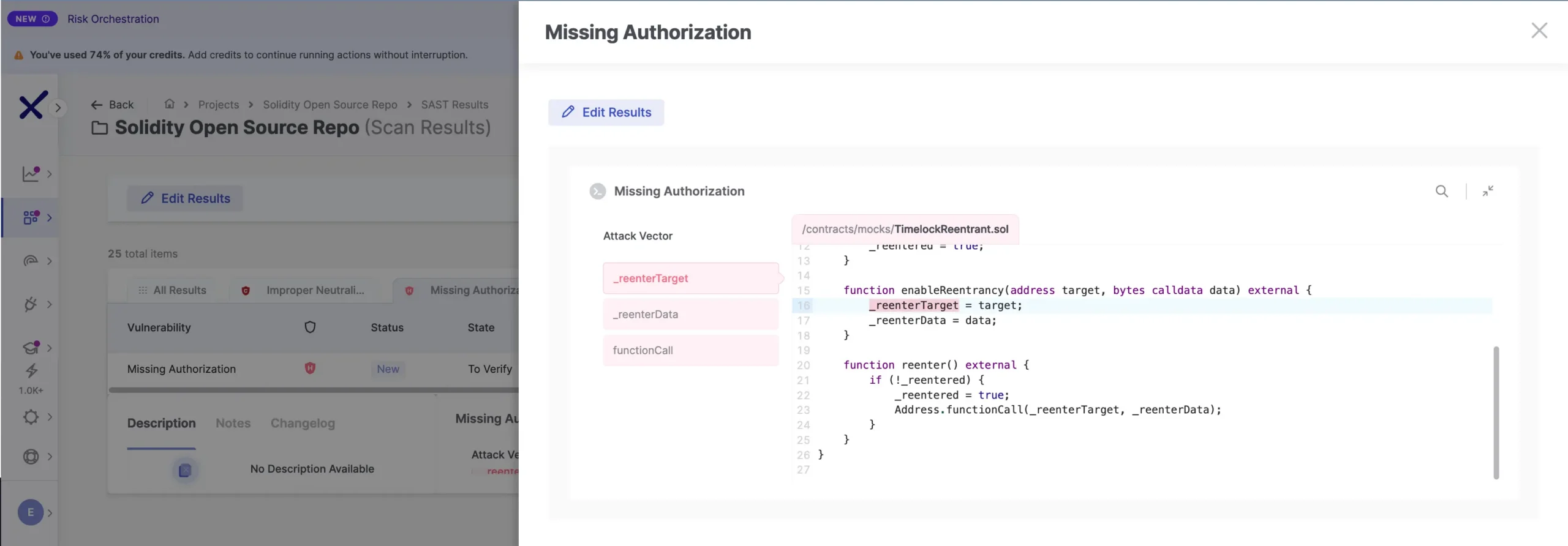
And the pressure is compounding. With agentic development, teams are producing dramatically more code, including more contract code, and AI-assisted developers introduce security findings at 10× the rate of their peers (Cloud Security Alliance, 2026 report). AI-generated Solidity inherits every insecure pattern in the model’s training data, and it arrives faster than any manual review process can absorb.
The AI alternative fails a different way
The obvious fix – “just have a frontier model review the contract” – trades one failure mode for another. In head-to-head testing by Checkmarx Zero Research (2026), Claude Opus 4.7 produced a 44.1% false positive rate. Independent testing shows LLM-only scanning delivers just 32% finding consistency across five scans of identical code — and temperature zero doesn’t fix it. The model finds interesting things, then changes its mind on the next run, and is grading its own work the whole time with no independent validation.
When your contract is about to hold user funds, “the scanner produced different findings this morning” isn’t a quirk. It’s disqualifying. You’re left choosing between coverage you can’t trust and precision that can’t see, blind spots or buried signals, and the end result is the same: vulnerable code goes on-chain.
One scan, three stages: how Checkmarx Fusion closes both gaps at once
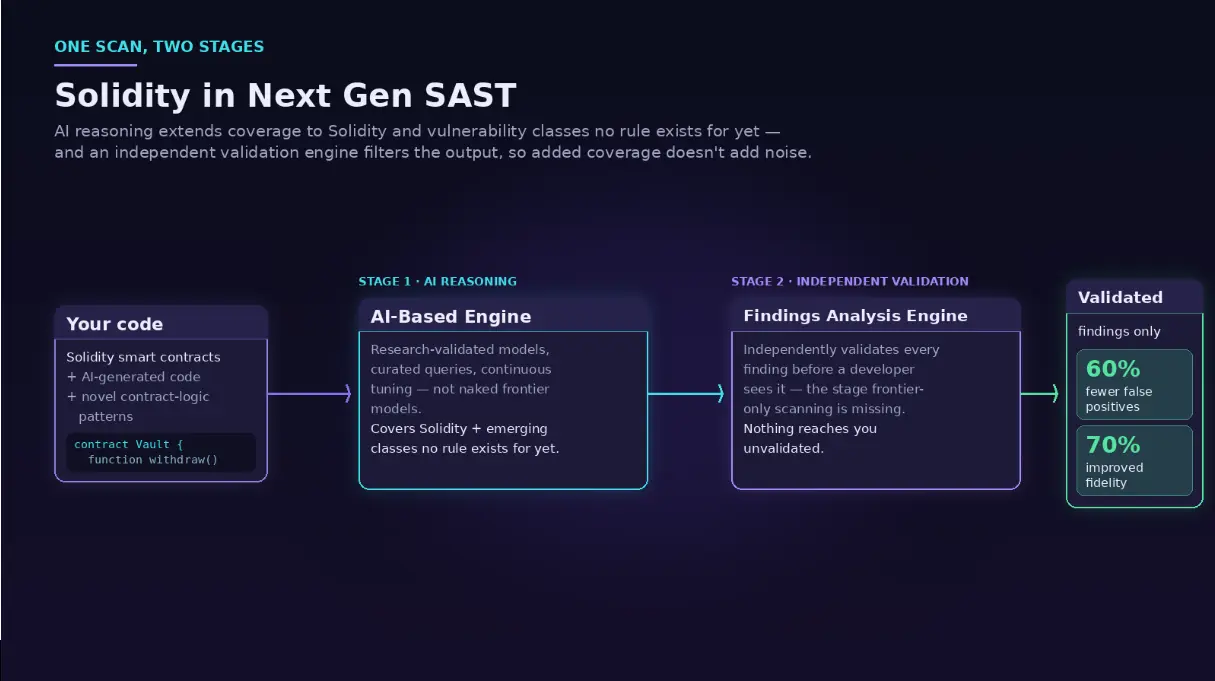
This is the problem Checkmarx Fusion was built to eliminate. Deterministic gives us certainty. AI gives us reach. Fused in one scan, coverage and trust rise together:
The Rules-Based Engine is the deterministic floor, two decades of security research encoded as explicit, auditable rules that cannot be hallucinated, re-rolled, or manipulated. Identical code produces identical findings, every run, 100% of the time (versus that 32% LLM benchmark).
The AI-Based Engine extends coverage to any language, Solidity included, and mixed codebases plus AI-generated code patterns and emerging vulnerability classes no rule exists for yet. That last category is precisely the profile of smart contract logic flaws. And these aren’t naked frontier models: they’re research-validated models running curated queries, continuously tuned by Checkmarx researchers.
The Findings Analysis Engine independently validates every finding from both engines before a developer ever sees it. This is a stage that frontier-only scanning is missing entirely. The result: 60% fewer false positives and 70% improved fidelity versus traditional SAST. Coverage went up while noise went down, in the same release.
On top of that sits a multi-model LLM layer: orchestrating multiple frontier models over the previous layers with every result still flowing through the Findings Analysis Engine. Nothing reaches you unvalidated.
Reproducibility is the audit story Web3 has been missing
Smart contract teams live and die by audits. Investors expect them, users check for them, and protocols publish them. But an audit is only as strong as the evidence beneath it, and probabilistic-only scanning produces output that changes between identical runs, which is not evidence at all.
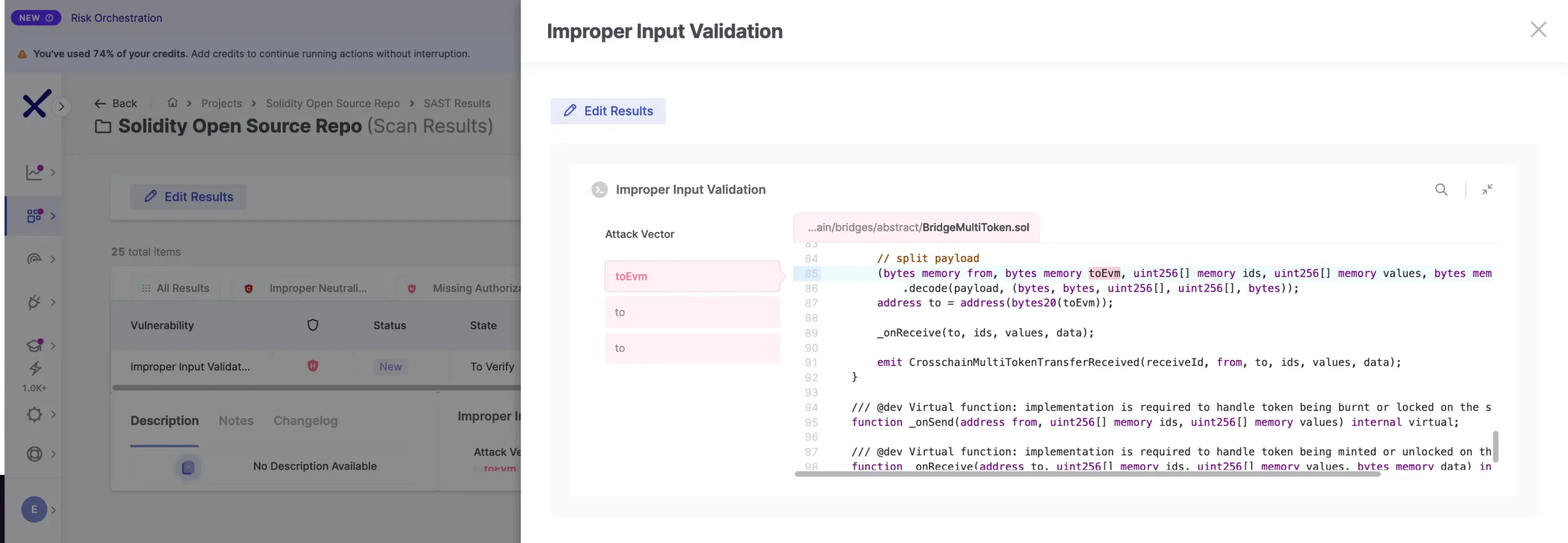
A deterministic floor changes that. Scan results that are reproducible, auditable, and consistent across runs are pre-deploy evidence you can hand to an auditor, a counterparty, or your own future self. Measured, not asserted.
Fix it early in the cycle, because on-chain there is no later
Across the Agentic Development Lifecycle (ADLC), intervention cost rises roughly 10× per stage, while fixing it within the Checkmarx one with Fusion and Checkmarx next generation SAST intervention costs just minutes. For most teams that’s an economics argument. For Solidity teams it’s existential: once the contract is deployed, the cost of a missed finding isn’t a rework ticket. It’s the treasury.
That’s why prevention at the point of creation matters most here. Checkmarx allows developers using Solidity to scan their code base on demand within the Checkmarx one platform and get their results instantly and with validation running locally, so their code never leaves their environment. Developers save 85% of the time spent on critical vulnerabilities (~3.5 hours down to 20–30 minutes), which is the difference between security that gets used and security that gets bypassed under deadline pressure.
For the security leaders reading over your shoulder: this is also how the program scales. High-fidelity findings across every language your teams ship, including the ones your last scanner never heard of, validated before anyone burns an hour on them, reproducible enough to gate on, at a cost that scales with your code instead of a token meter.
Innovation in Web3 moves at block speed. Your security must move with it, because on the blockchain, there are no second chances, only second audits.
AI Code Security
AI-Generated Code
Blockchain Security
Checkmarx Fusion
checkmarx one
DevSecOps
Next Gen SAST
Vulnerability Management
Web3 Security