
Summary
AI code security solutions help organizations detect, prevent, and remediate security risks in AI-generated and AI-assisted code. The strongest platforms combine code analysis, dependency scanning, policy enforcement, and remediation support across IDEs, pull requests, CI/CD pipelines, and portfolio-level governance. For enterprise teams, the biggest differentiator is whether a platform acts as a unified, agentic AppSec system or as a narrower AI-boosted scanner.
What Are AI Code Security Solutions?
AI code security solutions are advanced tools and practices that leverage artificial intelligence (AI), particularly machine learning and large language models (LLMs), to detect, prevent, and remediate security vulnerabilities in software code. They aim to integrate security earlier into the development lifecycle (DevSecOps) to manage the new risks introduced by AI-assisted coding tools. Top solutions include Checkmarx, Snyk Code, and GitLab Ultimate.
Gen AI code security solutions are specialized tools and platforms that use artificial intelligence and machine learning to identify, analyze, and remediate vulnerabilities in software codebases. These solutions automate the review of source code, scanning for security flaws, bugs, and compliance issues without needing manual intervention at every step.
In practice, these tools embed directly into developer workflows rather than operating as separate security gates. They integrate with IDEs to provide real-time feedback as code is written, with AI code assistants to validate generated snippets before acceptance, and with pull request workflows to automate security reviews alongside peer review. In CI/CD pipelines, they enforce policies such as blocking builds on critical issues or requiring fixes before merge. At the enterprise level, they add layered controls, including centralized policy management, role-based approvals, audit logs, and standardized best practices for secure coding.
This is part of a series of articles about AI cybersecurity.
AI Code Security Solutions at a Glance: Quick Comparison
Here is a quick comparison of notable AI code security solutions, including their strongest use cases, key strengths, and tradeoffs. Use this table to shortlist tools for secure AI-assisted development, then scroll down for a deeper review of each option.
| Tool | Strengths | Key Considerations |
|---|---|---|
| Checkmarx One Assist | Agentic AppSec coverage across IDE, CI/CD, and portfolio analytics; correlates findings across code and supply chain to reduce noise and speed remediation | Best value comes with workflow rollout and governance setup so actions stay controlled and auditable |
| Snyk Code | Build-free SAST with AI-assisted fixes and strong IDE/CI integration | Some users report false positives and slower scans in larger repositories |
| GitLab Ultimate | Unified DevSecOps platform combining CI/CD, security testing, and governance | Feature breadth can create a learning curve and some capabilities require higher tiers |
| SonarQube | Strong static analysis with broad language support and automated quality gates | Initial setup and integrations may require effort; advanced features may increase cost |
| Codacy | Unified code quality and security platform with AI guardrails for AI-generated code | Performance may slow on large codebases and rule configuration can require tuning |
Related content: Read our guide to AI cybersecurity solutions
How AI Code Security Solutions Work
AI code security solutions work by embedding security controls into the places where AI-assisted development happens most often: the IDE, pull requests, CI/CD pipelines, and portfolio-level governance layers.
They typically combine four types of capabilities:
AI-driven code scanning
These tools analyze source code, dependencies, infrastructure as code, secrets, and sometimes containers to identify vulnerabilities introduced by both human and AI-generated changes.
In-IDE secure coding assistance
Many platforms provide real-time guidance inside the IDE or coding assistant workflow, helping developers catch issues before code is committed.
CI/CD policy enforcement and remediation
Security rules can be enforced automatically in pipelines so non-compliant code, risky packages, or insecure configurations are stopped before release. More advanced platforms also provide guided or automated remediation.
Portfolio-level risk analytics
Enterprise-grade solutions correlate findings across repositories, applications, and pipelines so security leaders can prioritize what matters most instead of working from isolated alerts.
This combination is what separates AI code security solutions from traditional post-commit scanners and makes them more effective for modern AI-assisted development.
Who Needs AI Code Security Solutions?
AI code security solutions are relevant for multiple roles involved in building, securing, and operating software. They help each group reduce risk, speed up remediation, and maintain development velocity, especially in environments using AI-assisted coding.
CISOs and security leaders: Need visibility and control over application risk. AI secure coding tools help reduce vulnerabilities reaching production, lower cost per fix, and provide auditable processes for securing both human- and AI-generated code.
AppSec teams and security engineers: Use them to shift security earlier in development. Real-time detection and inline fixes reduce noise in pipelines and free teams to focus on high-risk issues instead of repetitive remediation guidance.
DevOps and platform engineering teams: Benefit from more stable CI/CD pipelines. Pre-commit issue detection prevents broken builds and reduces security bottlenecks, while lightweight integrations scale across repositories without major workflow changes.
Developers and engineering leads: Get immediate feedback and fixes inside their IDE. This allows them to stay in flow, resolve issues quickly, and safely use AI coding assistants with built-in security guardrails.
Organizations adopting AI-assisted development: Require safeguards for AI-generated code. AI code review tools add real-time scanning, policy enforcement, and safe refactoring to ensure speed does not introduce new security risks.
Key Benefits of AI Code Security Solutions
AI code security solutions help organizations secure modern software delivery without sacrificing development speed.
Catch issues earlier
By surfacing risks in the IDE, pull requests, and CI/CD pipelines, these tools reduce the number of vulnerabilities that reach later stages of development.
Reduce triage overhead
Multi-signal analysis and contextual prioritization help AppSec teams focus on the issues that matter most instead of sorting through isolated findings.
Improve developer productivity
Inline guidance and remediation support help developers fix issues quickly without leaving their workflows.
Secure AI-generated code at scale
These tools provide guardrails for AI-assisted coding, reducing the risk of vulnerable snippets, unsafe dependencies, and policy violations entering production.
Support enterprise governance
Portfolio-level visibility, policy controls, and reporting help organizations scale secure development across teams, repositories, and applications.
Core Risks in AI-Generated Code
AI-generated code creates several novel risks which require a new class of security tools. Let’s review the most common risks focusing AI-first development organizations.
Hallucinated Logic and Unsafe Patterns
One major risk in AI-generated code is hallucinated logic, where the AI fabricates or improvises code that appears plausible but does not align with valid software behavior. This can lead to unsafe patterns, such as insecure data handling or unauthorized privilege escalations, that introduce subtle but severe vulnerabilities. Since these patterns may not directly match known exploits, traditional scanners can struggle to detect them, increasing the risk they persist through to deployment.
Even more concerning, these hallucinated behaviors often result from the AI model’s attempt to fulfill ambiguous or poorly specified requests. Developers may not immediately spot these issues amid complex generated code, especially under tight delivery timelines. If the generated logic is based on flawed training data or mimics harmful patterns found on public repositories, it can actively undermine application security rather than strengthening it.
Legacy Vulnerabilities in AI-Generated Output
AI-generated code can reproduce well-known legacy vulnerabilities, such as SQL injection, cross-site scripting, or hardcoded credentials. Since many code-generating AIs are trained on large, internet-scale datasets that include outdated, insecure, or vulnerable code, there is a risk that these historic weaknesses are perpetuated in new projects. Without rigorous post-generation review, legacy vulnerabilities can slip into production environments undetected.
These inherited issues may also be obfuscated or blended with new logic, making them harder for developers or static tools to identify and isolate. The reliance on AI-generated snippets for boilerplate code or third-party integrations heightens this risk, as security best practices and context-specific adjustments may be overlooked. Robust scanning and validation are essential to ensure legacy issues are not reintroduced via AI output.
Missing Business Context and Logic Errors
AI code generation engines lack a deep understanding of a company’s unique business logic and security requirements. Without access to specific context, such as workflow rules, data-handling mandates, or role-based access controls, AI can produce code that seems functionally correct but violates critical business constraints. This can introduce subtle vulnerabilities, such as unintentionally exposing sensitive data or bypassing important authorization checks.
Even when the AI-generated code is technically accurate, missing or misunderstood business context can result in logical errors that undermine critical application requirements. For example, an AI may implement input validation that is overly permissive or structure workflows that inadvertently violate compliance policies. Detecting and correcting these issues requires human review and the integration of business-specific guardrails alongside automated code generation.
Hidden Supply Chain and Package Risks Introduced by AI Assistants
AI coding assistants frequently suggest open-source packages to complete tasks, often without sufficient vetting for security or maintenance status. This introduces risks from outdated libraries, malicious packages, or components with known vulnerabilities. Attackers increasingly target public registries with typosquatting, dependency confusion, or intentionally vulnerable packages, banking on developers, especially those using AI tools, to accept suggestions without scrutiny.
The risk is compounded by AI’s lack of contextual awareness when recommending dependencies. It may prioritize popularity or syntactic fit over trustworthiness, leading to the inclusion of poorly maintained or unscanned packages. Traditional software composition analysis tools can help, but integrating AI-aware SCA is important for understanding the context in which packages were introduced and how they relate to code behavior. AI code security solutions that monitor for malicious dependencies, enforce version policies, and analyze transitive risks are essential to defend against this class of AI-driven supply chain threats.
Notable AI Code Security Solutions
1. Checkmarx One Assist

Best for: Organizations that want a unified AI AppSec platform to secure code and supply chain risk at high velocity, with workflow-native support for developers and AppSec leaders.
Key strengths: Correlated risk across multiple testing signals, including code, dependencies, APIs, IaC, and containers, plus agentic assistance across IDE, CI/CD, and portfolio reporting to prioritize and accelerate fixes.
Things to consider: Plan a phased rollout across repositories, pipelines, and applications, and define governance guardrails early to ensure consistent policy enforcement and auditability.
Checkmarx One Assist is a family of agentic AI AppSec agents, Developer Assist, Policy Assist, and Insights Assist, which span the inner, middle, and outer loops of modern software delivery. Powered by the Checkmarx One platform and its unified telemetry, these agents live where teams work: the IDE, CI/CD pipelines, and executive dashboards.
Together, these agents prevent and remediate vulnerabilities in real time, standardize security policies at scale, and give leadership a live, risk-based view of the entire application portfolio so enterprises can ship AI-era software faster without losing control.
Key features include:
- Inner loop: Secure coding in the IDE. Developer Assist prevents and fixes vulnerabilities as code is written, including AI-generated code, across SAST, SCA, IaC, containers, and secrets.
- Middle loop: Policy enforcement in CI/CD. Policy Assist continuously evaluates code, configurations, and dependencies in pipelines, automatically enforcing AppSec policies, SLAs, and risk thresholds while reducing alert noise.
- Outer loop: Portfolio-level insights and governance. Insights Assist aggregates signals from Checkmarx One to surface posture, trends, and exceptions for leadership, enabling risk-based planning, reporting, and investment decisions.
- End-to-end AI threat coverage. The agents use shared intelligence from Checkmarx One, spanning applications, open-source packages, containers, cloud, and malicious package telemetry, to protect against AI-driven threats and software supply chain risk.
- Faster adoption and less friction. Role-specific agents fit naturally into developer, AppSec, and leadership workflows, accelerating value realization and helping organizations scale secure development practices without large process overhauls.
Key differentiators include:
- Agentic AppSec for AI-assisted development: Checkmarx secures code as it is written and changed, not only after it reaches downstream scans, making it well suited to AI-generated and AI-assisted development workflows.
- Continuous assurance across mixed codebases: Checkmarx correlates risk across AI-generated, human-written, and legacy code, along with dependencies, IaC, APIs, containers, and supply-chain signals, helping enterprises secure modern software without relying on disconnected point tools.
- Unified control from IDE to CI/CD to portfolio oversight: Developer Assist, Policy Assist, and Insights Assist combine workflow-native prevention, automated policy enforcement, and leadership-level visibility in one platform.
- Policy-aware remediation, not just suggestions: Checkmarx differentiates from AI-boosted scanners by combining detection, prioritization, and governed remediation using shared platform context and enterprise guardrails.
- Built for enterprise-scale secure velocity: The platform is designed to reduce friction for developers while preserving auditability, standardization, and control for AppSec and security leaders.

Secure AI-Generated Code in Real Time
Checkmarx One Assist – AI-Powered AppSec
See how Checkmarx secures AI-generated code from IDE to CI/CD with agentic AppSec
See it in Action2. Snyk Code
Best for: Developer-first teams that want fast SAST scanning and automated remediation embedded directly in IDEs and pull request workflows.
Key strengths: Build-free static analysis with AI-assisted fixes and strong integration across developer tools and CI/CD environments.
Things to consider: Some users report false positives, configuration complexity, and slower scans for larger repositories.
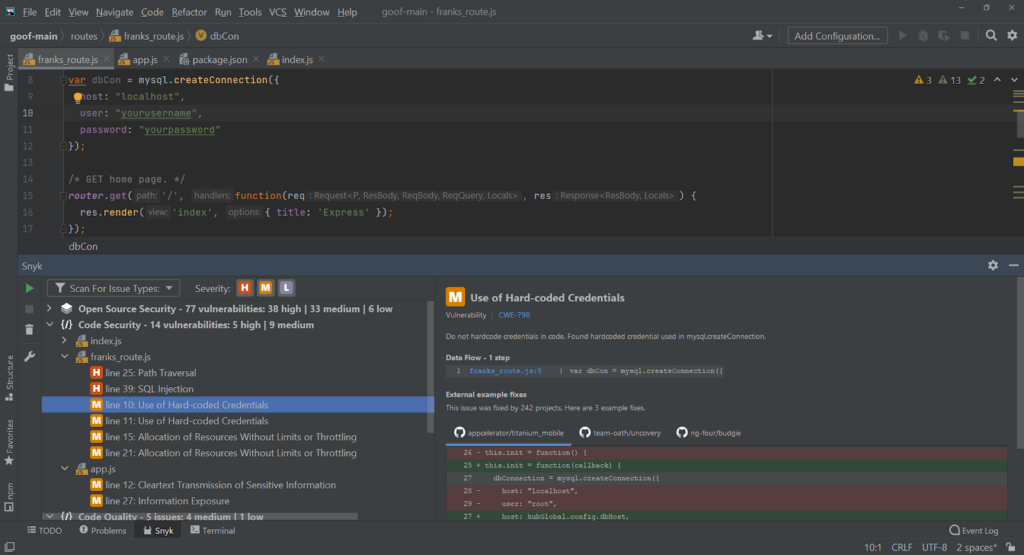
Snyk Code is a static application security testing tool for developers. It provides real-time code scanning and automatic remediation directly in IDEs and pull requests. The platform focuses on fast, build-free analysis and pre-validated fixes, using a self-hosted AI engine and a large knowledge base to detect and prioritize risky code.
Key features:
- Real-time scanning and auto-fix
- Developer-friendly workflow
- Extensive language and tool coverage
- AI-powered knowledge base
- Risk-based prioritization
Limitations:
- False positives and slow scans
- Complex configuration
- Interface usability concerns
- Customer support concerns
Source: Snyk
3. GitLab Ultimate

Best for: Enterprises looking for an all-in-one DevSecOps platform that integrates development, security testing, and compliance workflows.
Key strengths: Unified platform combining CI/CD, security testing, governance controls, and portfolio management with native integrations.
Things to consider: The platform’s breadth can introduce a learning curve, and some advanced capabilities are limited to higher pricing tiers.
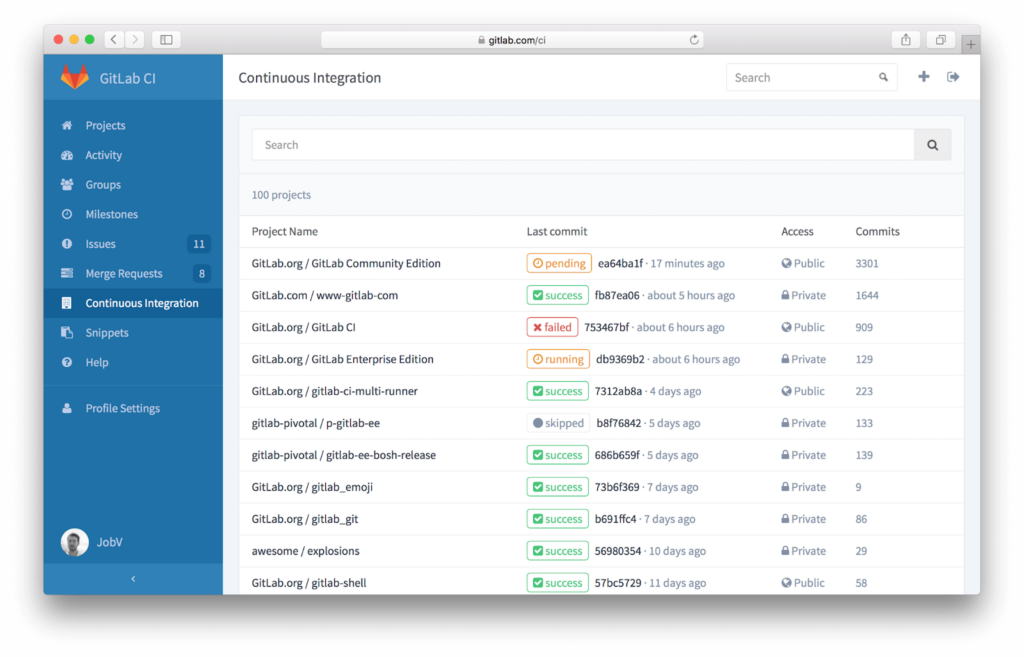
GitLab Ultimate is an enterprise DevSecOps platform that combines source code management, CI/CD, security testing, compliance, and portfolio management in a single interface. It adds advanced security capabilities, agentic AI features, and governance controls to help organizations scale software delivery while managing risk.
Key features:
- Integrated CI/CD pipelines
- Advanced security capabilities
- Compliance and governance controls
- Portfolio and value stream management
- Seamless integrations
Limitations:
- Complex interface
- Steep learning curve
- Feature limitations by tier
Source: GitLab
4. SonarQube

Best for: Development teams seeking automated code quality and security analysis integrated into CI/CD pipelines.
Key strengths: Broad language support with strong static analysis capabilities and automated quality gates to enforce coding standards.
Things to consider: Initial setup and integrations can be complex, and advanced security features may require higher-tier editions.
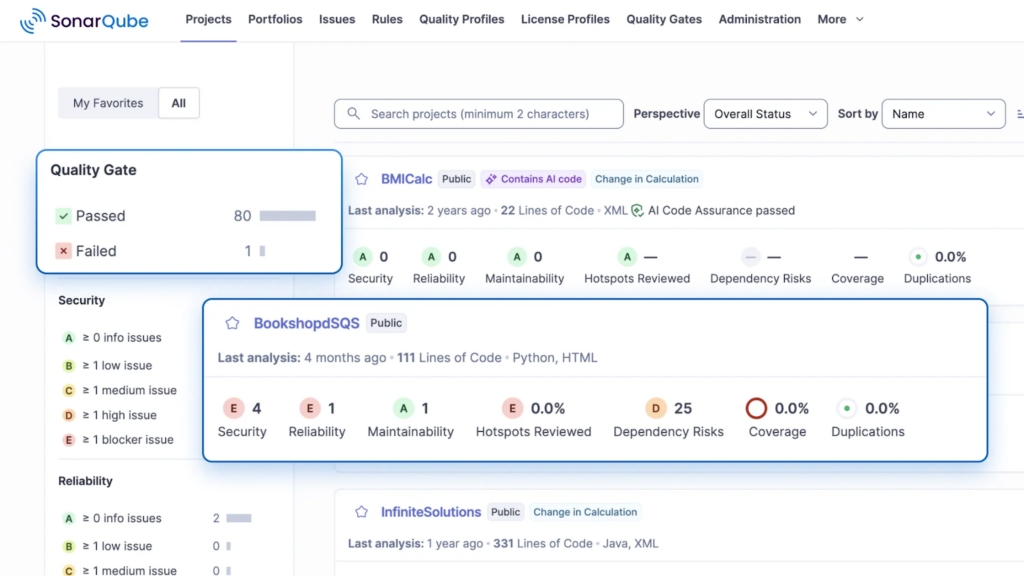
SonarQube is a code quality and security analysis platform that performs automated static analysis across more than 35 programming languages. It integrates into IDEs and CI/CD pipelines to detect bugs, vulnerabilities, and maintainability issues early in development. The platform also provides AI-powered fix suggestions and compliance reporting capabilities.
Key features:
- Automated static analysis
- CI/CD integration
- AI-powered remediation
- Broad language support
- Quality gates and reporting
Limitations:
- Complex setup and configuration
- Integration issues
- Software bugs
- Pricing concerns
Source: SonarQube

5. Codacy

Best for: Teams that want centralized enforcement of code quality and security standards across repositories and CI/CD pipelines.
Key strengths: Combines static analysis, dependency scanning, and AI guardrails for AI-generated code within a unified platform.
Things to consider: Performance may slow on very large codebases, and customization of rules and integrations may require additional configuration.
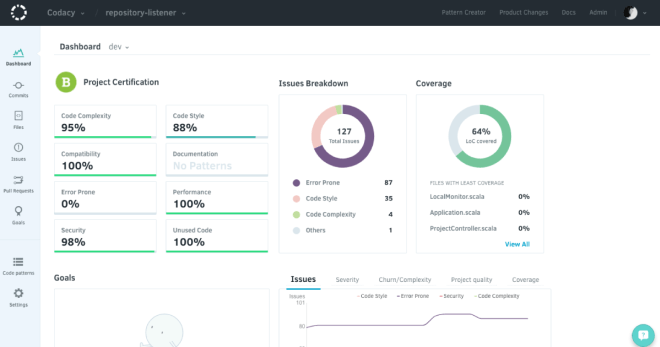
Codacy is a security and code quality platform that enforces centralized rules across the entire CI/CD lifecycle. It combines static analysis, dependency scanning, test coverage tracking, duplication detection, and AI guardrails for AI-generated code. The platform integrates with IDEs, repositories, and CI tools to automate quality and security checks.
Key features:
- Unified code quality and security platform
- CI/CD and pull request integration
- Broad language support
- Customizable rules configuration
- AI guardrails
Limitations:
- Pricing concerns
- Performance on large codebases
- Feature gaps in some environments
- Rule configuration complexity
Source: Codacy
How to Choose AI Code Security Solutions
Selecting the right AI code security tools depends on how your teams build, test, and release software. Here are the key factors to consider when evaluating tools for your environment:
- End-to-end coverage across the SDLC: Look for solutions that operate seamlessly from IDE to CI/CD to portfolio-level reporting. This reduces handoffs, enforces consistency, and prevents gaps between development and production.
- Multi-signal correlation across code and dependencies: Strong platforms analyze more than source code. They correlate findings across dependencies, infrastructure, APIs, and containers to reduce duplicate alerts and highlight real risk.
- Real-time remediation within developer workflows: Prioritize tools that fix issues where developers work. Inline guidance and automated fixes in pull requests help resolve vulnerabilities quickly without slowing delivery.
- Policy-aware automation and governance: Choose solutions that enforce security policies in pipelines. Capabilities like SLA tracking, approvals, and exception handling ensure remediation stays controlled and auditable.
- Risk-based prioritization with low noise: High alert volume reduces effectiveness. Tools should prioritize exploitable issues and minimize false positives so teams can focus on what matters.
- Support for AI-generated code and modern development: Ensure the platform can secure AI-generated code in real time. This includes detecting unsafe patterns, validating logic, and applying guardrails before code reaches production.
Why Enterprises Prefer Unified Platforms
Unified platforms address a gap that point tools and “AI-boosted scanners” struggle to close. Scanners can detect issues in isolation, but they often generate large volumes of alerts without clear prioritization. This creates noise in developer backlogs and makes it difficult to determine which vulnerabilities actually pose real risk. Enterprise platforms solve this by applying context-aware analysis and application security posture management (ASPM) to focus attention on what is exploitable and high impact.
Platforms like Checkmarx One combine multiple security layers, including SAST, SCA, IaC, container security, and supply chain analysis, into a single system. This unified approach allows security signals to be correlated across the entire application stack rather than evaluated independently. As a result, teams can see how vulnerabilities interact across code, dependencies, and infrastructure, and prioritize fixes based on real-world risk instead of static severity scores.
Another key difference is how AI is applied. Many tools add AI as a feature to improve detection or suggest fixes, but still operate as standalone scanners. In contrast, agentic AI platforms embed AI across the full development lifecycle. They provide real-time guidance in the IDE, enforce policies in CI/CD pipelines, and deliver risk insights at the portfolio level. These agents are context-aware, drawing on shared data, policies, and business rules to make decisions that align with enterprise standards.
Ultimately, enterprises prefer unified, agentic platforms because they move beyond detection. They connect prevention, prioritization, and remediation into a continuous system, helping teams manage the speed and complexity of AI-driven software development while maintaining control over risk.

Need a Unified Platform View?
Checkmarx One Application Security Platform
Explore how Checkmarx connects AI code security, policy enforcement, and portfolio-level risk visibility
See it in ActionConclusion
AI code security solutions help teams manage the growing complexity and volume of modern software development. By combining machine learning, large language models, and multi-signal analysis, these tools detect vulnerabilities earlier, reduce noise, and accelerate remediation. They are becoming a core part of DevSecOps, ensuring that speed and automation do not come at the cost of security.
Checkmarx stands out for organizations that need more than an AI-enhanced scanner. With Developer Assist, Policy Assist, and Insights Assist, Checkmarx One Assist brings agentic AppSec into the IDE, CI/CD pipelines, and leadership layer, helping teams secure AI-generated, human-written, and legacy code within one unified platform. That combination of workflow-native prevention, policy-aware enforcement, and portfolio-level visibility makes Checkmarx a stronger fit for enterprise software teams than tools focused mainly on scanning and point remediation.