
Summary
API security for compliance means proving APIs are discovered, tested and auditable against GDPR, PCI DSS and HIPAA. Checkmarx is best for code-level discovery with runtime protection through integrated DAST, StackHawk is best for CI/CD testing, Akamai is best for compliance framework mapping.
What Is API Security for Compliance?
Evaluating API security solutions for compliance requires verifying that a platform maps technical controls to specific regulatory mandates like GDPR, HIPAA, or PCI DSS. This involves safeguarding APIs from unauthorized access, data breaches, and misuse while ensuring the confidentiality, integrity, and availability of sensitive information exchanged through these interfaces.
To achieve compliance, organizations must implement robust authentication, authorization, encryption, monitoring, and logging mechanisms for their APIs. These controls not only prevent data leaks and unauthorized access but also help demonstrate adherence to regulations such as GDPR, PCI DSS, HIPAA, SOC 2, and ISO 27001.
Key evaluation criteria
Use these six criteria to compare solutions consistently:
- API discovery and inventory coverage: how the solution finds APIs, including undocumented, shadow and abandoned endpoints
- Sensitive data identification and classification: whether it can tell you which APIs handle PII, payment data or health records
- Compliance control testing and enforcement: how it tests authentication, authorisation and data exposure controls, and whether it can block violations
- Audit evidence and framework reporting: what it produces for auditors, and whether findings map to named frameworks
- Change tracking and historical audit trail: whether it records how an API changed over time and who changed it
- Deployment model and data residency: where the solution runs and where the data it collects is held
Solutions covered in this guide:
Development lifecycle API security solutions
- Checkmarx API Security: Source code API discovery and change tracking
- Invicti API Security: Multi-source discovery with authenticated DAST
- StackHawk: Pull request API testing with sensitive data flags
- 42Crunch API Security Platform: Contract-based testing and enforcement
Runtime API discovery and protection platforms
- Salt Security: Runtime discovery and compliance posture mapping
- Akamai API Security: Multi-source discovery and framework mapping
- Imperva API Security: Data classification and inline API protection
- Data Theorem API Secure: Continuous discovery and runtime protection
Why APIs Create Compliance Risks
APIs create compliance risks because they often expose sensitive systems and data to external users, partners, and applications. When APIs are poorly secured, undocumented, or insufficiently monitored, organizations may fail to meet regulatory requirements for data protection, access control, auditability, and incident response.
- Sensitive data exposure: APIs frequently process PII, payment data, and PHI, making insecure endpoints a major compliance risk. Weak authentication, poor encryption, or improper validation can expose regulated data and lead to breaches, fines, and investigations.
- Shadow and undocumented APIs: APIs that are unknown, unmanaged, or undocumented can bypass security reviews and compliance controls. These blind spots may lack proper access controls, monitoring, and auditability, increasing the chance of violations.
- Insufficient monitoring and auditability: Without detailed logging and real-time monitoring, organizations may be unable to detect misuse, investigate incidents, or prove compliance. Strong audit trails are essential for regulatory reporting and forensic analysis.
- Broken authentication and authorization: Weak token handling, exposed API keys, missing access checks, or excessive permissions can allow unauthorized access. Enforcing least privilege and endpoint-level authorization helps prevent compliance failures.
Related content: Read our guide to API security best practices
Key Compliance Requirements Affecting API Security
The following table summarizes how major compliance standards impact API security. We explore each standard in more detail below.
| Compliance Standard | API-Related Requirements | API Security Considerations |
| GDPR | Protect EU residents’ personal data; support data subject rights such as access, rectification, and deletion; document and audit data processing activities. | Use data minimization, encryption, strong access controls, privacy by design, data masking, anonymization, and regular API vulnerability testing. |
| PCI DSS | Secure APIs that store, process, or transmit payment card data; maintain detailed logs; perform regular scans and penetration testing. | Enforce strong authentication, end-to-end encryption, strict access controls, protection against injection, man-in-the-middle attacks, and data interception. |
| HIPAA | Protect electronic protected health information; track access and changes to health data; enforce the minimum necessary standard. | Implement strict authentication, authorization, encryption, comprehensive logging, access monitoring, and controls to limit data exposure. |
| SOC 2 | Ensure APIs meet security, availability, processing integrity, confidentiality, and privacy criteria; provide auditable evidence of controls. | Apply authentication, authorization, logging, continuous monitoring, anomaly detection, incident response, and regular control reviews. |
| ISO 27001 | Include APIs in the information security management system, risk assessments, audits, and security policies. | Use access controls, encryption, monitoring, documentation, incident response, and regular API security assessments aligned with ISMS controls. |
GDPR
The General Data Protection Regulation (GDPR) imposes strict rules on the processing and protection of personal data belonging to individuals in the European Union. APIs that handle EU residents’ data must implement data minimization, encryption, and strong access controls to prevent unauthorized access or accidental exposure. GDPR also requires organizations to provide mechanisms for data subject rights, such as the right to access, rectify, or delete personal information, which must be supported by secure API design and management.
Non-compliance with GDPR can result in significant fines and reputational damage. Organizations must ensure that APIs are regularly tested for vulnerabilities and that all data processing activities are fully documented and auditable. Implementing privacy by design, including data masking and anonymization at the API level, is critical for meeting GDPR requirements and reducing the risk of regulatory penalties.
PCI DSS
The Payment Card Industry Data Security Standard (PCI DSS) governs the handling of payment card data and applies to any API that stores, processes, or transmits credit card information. PCI DSS requires strong authentication, end-to-end encryption, and strict access controls to ensure that cardholder data remains secure. APIs must also be protected against common attacks such as injection, man-in-the-middle, and data interception.
Regular vulnerability scans, penetration testing, and detailed logging of API activity are mandatory under PCI DSS. Failure to comply can result in the loss of the ability to process card payments, hefty fines, and mandatory remediation efforts. By implementing PCI DSS controls at the API layer, organizations can protect payment data and demonstrate compliance to acquiring banks and regulators.
HIPAA
The Health Insurance Portability and Accountability Act (HIPAA) establishes standards for protecting electronic protected health information (ePHI) in the United States. APIs that interact with healthcare systems must enforce strict authentication, authorization, and encryption measures to protect ePHI from unauthorized access or disclosure. HIPAA also mandates the ability to track access and modifications to health data through comprehensive logging.
APIs must support privacy and security rules, including the minimum necessary standard, which limits data exposure to only what is required for a specific transaction. Failure to secure APIs can lead to significant regulatory penalties, breach notification requirements, and reputational damage. Implementing HIPAA-compliant security controls at the API level is essential for healthcare organizations and their partners.
SOC 2
SOC 2 is an auditing framework focused on the security, availability, processing integrity, confidentiality, and privacy of customer data. APIs must be designed and managed to meet these trust service criteria, with controls in place for authentication, authorization, logging, and incident response. SOC 2 emphasizes continuous monitoring and risk assessment, requiring organizations to regularly review and update their API security measures.
Achieving SOC 2 compliance involves demonstrating that all API interactions are secure, logged, and auditable. Organizations must implement controls to prevent unauthorized access, detect anomalies, and respond to incidents. Regular audits and evidence of compliance are necessary to maintain SOC 2 certification, making comprehensive API security a foundational requirement.
ISO 27001
ISO 27001 is an international standard for information security management systems (ISMS). It requires organizations to identify and mitigate risks to information assets, including those exposed through APIs. ISO 27001 mandates the implementation of access controls, encryption, and regular security assessments for all systems handling sensitive data, including APIs.
APIs must be included in the organization’s risk management and audit processes, ensuring that they are protected from emerging threats and compliant with information security policies. Documentation, monitoring, and incident response are key components of ISO 27001, and failure to secure APIs can jeopardize certification. By aligning API security with ISO 27001 controls, organizations can demonstrate a strong commitment to information security and regulatory compliance.
Choosing an API Security Solution for Regulated Environments: Key Criteria
The right solution depends less on feature counts than on where your evidence gaps are. Work through the six criteria below against your own API estate and audit calendar.
API Discovery and Inventory Coverage
Every compliance requirement that applies to APIs assumes you know which APIs you have. Discovery methods differ in a way that matters: traffic-based discovery only sees APIs that are deployed and receiving requests, gateway-based discovery only sees APIs someone registered, and code-based discovery sees endpoints before they ship. Shadow APIs and abandoned endpoints from old versions are precisely the ones that escape audit, so the method a solution uses determines what stays invisible.
Evaluation criteria:
- Does it discover APIs from source code, from live traffic, from gateways, or from all three?
- Can it find undocumented endpoints when no OpenAPI specification exists?
- Does it flag abandoned or deprecated endpoints still running in production?
- How long does a full inventory take to build in an estate your size?
- Does it cover internal service-to-service APIs, not just internet-facing ones?
Sensitive Data Identification and Classification
Regulations apply to data, not to endpoints. GDPR covers personal data, PCI DSS covers cardholder data, HIPAA covers ePHI. A list of 4,000 API endpoints tells an auditor nothing until you can say which of them carry regulated data. Solutions differ in whether they classify data at all, whether classification is inferred from observed payloads or read from code, and how granular the categories are.
Evaluation criteria:
- Does it label endpoints by data type, such as PII, payment data or health data?
- Is classification based on live traffic, on source code, or on the API specification?
- Can it detect endpoints returning more data than the client needs?
- Are classification categories configurable for industry-specific data types?
Compliance Control Testing and Enforcement
Frameworks require that access controls work, not just that they exist. PCI DSS 4.0 requires custom code including APIs to be reviewed before release; several frameworks require least-privilege enforcement. Broken object level authorisation is the failure mode that matters most here, because it lets an authenticated user reach another user’s records by changing an identifier. Some solutions test for this before deployment, some detect it in production traffic, and some can block it inline.
Evaluation criteria:
- Does it test for the OWASP API Security Top 10, including BOLA and BFLA?
- Does testing run before release, after deployment, or both?
- Can it block violations inline, or only alert on them?
- Does it fail a build or pull request when a critical issue is found?
- How much tuning is needed before findings are trustworthy?
Related content: Read our guide to dynamic application security testing (DAST)
Audit Evidence and Framework Reporting
The practical test is whether you can hand an auditor an export instead of building a spreadsheet. Solutions vary widely: some map findings directly to PCI DSS, GDPR, HIPAA, ISO 27001 and SOC 2 control sets, while others produce security findings that you then have to translate into control language yourself. Ask to see a real report during evaluation rather than a dashboard screenshot.
Evaluation criteria:
- Are findings mapped to named frameworks, or only to OWASP categories?
- Can you export evidence in a form an external auditor will accept?
- Does it track remediation progress and risk trends over time?
- Are reports shared outside the platform as detailed as the in-platform view?
Change Tracking and Historical Audit Trail
Most frameworks require records of how systems changed and who changed them. For APIs this means knowing when an endpoint was added, when authentication was weakened, and which commit introduced the change. This is also the difference between remediating a finding and explaining it. Traffic-based platforms generally detect that something drifted; code-based tools can usually say who did it.
Evaluation criteria:
- Does it retain a history of changes per endpoint, or only a current-state view?
- Can findings be traced back to a commit, a repository and a developer?
- How long is historical data retained, and is retention configurable?
- Does it detect drift between the API specification and the running implementation?
Deployment Model and Data Residency
Where the product runs and where it stores collected data is a compliance question in itself, particularly under GDPR and in regulated sectors with data localisation rules. Traffic-analysing platforms may hold copies of request and response data, which changes the risk profile. Check whether on-premises or self-managed options exist, and whether the vendor offers regional hosting.
Evaluation criteria:
- Is SaaS the only option, or are self-managed and on-premises deployments available?
- Which regions can platform data be hosted in?
- Does the solution copy or store API request and response payloads?
- Is deployment agent-based or agentless, and what does that mean for internal traffic?
- Does the vendor hold relevant certifications such as SOC 2 Type II or ISO 27001?
Common API Security Solutions and How They Meet the Criteria
The table below summarises how each solution measures up against the six criteria. Each one is explored in detail in the section that follows.
| Category | Solution | How It Meets the Criteria |
| Development lifecycle API security solutions | Checkmarx API Security | Discovers APIs from source code and documentation, including shadow and zombie endpoints, and keeps a change log tied to commits. Strong on pre-production discovery and history; data classification is not part of the product. |
| Development lifecycle API security solutions | Invicti API Security | Correlates discovery from code, web app scans, gateways and network traffic into one inventory, then tests findings with DAST. Broad discovery, but no data classification or runtime enforcement. |
| Development lifecycle API security solutions | StackHawk | Maps APIs from source repositories, flags where sensitive data lives, and runs authenticated tests on every pull request. Good pre-release coverage; reporting is program-level rather than framework-mapped. |
| Development lifecycle API security solutions | 42Crunch API Security Platform | Scores APIs against 300+ contract checks, fuzzes from the OpenAPI definition and enforces contract-derived firewall policies at runtime. Effective when contracts are accurate, weaker when they are not. |
| Runtime API discovery and protection platforms | Salt Security | Discovers production APIs agentlessly, maps posture to PCI DSS, GDPR, NIST and SOC 2, and detects behavioural attacks. Compliance mapping is a strength; visibility begins only after deployment. |
| Runtime API discovery and protection platforms | Akamai API Security | Discovers across traffic, code, specs, gateways and external exposure, and maps findings to seven named frameworks with 200+ pre-release tests. Broadest framework coverage; less depth earlier in the lifecycle. |
| Runtime API discovery and protection platforms | Imperva API Security | Classifies APIs by data sensitivity, assesses risk against the OWASP API Top 10 and blocks BOLA inline through Cloud WAF. Best data classification of the group; discovery can be slow on some architectures. |
| Runtime API discovery and protection platforms | Data Theorem API Secure | Discovers APIs from the public perimeter and cloud environments, tests with SAST, DAST and SCA, and protects at runtime on 200+ attack signals. Broad functionality with a limited public review base. |
Notable API Security Solutions for Regulated Environments
How we selected these solutions: We shortlisted API security solutions based on API discovery and inventory coverage, sensitive data identification, compliance control testing, audit reporting, change tracking, and deployment flexibility.
Development Lifecycle API Security Solutions
Development lifecycle API security solutions focus on finding and testing API risks before production. They integrate with source repositories, API specifications, pull requests, and CI/CD pipelines to discover endpoints, test authentication and authorization controls, identify insecure API design, and trace findings back to the code or commit that introduced them.
1. Checkmarx API Security

Best for: Finding API risk in code before APIs reach production
Strengths: Source code discovery, change log, correlated SAST and DAST
Things to consider: No data classification; triage effort on large codebases
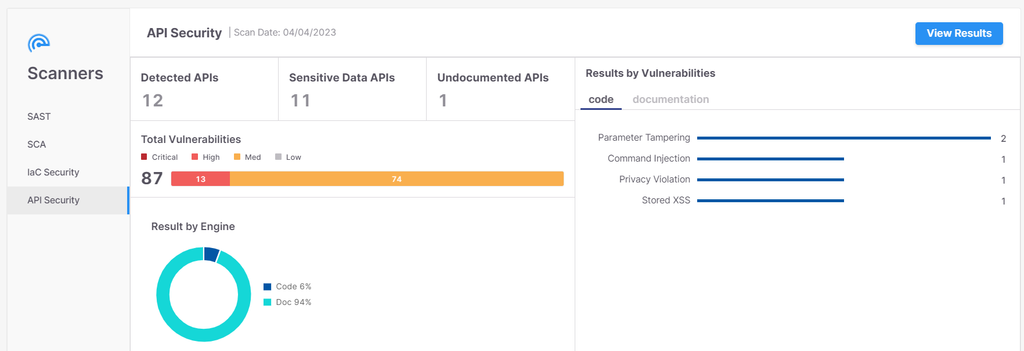
Checkmarx API Security discovers APIs by scanning application source code and documentation rather than by inspecting deployed traffic. This means it can inventory endpoints that have no documentation at all, including shadow APIs that AppSec teams are unaware of and zombie APIs left running after a version migration. Because discovery happens in the repository, endpoints appear in the inventory before they are deployed.
Checkmarx correlates runtime risk through integration with Checkmarx DAST rather than providing native runtime protection. The API security module is part of the broader Checkmarx One platform, so static findings from source code scanning and dynamic findings from DAST testing appear against the same endpoint in one inventory. That gives teams earlier visibility into which pre-production risks are confirmed exploitable at runtime, without the module itself acting as an inline runtime defense layer.
Vulnerabilities detected during API source code scanning are mapped to OWASP API Security Top 10 categories, and remediation is ranked by business risk rather than by CVSS score alone.
Key features include:
- Global API inventory: A single inventory of every API found in the application along with the vulnerabilities detected against each one, ordered so teams can prioritise by business risk.
- Source code API discovery: Scans application source code to find and inventory every API defined in the codebase, including undocumented shadow APIs and abandoned zombie endpoints that gateways and WAFs cannot see.
- API documentation scanning: Reads OpenAPI, Swagger and Postman collections and compares them against the global inventory to surface discrepancies between what the documentation claims and what the code contains.
- API change log: Records the full history of every API change, showing which commit introduced a risk, which developer made the change, and what the endpoint looked like beforehand.
- DAST integration: Correlates static findings with dynamic runtime testing in the unified inventory, elevating the priority of an endpoint when both engines flag it.
- Risk-based prioritisation: Ranks API vulnerabilities by business value and risk so remediation effort goes to the endpoints that carry the most exposure.
| Criterion | Solution Fit | Key Considerations |
| API discovery and inventory coverage | Scans source code and documentation to inventory every API defined in the application, including shadow and zombie endpoints, and compares documentation against the code to expose gaps. | Coverage follows the repositories that are connected; APIs built outside scanned code rely on the DAST integration to appear. |
| Sensitive data identification and classification | Prioritises endpoints by business value and risk rather than labelling the data types an API carries. Data classification is not described on the product page. | Teams that need per-endpoint PII, PCI or PHI tagging would pair this with a data classification tool. |
| Compliance control testing and enforcement | Detects vulnerabilities mapped to OWASP API Security Top 10 categories during SAST scanning, then confirms which are exploitable at runtime by correlating with DAST results. | Mapping is to OWASP API risks rather than to named regulatory control sets. Reviewers report false positive volume on large codebases needs triage time. |
| Audit evidence and framework reporting | Presents a unified inventory of APIs and correlated findings within Checkmarx One. The platform holds SOC 2 Type II certification. | Reviewers note that reports generated for external parties carry less detail than the in-platform view. |
| Change tracking and historical audit trail | The API Change Log holds the full history of every API change with the originating commit, the developer responsible and the prior state of the endpoint. | History builds from the point repository integration is connected, so earlier changes are not retrospectively captured. |
| Deployment model and data residency | Delivered through the Checkmarx One platform, with an on-premises SAST option listed among the platform’s deployment choices. | Confirm which specific components can run on-premises if data residency constraints apply to the whole pipeline. |
Source: Checkmarx
2. Invicti API Security

Best for: Building an API inventory from code, gateways and live traffic
Strengths: Four-layer discovery and authenticated DAST without manual specs
Things to consider: Configuration can be involved; no runtime enforcement
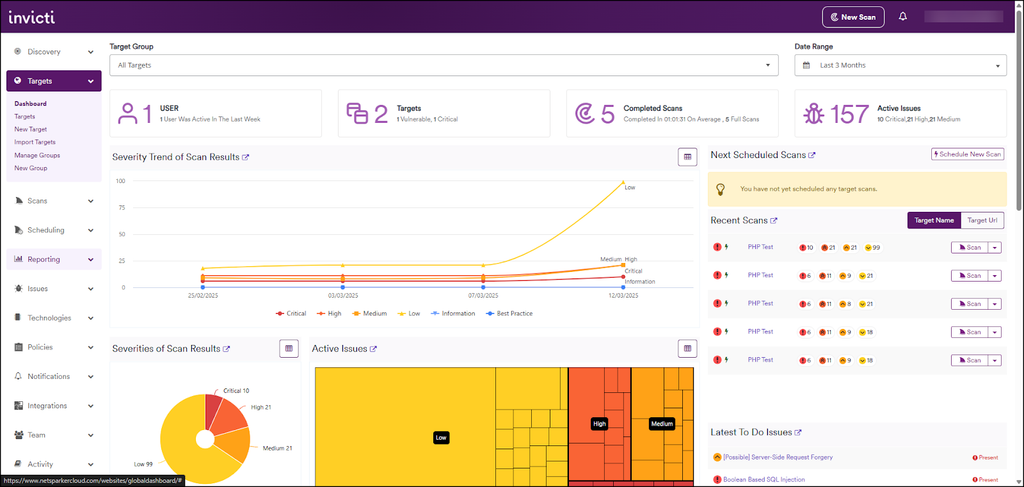
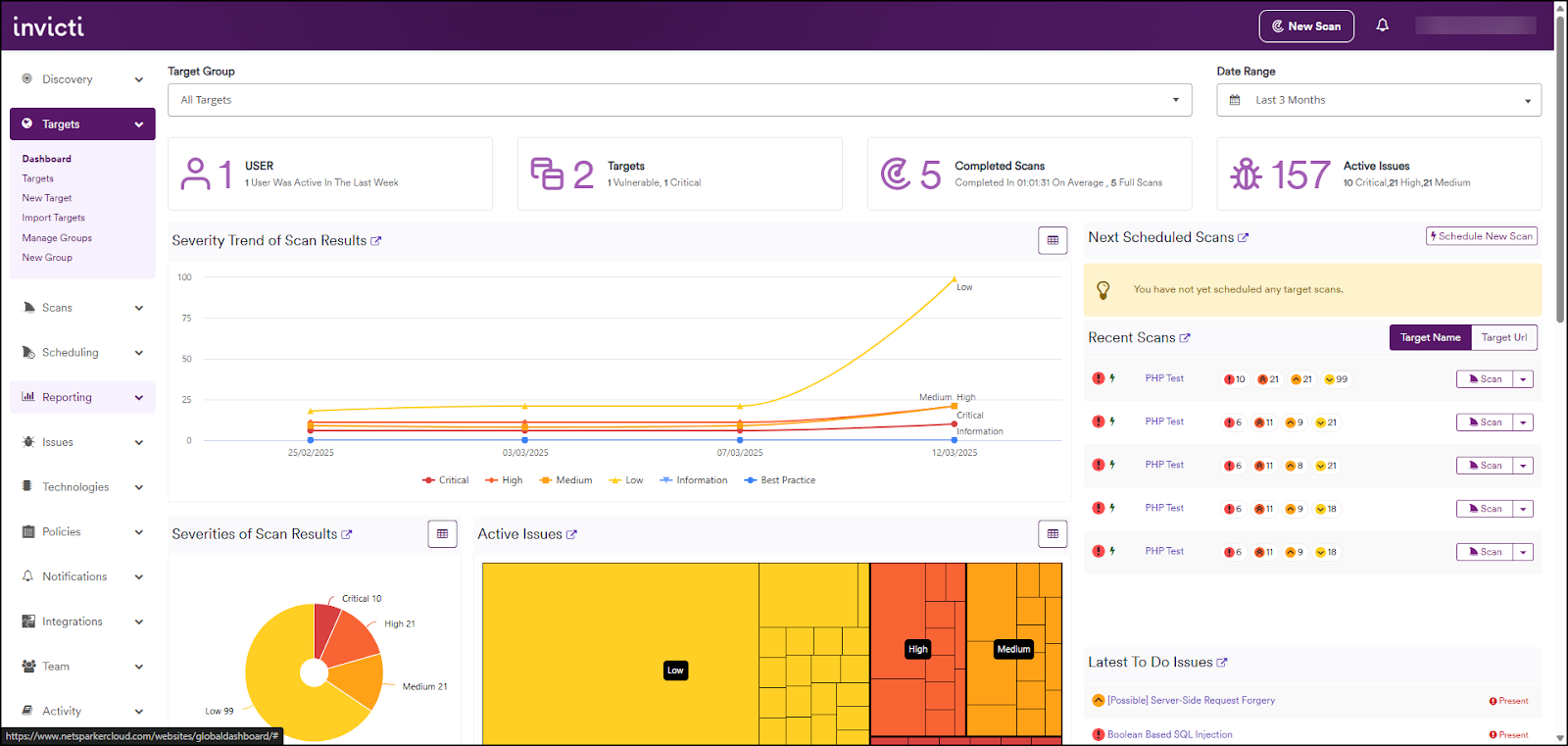
Invicti builds its API inventory by correlating four separate discovery layers. It connects to GitHub, GitLab and Bitbucket to identify endpoints defined in code and locate specification files, and generates schemas where documentation is missing. Its DAST engine crawls web applications, observes the API calls the interface makes, and extracts those endpoints automatically.
The remaining two layers cover deployed APIs. Gateway integrations retrieve endpoints, schemas and documentation from Kong, Apigee, AWS API Gateway and Azure API Management. Network traffic analysis observes requests and responses across F5, NGINX, Cloudflare and Kubernetes environments to identify active endpoints and reconstruct their structures. Discovered APIs are then passed automatically to the DAST engine for testing.
Key features include:
- Source code API discovery: Connects to developer repositories to identify endpoints defined in code, locate specification files and generate schemas when documentation is absent, so APIs surface before deployment.
- Discovery during web application scans: The DAST engine crawls web applications, observes the API calls made by the interface and extracts those endpoints into the inventory without manual configuration.
- API gateway integration: Retrieves endpoints, schemas and documentation directly from Kong, Apigee, AWS API Gateway and Azure API Management.
- Network traffic analysis: Observes requests and responses across F5, NGINX, Cloudflare and Kubernetes to identify active endpoints and reconstruct API structures, catching endpoints absent from code and documentation.
- Automatic schema generation: Extracts or reconstructs API schemas from code, gateways and traffic, removing the requirement for developers to supply OpenAPI or Swagger files before testing.
- Authenticated API scanning: Detects and works with tokens, cookies and OAuth so endpoints are tested behind authentication rather than only at the public surface.
| Criterion | Solution Fit | Key Considerations |
| API discovery and inventory coverage | Correlates source code, web application scans, gateway integrations and network traffic into a continuously updated inventory covering REST, GraphQL, mobile backend, service-to-service, headless and shadow APIs. | Full breadth requires connecting all four layers. Traffic analysis only reveals endpoints once they are live and receiving requests. |
| Sensitive data identification and classification | Not described on the product page. The platform covers endpoint discovery, schema reconstruction and vulnerability testing. | Without per-endpoint data labelling, scoping which APIs fall under GDPR or PCI DSS would depend on other tooling. |
| Compliance control testing and enforcement | Discovered APIs are passed automatically to the DAST engine and tested for OWASP API Top 10 issues including broken access control, injection and authentication weaknesses. | Testing is dynamic only. Some reviewers report their API setup did not work with Invicti’s scanning approach despite vendor support. |
| Audit evidence and framework reporting | The platform includes a compliance and executive reporting module for measuring risk and impact. | The product page gives no detail on framework-specific report packs, so PCI DSS or HIPAA mapping is worth confirming in a demo. |
| Change tracking and historical audit trail | Integrates with CI/CD pipelines and repositories to detect new or modified APIs as applications evolve, adding them to the inventory automatically. | Inventory freshness is covered, but a per-endpoint historical change record is not described. |
| Deployment model and data residency | Platform instances are offered in US, EU and CA regions. | Region is selected at account level. Reviewers describe complex initial setup and nested configuration menus that take time to learn. |
Source: Invicti
3. StackHawk

Best for: Testing APIs on every pull request before they reach production
Strengths: Repo-based discovery, sensitive data flags and CI/CD testing
Things to consider: YAML-driven config; not a substitute for a penetration test
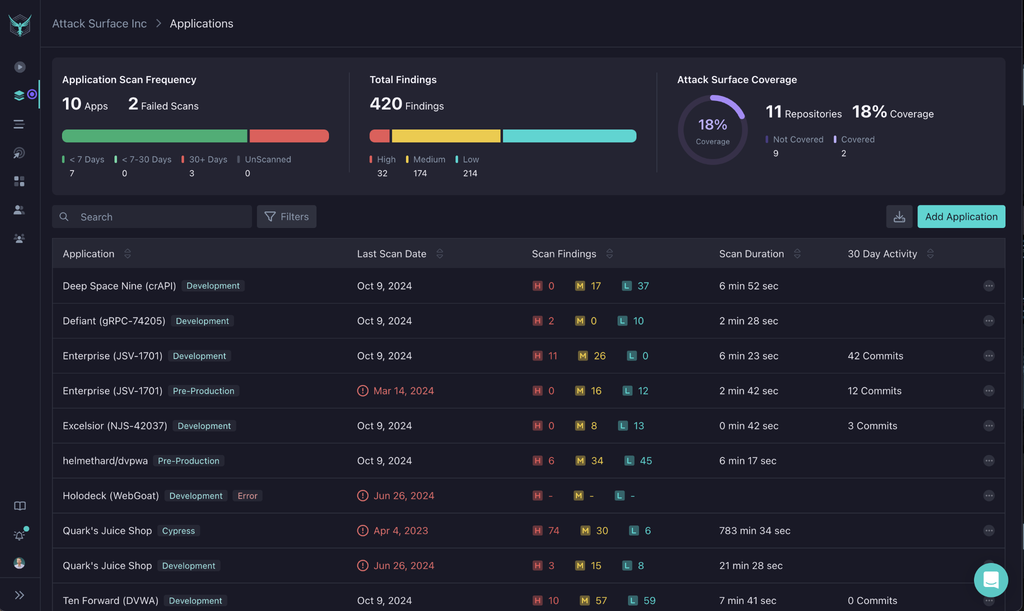
StackHawk connects to source code repositories to map applications and APIs across the attack surface, then generates OpenAPI specifications directly from the code. This removes the dependency on developers hand-writing specifications before security testing can start. Alongside the endpoint map, the platform identifies where sensitive data lives in each repository, along with the languages and frameworks in use and the rate of commit activity.
Testing runs against the live application inside CI/CD infrastructure rather than being triggered externally, so scans happen at commit and pull request time. The engine covers REST, GraphQL, gRPC and SOAP, and tests for authorisation and authentication flaws, business logic issues, mass assignment, excessive data exposure, injection and LLM-specific risks. An oversight layer reports coverage and posture across the programme.
Key features include:
- API discovery from source repositories: Integrates with connected repositories to map every application and API, giving a code-derived view of the attack surface rather than a traffic-derived one.
- Repo insights and sensitive data flags: Automatically identifies where sensitive data lives, which languages and frameworks are in use, and how frequently each repository changes, so testing can be prioritised.
- OpenAPI spec generation: Creates API specifications from source code so endpoints become testable assets without waiting for developers to write documentation.
- Runtime testing in CI/CD and pull requests: Runs deterministic, reproducible tests against the running application inside CI/CD infrastructure, with configurable logic to block or pass a build.
- Coverage of API-specific risk classes: Tests for BOLA, BFLA and broken access control, business logic flaws, mass assignment, excessive data exposure, injection and prompt injection across REST, GraphQL, gRPC and SOAP.
- Program oversight dashboards: Reports testing coverage, findings surfaced and overall risk posture, and prioritises applications by sensitive data handling and commit activity.
| Criterion | Solution Fit | Key Considerations |
| API discovery and inventory coverage | Maps applications and APIs from connected source repositories and generates OpenAPI specifications from code, covering endpoints that have no documentation. | Discovery is repository-based, so APIs running in production outside connected repositories will not appear in the attack surface view. |
| Sensitive data identification and classification | Automatically identifies where sensitive data lives in each repository and uses that signal to prioritise which APIs get tested first. | Labels are inferred from source code patterns and are available only for supported languages, so coverage varies by stack. |
| Compliance control testing and enforcement | Runs authenticated tests on every pull request covering authorisation flaws, business logic issues, excessive data exposure and injection, and can fail a build when critical issues are found. | Reviewers note it does not replace a manual penetration test, and that GraphQL vulnerability coverage was thinner than expected for some teams. |
| Audit evidence and framework reporting | Oversight dashboards report testing coverage, findings surfaced and risk posture across the application portfolio. | Reporting is programme-oriented. No mapping to named regulatory frameworks is described on the product page. |
| Change tracking and historical audit trail | Tracks commit activity per application and reruns detection automatically as code changes, keeping labels and inventory current. | Change context sits at repository level rather than as a per-endpoint history showing what changed on a given API. |
| Deployment model and data residency | The scanner runs inside the customer’s own CI/CD infrastructure via a Docker-based deployment, with the platform delivered as SaaS. | Reviewers cite overhead in managing the scanner container, and note that most scan configuration lives in a YAML file rather than the portal. |
Source: StackHawk
4. 42Crunch API Security Platform

Best for: Enforcing API security policy from an OpenAPI contract
Strengths: Contract audit scoring, fuzzing and runtime firewall policies
Things to consider: Depends on accurate contracts; per-API firewall adds overhead
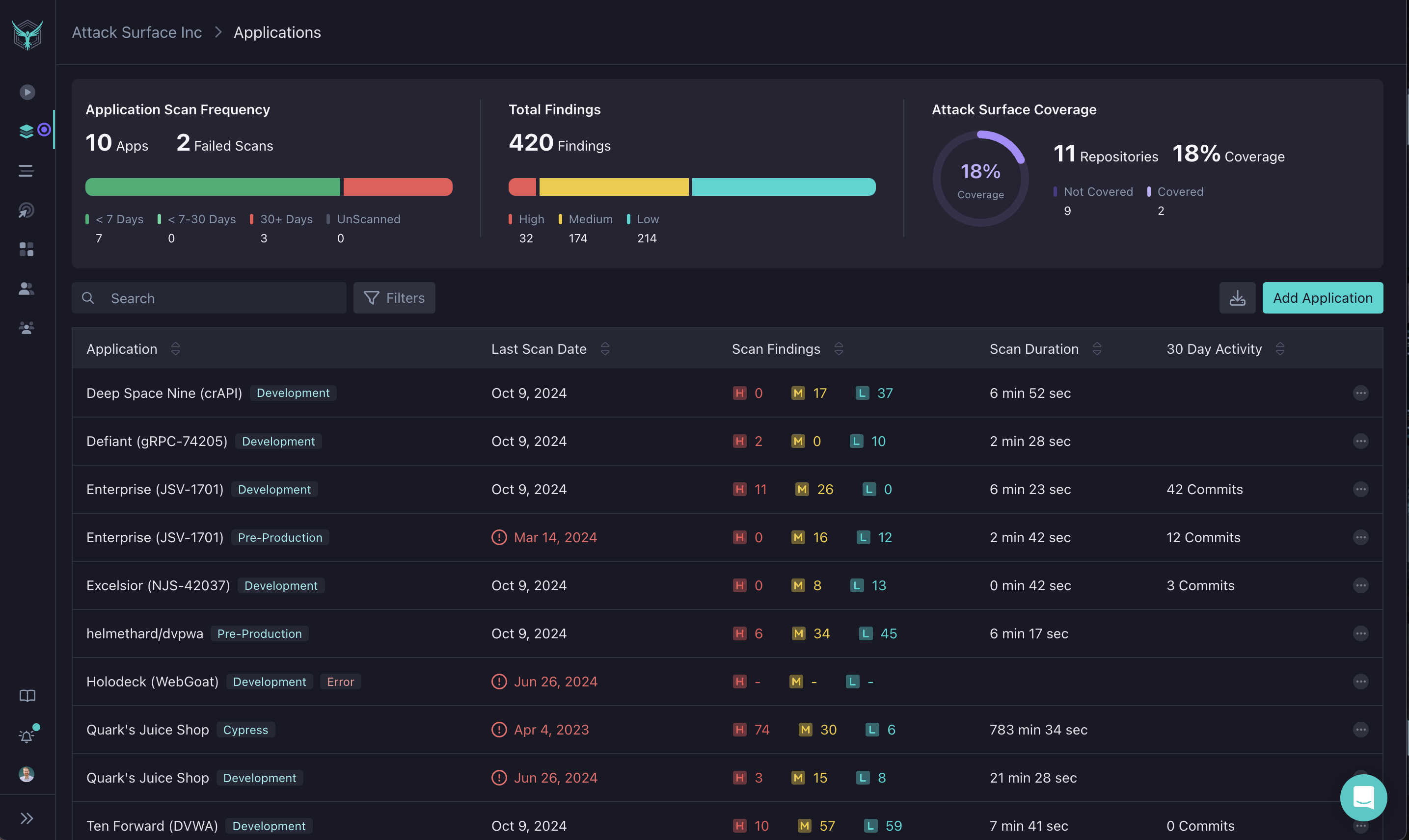
42Crunch treats the OpenAPI contract as the control point. It discovers and catalogues APIs through gateway integrations, builds contracts from live traffic and other sources, and connects to development repositories so new APIs are captured without manual inventory work. The same contract then drives everything downstream.
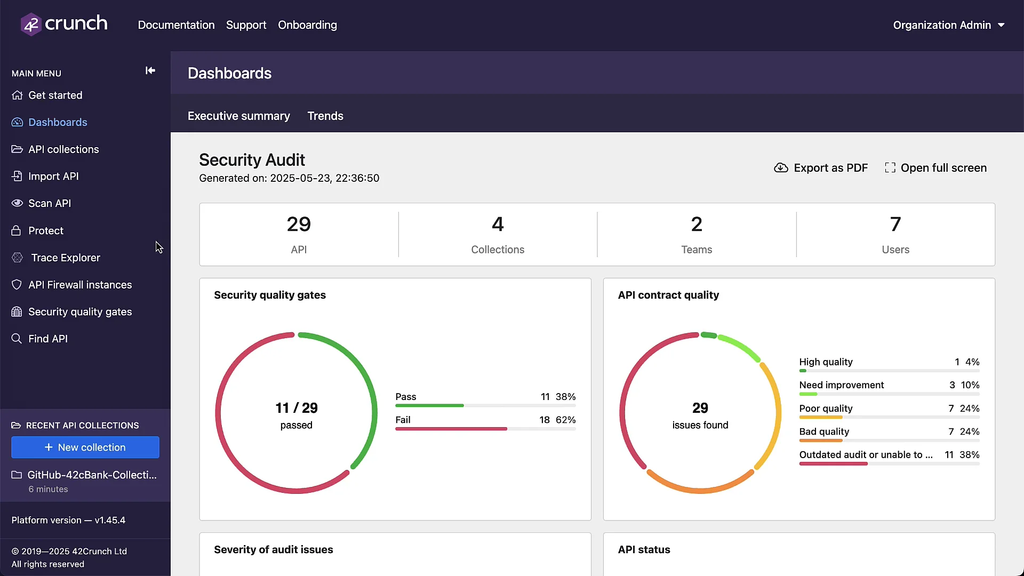
Each API is scored against more than 300 automated checks covering semantics, code hygiene and data definition, and security fuzzing is generated directly from the contract and run inside CI/CD. At runtime, an API firewall configures itself from the contract with no manual rule writing, detects and blocks shadow and zombie APIs, and works across any API gateway. Protection policies are redeployed automatically whenever the API changes, and events feed into SIEM tooling.
Key features include:
- Automated API discovery and cataloguing: Discovers APIs across the gateway ecosystem, builds contracts from live traffic and other sources, and integrates with development repositories so new APIs enter the catalogue automatically.
- Contract-based security audit: Calculates a security score for each API against more than 300 checks covering security definitions and data validation, with issues ranked by severity.
- Contract-driven security testing: Generates security fuzzing directly from the OpenAPI contract and runs it inside any open-source or commercial CI/CD pipeline.
- Centrally managed compliance rules: Holds standardised secured API contracts and centrally managed security compliance rules and runtime policies, giving security teams governance across distributed development teams.
- Runtime API threat protection: An API firewall configured automatically from the contract, blocking shadow and zombie APIs and API-specific attacks, deployment agnostic across any gateway, with SIEM connectivity.
- Developer workflow integrations: Embeds in IDEs, code repositories and CI/CD environments, with support for GraphQL and MCP server governance alongside REST.
| Criterion | Solution Fit | Key Considerations |
| API discovery and inventory coverage | Discovers and catalogues APIs through gateway integrations, builds API contracts automatically from live traffic and other sources, and links to development repositories. | Discovery depends on documentation and gateway paths. When specifications are missing or inaccurate, endpoints are missed, unlike code-native discovery approaches. |
| Sensitive data identification and classification | Applies API semantic, code hygiene and data definition checks across all APIs, covering how data is defined in the contract. | Checks validate declared data definitions rather than classifying data observed in live payloads, so undeclared exposure can go unflagged. |
| Compliance control testing and enforcement | Scores each API against 300+ checks, fuzzes from the contract in CI/CD, and enforces centrally managed compliance rules with a runtime firewall that blocks contract violations. | Reviewers note the strongest controls rely on teams maintaining accurate, current contracts. Drift between contract and implementation degrades both scanning and protection. |
| Audit evidence and framework reporting | Gives security teams centralised oversight of policy enforcement across the API lifecycle, with events forwarded to SIEM and SOC tooling. | Evidence is organised around contracts and audit scores rather than reports mapped to named regulatory frameworks. |
| Change tracking and historical audit trail | Runtime protection policies are automatically redeployed with each API change, keeping enforcement aligned to the current contract version. | History is tied to contract versions held in the repository rather than a built-in per-endpoint audit trail inside the platform. |
| Deployment model and data residency | Deploys at scale on Kubernetes, Amazon ECS and Red Hat OpenShift with a low footprint, protecting both north-south and east-west traffic across any gateway. | Reviewers note that deploying a micro firewall per API adds orchestration overhead, and that enterprise pricing is tiered by API and call volume. |
Source: 42Crunch
Runtime API Discovery and Protection Platforms
Runtime API discovery and protection platforms focus on APIs that are deployed and actively handling traffic. They analyze live requests, gateways, cloud environments, and production behavior to discover shadow or unmanaged APIs, classify sensitive data exposure, detect abuse and business logic attacks, and enforce or monitor controls against live API traffic.
5. Salt Security

Best for: Discovering and governing APIs running in production environments
Strengths: Posture mapping to PCI, GDPR and SOC 2 plus behavioural detection
Things to consider: No native SAST, so shadow APIs stay hidden until deployment
Salt Security analyses live API traffic to build real-time visibility into every API running in production, including shadow APIs, third-party connections and deprecated endpoints. Discovery works without manual tagging and without agents. The platform is organised into modules covering external exposure mapping, cloud API visibility, live traffic analysis, policy enforcement inside AI coding agents, and threat blocking.
Posture analysis is where the compliance work happens. The platform continuously assesses API posture and maps it to PCI DSS, GDPR, NIST and SOC 2, showing where controls are missing, misaligned or out of date, with governance enforced at scale through Policy Hub. Behavioural analysis handles detection, identifying API-specific threats, fraud patterns and low-and-slow attacks across the traffic it collects.
Key features include:
- Real-time API discovery: Provides visibility into every API running in production across environments, including shadow APIs, third-party connections and deprecated endpoints, without manual tagging or agents.
- Posture mapping to compliance frameworks: Continuously analyses API posture against PCI DSS, GDPR, NIST and SOC 2, showing where controls are missing, misaligned or have drifted.
- Policy Hub governance: Enforces governance policies at scale across the API estate rather than handling posture issues endpoint by endpoint.
- Sensitive data tracking across APIs: Extends data security practices to APIs by tracking sensitive data, with dedicated paths for protecting PII at scale and for healthcare data.
- Behavioural threat detection: Patented behavioural analysis identifies API-specific threats, fraud patterns and low-and-slow attacks by correlating attacker activity across reconnaissance stages.
- External exposure mapping: Maps the externally reachable API surface and identifies APIs powering AI agents and agentic workflows.
| Criterion | Solution Fit | Key Considerations |
| API discovery and inventory coverage | Delivers real-time visibility into every API running in production across environments, covering shadow APIs, third-party connections and deprecated endpoints without agents or manual tagging. | Visibility starts at deployment. Without native static analysis, APIs that exist only in code are not seen before they ship. |
| Sensitive data identification and classification | Extends data security to APIs by tracking sensitive data across the estate, with industry paths for PII at scale and healthcare data. | Classification is inferred from observed traffic, so endpoints that receive little traffic are characterised more slowly. |
| Compliance control testing and enforcement | Continuously assesses posture against PCI DSS, GDPR, NIST and SOC 2, enforces governance through Policy Hub, and blocks logic-based threats through Salt Protect. | Assessment runs against live traffic rather than pre-deployment testing, so control failures are found after release rather than before. |
| Audit evidence and framework reporting | Posture and compliance views are built for proving compliance, streamlining audits and avoiding policy drift. | Reviewers describe a noticeable learning curve and initial alert tuning effort before output settles into a usable state. |
| Change tracking and historical audit trail | Continuous posture analysis detects drift as configurations and endpoints change over time. | Drift detection is behavioural. The platform does not tie a change back to a commit, a repository or a named developer. |
| Deployment model and data residency | Deploys agentlessly and integrates with SIEM, ticketing, gateways and firewalls, with a published Trust Center for security and compliance information. | Reviewers report implementation can take significant time in unusual environments. Confirm regional data handling given the platform analyses live traffic. |
6. Akamai API Security

Best for: Governing API posture against multiple compliance frameworks
Strengths: Multi-source discovery with PCI, HIPAA, ISO and GDPR mapping
Things to consider: Integration maturity gaps; less shift-left depth
Akamai API Security discovers APIs across runtime traffic, code repositories, API documentation, gateways, cloud environments and external exposure points. The inventory covers shadow, zombie and unmanaged endpoints, and tags APIs connected to GenAI applications, LLM services and MCP servers. It is sold as vendor neutral and does not require other Akamai products to run.
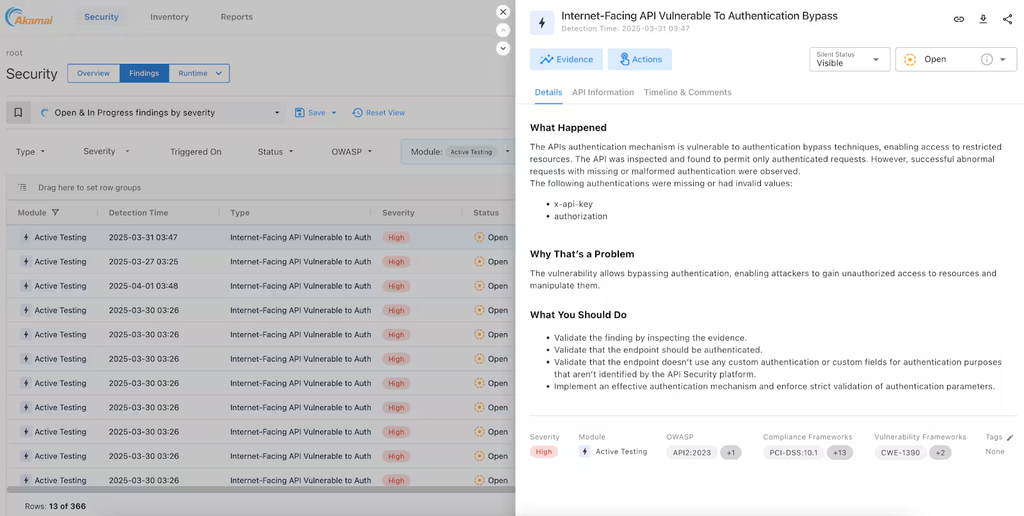
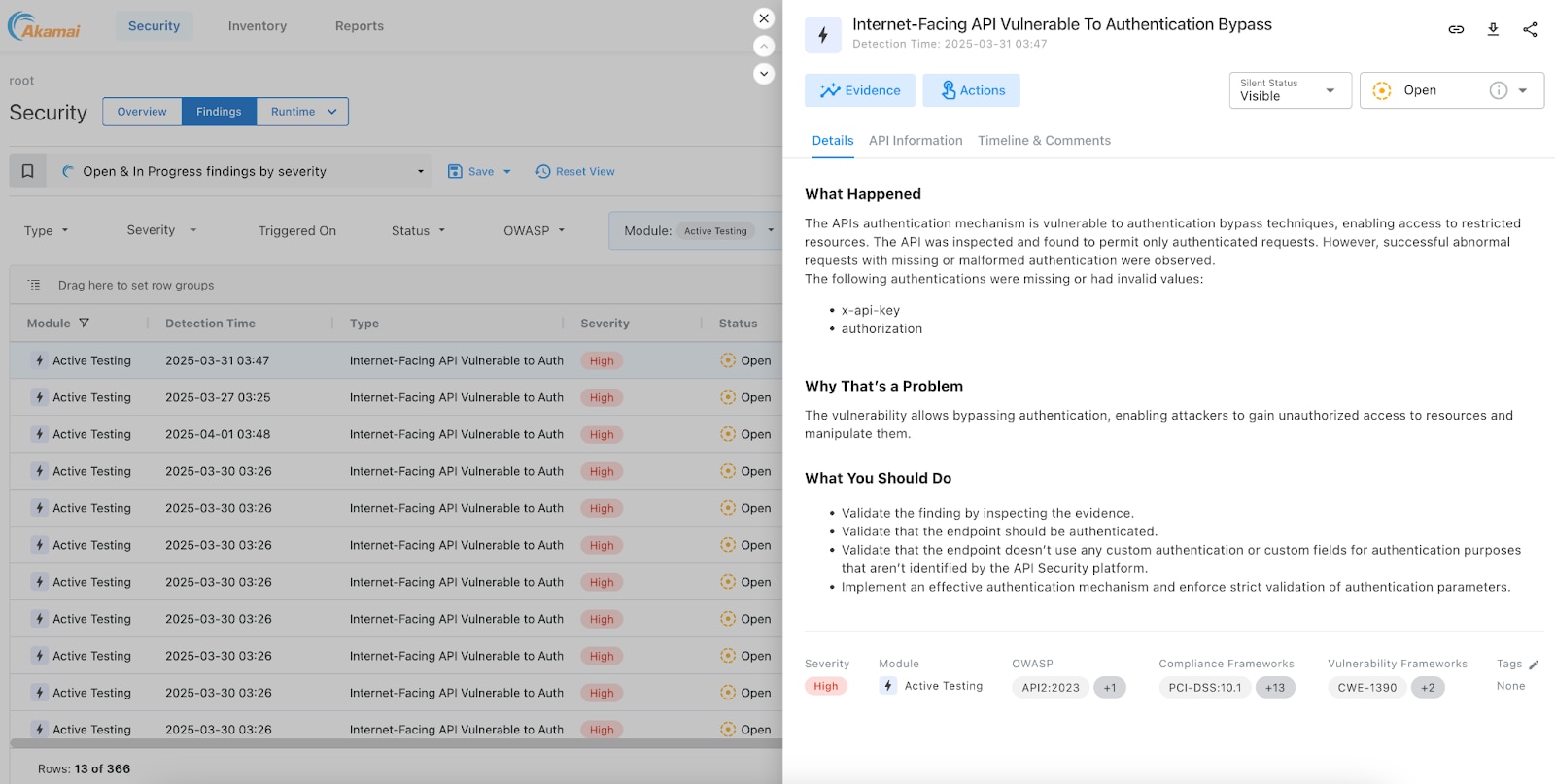
Compliance coverage is the broadest in this comparison: findings are mapped to OWASP API, PCI DSS, HIPAA, ISO 27001, GDPR, HITRUST and NIST, with posture gaps and remediation progress tracked over time. Testing runs 200+ dynamic tests in CI/CD and pre-production, and runtime analysis identifies abuse, business logic attacks, scraping and tampering. Findings route to owners, repositories, file paths and last committers where that context is available.
Key features include:
- Multi-source API discovery: Builds a continuously updated inventory from traffic, code, specifications, gateways, cloud environments and external exposure points, covering shadow, zombie, unmanaged and AI-linked APIs.
- Compliance framework mapping: Maps API findings to OWASP API, PCI DSS, HIPAA, ISO 27001, GDPR, HITRUST and NIST, and tracks posture gaps and remediation progress against them.
- Sensitive data exposure visibility: Identifies APIs that access, process or return sensitive data such as PII, internal documentation or intellectual property, and uses that context to rank risk.
- Pre-release API testing: Runs more than 200 dynamic tests in CI/CD and pre-production workflows that simulate malicious traffic, including tests aligned to the OWASP API Security Top 10.
- Runtime behaviour analysis: Analyses live behaviour to detect API abuse, business logic exploitation, sensitive data exposure, scraping, tampering and resource exhaustion.
- Findings routing and ownership mapping: Maps findings to owners, repositories, file paths and last committers where available, and routes them into SIEM, ITSM, ticketing, CMDB, WAAP and developer workflows.
| Criterion | Solution Fit | Key Considerations |
| API discovery and inventory coverage | Continuously discovers APIs across traffic, code, specifications, gateways, cloud and external exposure, including shadow, zombie, unmanaged, MCP and AI-linked endpoints. | Breadth scales with how many sources are connected. Code-side discovery is a supplementary input rather than a native static analysis engine. |
| Sensitive data identification and classification | Identifies APIs that access, process or return sensitive data such as PII, internal documentation or intellectual property, and applies that context to prioritisation. | Sensitive data findings derive from observed behaviour, so endpoints with low traffic volume take longer to characterise accurately. |
| Compliance control testing and enforcement | Assesses posture against best practices, OWASP API risks, internal policies and compliance frameworks, and runs 200+ tests in CI/CD before release. | The centre of the product remains runtime. Reviewers ask for more granular policy tuning and clearer visibility into behavioural decisions. |
| Audit evidence and framework reporting | Maps findings to seven named frameworks, tracks posture gaps and risk trends over time, and supports audit, regulatory and cyber insurance conversations. | Consumption-based pricing tied to monthly API request volume can make scoping harder for large estates, with overage costs above bundled limits. |
| Change tracking and historical audit trail | Maps API findings to owners, repositories, file paths and last committers where that information is available, and monitors risk trends over time. | Commit-level attribution is conditional on repository connections. Reviewers note post-acquisition integrations are not yet natively unified. |
| Deployment model and data residency | Platform agnostic across SaaS, hybrid and on-premises, including estates with multiple CDNs, WAFs and gateways, and does not require other Akamai products. | Reviewers describe a more complex initial setup than comparable tools, and one notes limited options for integrating with other CDN providers. |
Source: Akamai
7. Imperva API Security

Best for: Classifying API data sensitivity and blocking abuse inline
Strengths: Sensitivity classification, BOLA detection and inline mitigation
Things to consider: Discovery can be slow on single-domain API architectures
Imperva runs API discovery, risk assessment, detection and mitigation from a single console across cloud, on-premises and hybrid environments. Once activated, it continuously discovers and monitors public, private and shadow APIs, tracks changes, detects design flaws and classifies each API by the sensitivity of the data it handles, using categories including government ID, credit card details, address information and other PII.
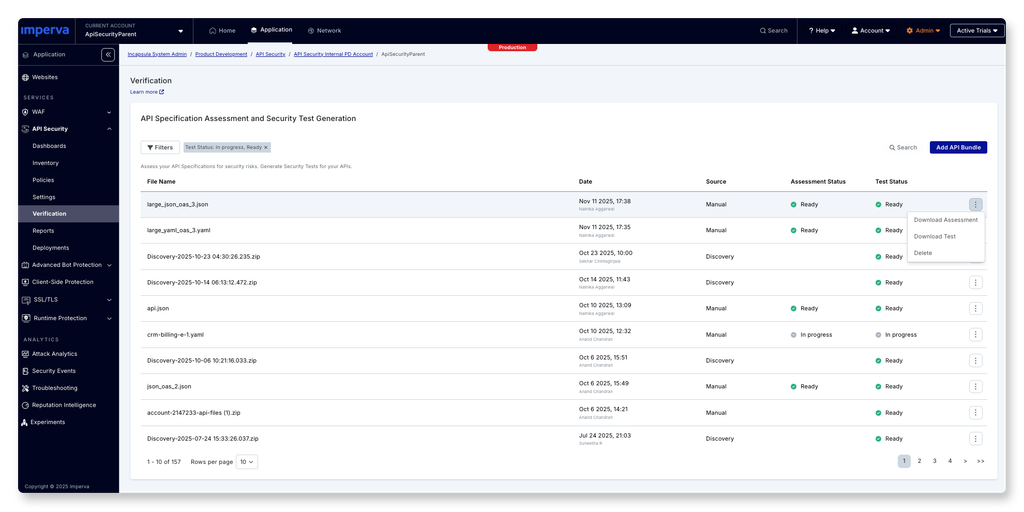
Risk assessment runs continuously against the OWASP API Security Top 10. A shift-left testing capability scans an uploaded API specification file to identify posture gaps, design flaws and configuration weaknesses, classifies each issue by severity and returns developer-ready fixes with CI/CD annotations. At runtime, hybrid behavioural and rule-based engines score anomalies and detect Broken Object Level Authorization exploitation, with automated mitigation enforced inline through Cloud WAF and WAF Gateway.
Key features include:
- Continuous API discovery: Discovers and monitors all public, private and shadow APIs across environments once activated, tracking changes and identifying design flaws as they appear.
- Sensitivity-based API classification: Classifies APIs by data sensitivity across categories including government ID, credit card details, address information and other personally identifiable information.
- Ongoing API risk assessment: Runs continuous risk assessments to identify design flaws and vulnerabilities associated with the OWASP API Security Top 10 across the whole inventory.
- Shift-left API specification testing: Scans an uploaded API specification file to pinpoint risky endpoints and configuration weaknesses, ranks issues by severity and returns copy-paste fixes with CI/CD annotations.
- Business logic threat protection: Profiles traffic to build behavioural baselines, then uses hybrid behavioural and rule-based engines to detect and block BOLA exploitation and other OWASP API Top 10 threats inline via Cloud WAF and WAF Gateway.
- Flexible deployment and integrations: Offers cloud-managed and self-managed options with agent-based or agentless setups, integrating with Kong, Mulesoft, Azure APIM, Apigee and F5.
| Criterion | Solution Fit | Key Considerations |
| API discovery and inventory coverage | Continuously discovers public, private and shadow APIs across cloud, on-premises and hybrid environments, and monitors both north-south and east-west traffic. | Reviewers report that architectures centralising hundreds or thousands of operations on a single domain can take months to fully enumerate. |
| Sensitive data identification and classification | Classifies APIs by sensitivity using defined categories including government ID, credit card details, address information and other PII, so the most sensitive endpoints can be prioritised. | Categories are predefined. Confirm coverage for PHI and any industry-specific data types your frameworks require. |
| Compliance control testing and enforcement | Assesses risk continuously against the OWASP API Security Top 10, scans uploaded specification files pre-release, and blocks BOLA and other API attacks inline through Cloud WAF and WAF Gateway. | Shift-left testing depends on an uploaded API specification rather than analysing source code, so undocumented endpoints are outside its scope. |
| Audit evidence and framework reporting | Discovery, risk assessment, detection and mitigation are managed in one console alongside WAF, DDoS and bot protection, giving a single view of API risk. | No named framework report packs are described on the product page. Reviewers note false positives on paths with dynamic parameters. |
| Change tracking and historical audit trail | Continuously tracks API changes and profiles traffic to establish behavioural baselines that surface deviations over time. | Change history is derived from observed traffic and is not linked back to code commits or the developers who made the change. |
| Deployment model and data residency | Offers cloud-managed and self-managed options with agent-based or agentless deployment, covering cloud WAF, microservices, encrypted applications and network-layer monitoring. | Reviewers note initial setup may require expertise, with additional challenges reported in complex API architectures. |
Source: Imperva

8. Data Theorem API Secure

Best for: Continuous external discovery and runtime protection of cloud APIs
Strengths: Blackbox and cloud discovery plus 200+ runtime attack signals
Things to consider: Few public reviews available; SaaS-only delivery
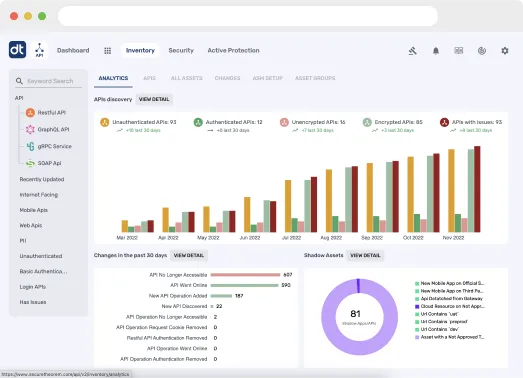
Data Theorem API Secure is an automated, continuous service that discovers APIs, assesses their health and provides runtime protection. Discovery works four ways: blackbox monitoring of the public perimeter with no agents or configuration, cloud discovery across AWS, Azure, GCP and private cloud, consolidation of inventories from existing gateways such as Apigee, Kong and AWS, and integration into developer tools to catch APIs as they are built.
Posture management covers leaky APIs, authentication evaluation, authorisation and encryption levels, security vulnerabilities, and orphaned and zombie endpoints, presented against a compliance score. Security testing combines static analysis, dynamic analysis, software composition analysis, customised tests and hacker toolkits. At runtime, the platform acts on more than 200 attack signals covering authentication, authorisation, encryption, bot activity, abuse and anomalies, including AI-driven attacks such as prompt injection and scraping.
Key features include:
- Blackbox and cloud API discovery: Continuously monitors the public perimeter with no agents or configuration, and discovers APIs across AWS, Azure, GCP and private cloud environments.
- Gateway and developer tool inventory: Consolidates inventories from existing gateway solutions including Apigee, Kong and AWS, and integrates into developer tools to capture APIs as they are built.
- API security posture management: Assesses leaky APIs, authentication strength, authorisation and encryption levels, security vulnerabilities, and orphaned and zombie endpoints against a compliance score.
- Multi-technique security testing: Applies static code analysis, dynamic analysis, software composition analysis, fully customised testing and hacker toolkits to find issues before production.
- Runtime active protection: Monitors more than 200 signals covering authentication, authorisation, encryption, attack prevention, malicious domains, bot protection, abuse and anomalies, with vulnerability remediation and rollback options.
- AI-driven attack detection: Detects and blocks prompt injection and LLM abuse, AI scraping activity, password spraying and login automation using behavioural detection at scale.
| Criterion | Solution Fit | Key Considerations |
| API discovery and inventory coverage | Combines blackbox perimeter monitoring, multi-cloud discovery, gateway inventory consolidation and developer tool integrations, and identifies orphaned and zombie endpoints. | Perimeter discovery centres on internet-facing assets. Coverage of internal east-west APIs is not detailed on the product page. |
| Sensitive data identification and classification | Posture management surfaces leaky APIs and evaluates encryption levels to identify where data could be exposed. | Leaky-API detection is described, but a named data classification taxonomy mapping endpoints to PII, PCI or PHI is not. |
| Compliance control testing and enforcement | Applies SAST, DAST, SCA, custom tests and hacker toolkits to fix API issues before production, with runtime protection acting on 200+ attack signals. | One public reviewer noted only being able to scan after publishing rather than before, which limits pre-release gating. |
| Audit evidence and framework reporting | Presents a global posture health view with a compliance score, backed by a compliance offering positioned around audit readiness for regulatory, customer and industry standards. | Very few public reviews exist for this product, so audit workflow maturity is difficult to verify independently before a trial. |
| Change tracking and historical audit trail | Continuous automated monitoring keeps the inventory current and surfaces new, orphaned and zombie endpoints as they appear. | A per-endpoint historical change record showing what changed and when is not described on the product page. |
| Deployment model and data residency | Fully automated SaaS-based monitoring of cloud environments, with CI/CD tool integrations. | SaaS-only delivery may not suit residency-constrained programmes. Reviewers of sibling Data Theorem products cite cost as a drawback. |
Source: Data Theorem
Conclusion
Selecting an API security solution requires balancing deep visibility with the specific demands of your regulatory framework. By prioritizing continuous discovery, sensitive data identification, and robust auditability, organizations can effectively secure their interfaces. Focusing on these core requirements ensures a scalable defense that maintains compliance without hindering development speed.