

Summary
Automated API discovery finds every API in an environment, and risk classification ranks them by exposure and data sensitivity. Checkmarx is best for discovering APIs in source code, StackHawk for repository-based attack surface mapping, Salt Security for traffic-based inventory, and Akamai API Security for multi-cloud estates.
What Is Automated API Discovery?
Automated API discovery and risk classification platforms map out an organization’s complete API attack surface and evaluate endpoints for security vulnerabilities, compliance drift, and sensitive data exposure. Leading providers utilize traffic analysis, source code scanning, or AI behavioral monitoring to continuously catalog APIs and prioritize risks.
Automated API discovery addresses the challenge of “API sprawl,” where APIs proliferate beyond what teams can manually track. Without automation, undocumented or forgotten APIs, often called “shadow” or “zombie” APIs, remain exposed and unmanaged, increasing security risks. Automated discovery reduces blind spots by cataloging every API in use, which forms the foundation for effective API management and security strategies.
This is part of a series of articles about API security
Quick Comparison: Automated API Discovery and Risk Classification Providers
The table below summarizes the key differences between the providers covered in this guide. We explore each one in more detail in the sections that follow.
| Category | Solution | Best For | Key Strengths | Things to Consider |
| Application Security Platforms | Checkmarx API Security | AppSec teams discovering APIs directly in source code | Code and documentation scanning, correlated SAST and DAST results | Scans of large codebases can take time to complete |
| Application Security Platforms | StackHawk | Teams mapping their API attack surface from source code | Repository-based discovery with automatic OpenAPI spec generation | Scanning engine is built on ZAP with limited plugin support |
| Application Security Platforms | Invicti | Security teams combining code, gateway, and traffic discovery | Four discovery layers feeding an automated DAST testing pipeline | Full scans of large applications can run for extended periods |
| Runtime and Traffic-Based Platforms | Salt Security | Enterprises building a continuous inventory from live API traffic | Continuous discovery with risk scoring and posture governance | Implementation can be complex in non-standard environments |
| Runtime and Traffic-Based Platforms | Akamai API Security | Large multi-cloud estates needing vendor-neutral API visibility | Discovery across traffic, code, specs, gateways, and external exposure | Policy tuning and configuration take time to get right |
| Runtime and Traffic-Based Platforms | Wallarm | Runtime API inventory built from observed production traffic | Traffic-derived specs, sensitive data tracking, and drift alerts | Configuration and tuning take time for teams new to the tool |
| Runtime and Traffic-Based Platforms | Cequence Security | Combining external attack surface and runtime API discovery | Attacker-view discovery plus runtime inventory with risk scoring | Initial setup and policy tuning need networking expertise |
| Runtime and Traffic-Based Platforms | Harness API Discovery | Discovering east-west APIs across distributed microservices | eBPF and gateway-based discovery with sensitive data classification | Some reporting and query saving functions remain limited |
What Is API Risk Classification?
API risk classification is the process of evaluating and assigning a risk level to each API based on factors such as data sensitivity, exposure to external networks, authentication mechanisms, and compliance requirements. This process involves analyzing API behavior, data handled, and access patterns to determine how likely an API is to be targeted or exploited, and what the potential impact would be if compromised.
By classifying APIs according to risk, organizations can prioritize security efforts and allocate resources more effectively.
Not all APIs present the same risk – some may handle sensitive customer data or perform critical business functions, while others serve less important roles. Accurate risk classification enables focused mitigation, ensuring the most critical vulnerabilities are addressed first and compliance obligations are met.
Why Automated Discovery and Risk Classification Work Better Together
Discovery Establishes Visibility
Automated discovery provides the essential visibility needed to manage APIs effectively. By systematically identifying every API in the environment, organizations gain a complete inventory, including those that were previously undocumented or forgotten. This continuous visibility is crucial in dynamic environments where APIs are frequently added, changed, or deprecated, as it prevents blind spots and ensures teams are aware of the full attack surface.
Visibility is the prerequisite for any subsequent security or governance efforts. Without knowing what APIs exist and where they are located, organizations cannot secure them or assess their risk. Automated discovery, therefore, acts as the first line of defense, setting the stage for more advanced API security and management processes by ensuring that nothing goes unnoticed.
Classification adds Security and Business Context
Risk classification builds on discovery by evaluating the importance and potential impact of each API. Once APIs are discovered, classification tools analyze factors such as the type of data processed, authentication methods, and exposure levels to determine the risk profile. This step adds crucial security context, distinguishing between APIs that require stringent controls and those that pose minimal risk.
In addition to security, classification introduces business context, allowing organizations to align security measures with business priorities. APIs supporting critical applications or handling regulated data can be highlighted for enhanced protection, while lower-risk APIs can be managed with less intensive measures. This context-driven approach ensures that security investments are proportional to business value and risk exposure.
Prioritization Helps Teams Determine what to Fix First
With comprehensive discovery and accurate risk classification, organizations can prioritize their remediation efforts. Not all API issues are equally urgent; prioritization ensures that resources are directed toward vulnerabilities or misconfigurations that present the greatest risk. This targeted approach accelerates incident response and maximizes the effectiveness of security teams, who often operate under tight deadlines and limited resources.
Prioritization is particularly important in large organizations with hundreds or thousands of APIs. By focusing on high-risk APIs, exposing sensitive data or lacking proper authentication, teams can quickly reduce the organization’s most significant security exposures.
This methodical approach improves overall security posture and helps demonstrate due diligence to regulators and stakeholders.
Remediation Closes the Loop
Once high-risk APIs and vulnerabilities are identified and prioritized, remediation becomes the final step in the process. Remediation involves fixing misconfigurations, patching vulnerabilities, updating authentication mechanisms, or even deprecating unused APIs. Automated tools can help streamline remediation by providing actionable insights, integrating with ticketing systems, or automating certain fixes, thereby reducing the window of exposure.
Closing the loop with remediation is essential for maintaining a secure API environment. It ensures that the work done during discovery, classification, and prioritization leads to tangible risk reduction. Continuous monitoring and reassessment are also necessary, as APIs and their risk profiles change over time. A closed-loop process supports ongoing security and compliance, keeping the organization resilient against evolving threats.
Related content: Read our guide to API security best practices
Key Features of Automated Discovery and Risk Classification Providers
Shadow and Zombie API Detection
One of the most critical features of automated discovery tools is their ability to detect shadow and zombie APIs. Shadow APIs are those deployed outside official processes, often undocumented and invisible to security teams. Zombie APIs refer to outdated or forgotten endpoints that remain active but are no longer maintained. Both types represent significant security risks, as they can be exploited by attackers due to their lack of oversight and maintenance.
Automated detection uses network analysis, traffic monitoring, and code scanning to identify these hidden or neglected APIs. By bringing them into the security team’s awareness, organizations can decide whether to secure, update, or decommission them. This reduces the attack surface and ensures that all APIs, not just those in active development, are managed and secured appropriately.
API Inventory and Cataloging
Automated API inventory and cataloging tools compile a comprehensive list of all APIs within an organization. This catalog includes key details such as endpoints, owners, usage statistics, and security configurations. Having an up-to-date inventory is fundamental for effective API management, compliance tracking, and security monitoring.
A robust API catalog also supports collaboration across teams by providing a single source of truth. Developers, security professionals, and compliance officers can reference the inventory to understand the landscape, assess dependencies, and coordinate changes. Continuous cataloging ensures that newly added or modified APIs are immediately visible and managed from the outset.
Sensitive Data Discovery
Sensitive data discovery tools analyze API traffic and payloads to identify when and where sensitive information (personal data, payment details, or proprietary business information) is being processed or transmitted.
This capability is essential for meeting data protection regulations like GDPR, HIPAA, or PCI DSS, which require organizations to know where sensitive data resides and how it flows through their systems.
By automatically flagging APIs that handle sensitive data, these tools help organizations apply appropriate security controls, such as encryption or access restrictions. They also enable more effective monitoring and alerting, reducing the likelihood of data breaches and compliance violations. Ongoing sensitive data discovery ensures that changes in API behavior or data usage do not introduce new risks over time.
Authentication and Authorization Analysis
Authentication and authorization analysis evaluates how APIs verify and control access to resources. Automated tools assess whether APIs are using strong authentication methods (such as OAuth or JWT) and whether authorization policies effectively restrict access to permitted users and applications. Weak or misconfigured authentication and authorization are common causes of API breaches.
By continuously analyzing these controls, organizations can quickly identify gaps or weaknesses, such as missing authentication, overly broad permissions, or outdated tokens. Automated analysis enables proactive remediation, reducing the risk of unauthorized access and data exposure. It also supports compliance with security standards that mandate robust identity and access management practices for APIs.
Vulnerability and Misconfiguration Detection
Automated tools scan APIs for known vulnerabilities and common misconfigurations, such as open endpoints, missing rate limiting, or insecure transport protocols. These issues often arise from development oversights or changes in the environment, and they can be exploited by attackers to gain access or disrupt services. Early detection is key to minimizing risk.
Vulnerability and misconfiguration detection tools provide detailed reports and recommendations, enabling teams to address issues before they can be exploited. Integration with CI/CD pipelines allows organizations to catch vulnerabilities early in the development lifecycle, further reducing exposure. Regular scanning and detection ensure that APIs remain secure even as they evolve.
API Specification and Schema Analysis
API specification and schema analysis involves comparing the actual behavior of APIs against their intended design, as defined in OpenAPI, Swagger, or other documentation standards. Automated tools detect discrepancies such as undocumented endpoints, parameter mismatches, or data type inconsistencies, which can indicate security flaws or operational risks.
This analysis helps ensure that APIs are implemented as intended and that consumers can rely on accurate documentation. It also supports version control and change management, as deviations from the specification are flagged for review. By maintaining alignment between specifications and actual behavior, organizations reduce the risk of unintended exposures and integration failures.
Runtime Visibility and Behavioral Analysis
Runtime visibility and behavioral analysis provide real-time monitoring of API activity, capturing usage patterns, traffic anomalies, and potential attack indicators. Automated tools establish baselines for normal API behavior and alert on deviations that may signal threats such as abuse, data exfiltration, or denial-of-service attacks.
Continuous behavioral analysis enables organizations to respond quickly to emerging threats and operational issues. It also provides insights for capacity planning, API optimization, and user experience improvements. By combining runtime visibility with other discovery and classification features, organizations achieve a holistic view of their API ecosystem, supporting both security and operational excellence.
API Data Flow Mapping and Visualization
API data flow mapping shows how information moves between APIs, applications, services, and external systems. Automated tools identify API connections and dependencies, then visualize where data originates, which services process it, and where it is ultimately sent. This is particularly useful for tracing sensitive data across complex microservice and multi-cloud environments.
These maps help security teams identify unexpected data flows, unnecessary external exposure, and dependencies that may increase risk. They also support incident investigation and compliance by showing which systems could be affected by a compromised API or data leak. Continuously updated maps ensure that teams can assess risk based on the current environment rather than outdated architecture documentation.
API Posture Management and Governance
API posture management provides a centralized way to assess whether APIs comply with an organization’s security policies and technical standards. Automated tools evaluate APIs for issues such as missing authentication, excessive exposure, insecure configurations, outdated versions, and policy violations. Findings can be aggregated into risk scores or posture dashboards to highlight APIs that require attention.
Governance capabilities help teams apply consistent requirements throughout the API lifecycle. Organizations can define policies for authentication, encryption, data handling, ownership, documentation, and deprecation, then continuously check APIs against those policies. This approach makes it easier to detect configuration drift, assign remediation work, and provide evidence for internal audits and regulatory compliance.
Related content: Read our guide to application security posture management (ASPM)
Notable Automated API Discovery and Risk Classification Providers
How we selected these providers: We shortlisted API discovery and risk classification providers based on the breadth of their discovery methods, their ability to surface shadow and zombie APIs, sensitive data detection, risk scoring and prioritization, and specification drift analysis.
Application Security Platforms with Built-In API Discovery
1. Checkmarx API Security

Best for: AppSec teams discovering APIs directly in source code
Strengths: Code and documentation scanning, correlated SAST and DAST results
Things to consider: Scans of large codebases can take time to complete
Checkmarx API Security is part of the Checkmarx One platform. It discovers APIs by scanning application source code and API documentation rather than waiting for traffic, which brings undocumented endpoints into the inventory before they reach production.
The product builds a global API inventory covering every API found along with the vulnerabilities detected in each one. Findings are ranked by business value and risk rather than by severity score alone, and the inventory feeds remediation prioritization for AppSec teams and developers.
Checkmarx API discovery is based on source code, and runs pre-deployment, independent of traffic. The Checkmarx One platform provides runtime coverage via integrated dynamic application security testing (DAST) scans. So while the Checkmarx API security solution does not directly offer runtime scans, runtime security of APIs is handled as part of the broader platform.
Key features include:
- Source code API discovery: Scans application source code to identify and inventory every API defined in the codebase, including shadow APIs that AppSec teams are unaware of and zombie APIs left running after version migrations.
- Global API inventory: Maintains a single inventory of every discovered API alongside the vulnerabilities detected in it, so remediation can be sequenced by business risk rather than by raw severity score.
- API documentation scanning: Reads OpenAPI, Swagger, and Postman collections and compares them against the code-derived inventory to flag undocumented APIs and data discrepancies between documentation and code.
- API change log: Records the full history of each API, including the commit that introduced a change, the developer who made it, and the previous state of the endpoint.
- Correlated SAST and DAST results: Integrates with Checkmarx DAST so static and dynamic findings appear in the same API inventory, with endpoints flagged by both tools elevated in priority.
- OWASP API Security Top 10 mapping: Detects API vulnerabilities mapped to OWASP API Security Top 10 categories, including broken object level authorization, broken authentication, and excessive data exposure.
Limitations (as reported by users on TrustRadius):
- Scan duration on large codebases: Reviewers note that scans of large repositories can take longer than expected.
- Initial learning curve: Some users report that the range of options in the interface takes time to navigate when the platform is first being set up.
- Manual validation of some findings: Reviewers mention that a portion of results needs review before being passed on to development teams.
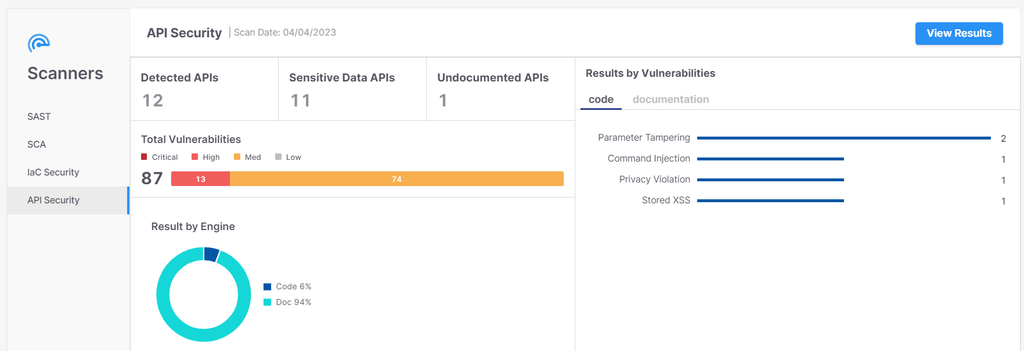
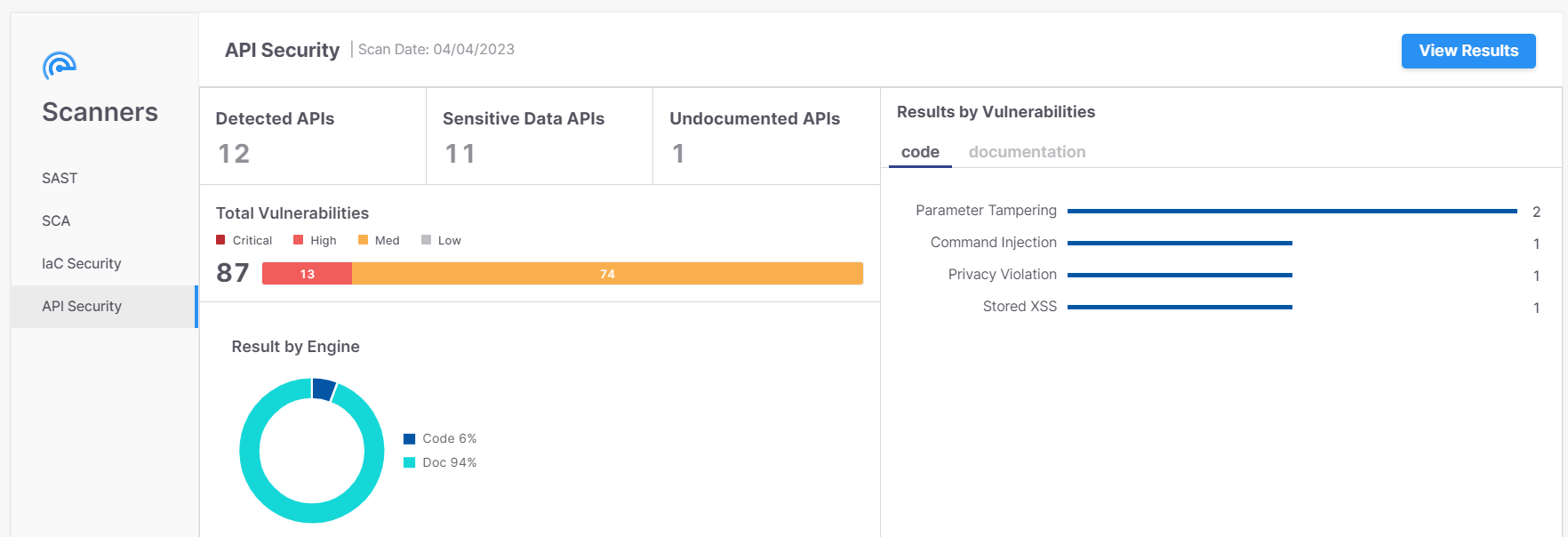
Source: Checkmarx
2. StackHawk

Best for: Teams mapping their API attack surface from source code
Strengths: Repository-based discovery with automatic OpenAPI spec generation
Things to consider: Scanning engine is built on ZAP with limited plugin support
StackHawk discovers APIs by connecting to source code repositories in GitHub, GitLab, Bitbucket, and Azure Repos. It analyzes each repository to identify endpoints and testable applications without deploying agents or scanning production systems.
The inventory updates with every commit and covers REST, GraphQL, gRPC, and WebSocket endpoints as well as serverless functions. Discovery output feeds directly into the platform’s runtime testing, so newly found endpoints can be scanned without manual configuration.
Key features include:
- Repository-based API discovery: Connects to major source control platforms and analyzes every repository to identify APIs, applications, and testable attack surface, with no agents and no production scanning required.
- Multi-protocol endpoint detection: Identifies REST, GraphQL, gRPC, and WebSocket endpoints alongside serverless functions, so discovery is not restricted to conventional REST services.
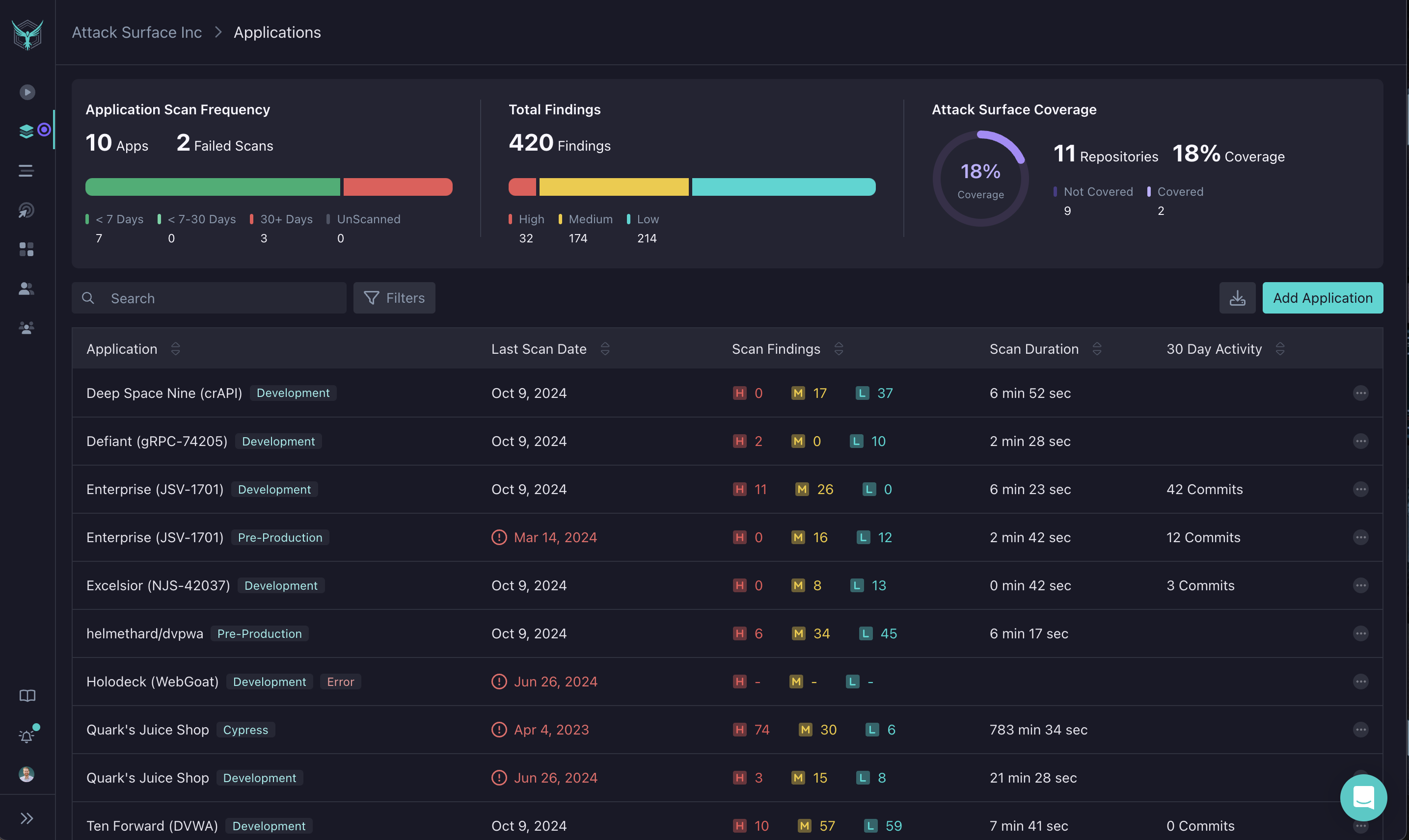
- Sensitive data identification in code: Flags repositories whose code handles PII, PCI, or HIPAA data types, allowing the attack surface view to be filtered and prioritized by data exposure.
- Change velocity insights: Surfaces commit activity per repository and distinguishes testable applications from documentation repos, libraries, and infrastructure code.
- Automatic OpenAPI spec generation: Generates API specifications from source code and refreshes them as the code changes, removing the need for developers to write and maintain specs by hand.
- Continuous inventory updates: Reanalyzes connected repositories on an ongoing basis so newly added or modified endpoints appear in the attack surface view without reconfiguration.
Limitations (as reported by users on G2):
- Scanning engine based on ZAP: Users note that the core scanner is the open source ZAP engine without added checks, and that custom plugins cannot be introduced.
- Configuration held in YAML: Reviewers report that most scan configuration is handled in a YAML file rather than the portal, with limited settings exposed in the interface.
- Container requirement: Some users describe managing the Docker container as overhead and note it fits less well with applications that are not containerized.
- Detail in vulnerability descriptions: Reviewers ask for deeper descriptions and more remediation examples to shorten debugging time.
- Coverage gaps in some areas: Users mention limited findings for GraphQL and less comprehensive scanning of frontend applications.
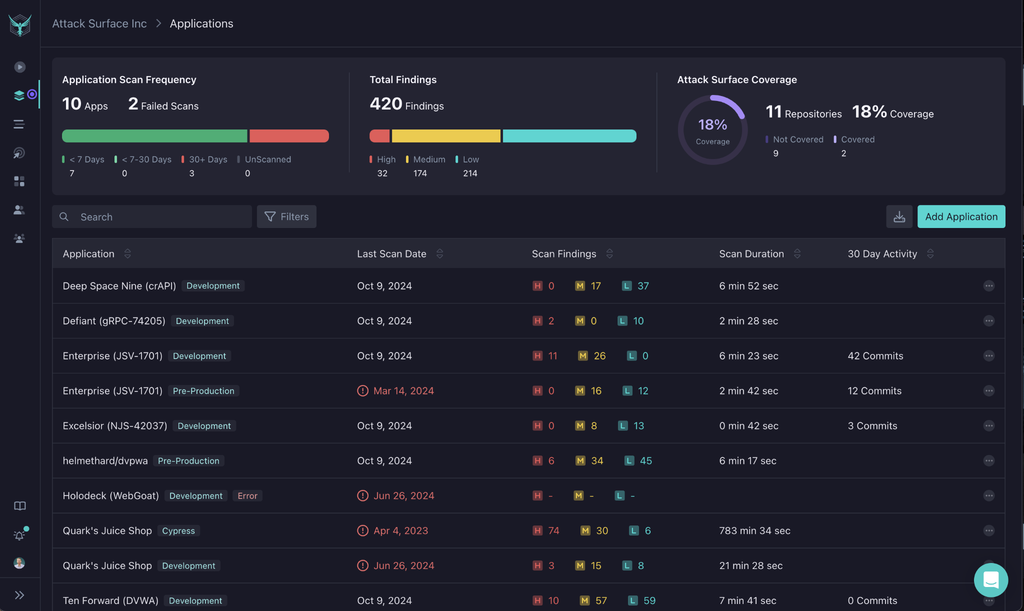
Source: StackHawk
3. Invicti

Best for: Security teams combining code, gateway, and traffic discovery
Strengths: Four discovery layers feeding an automated DAST testing pipeline
Things to consider: Full scans of large applications can run for extended periods
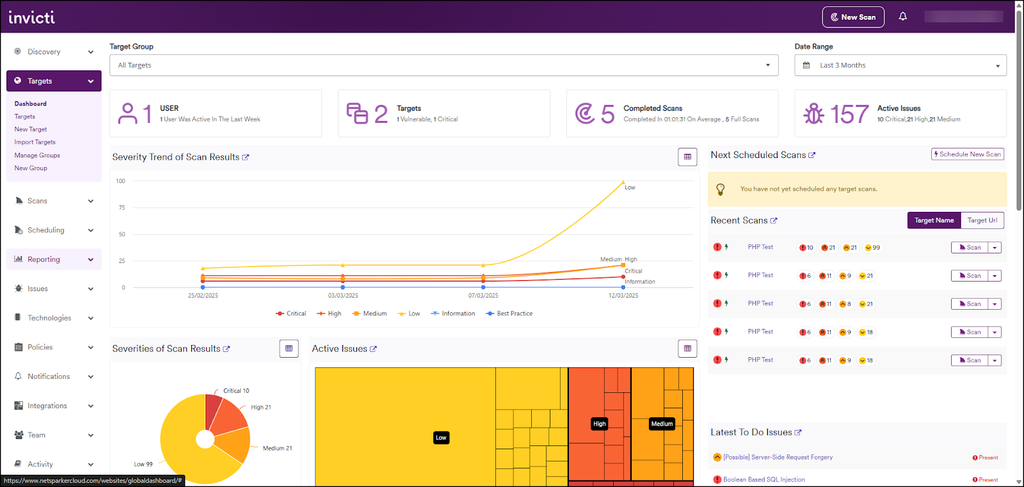
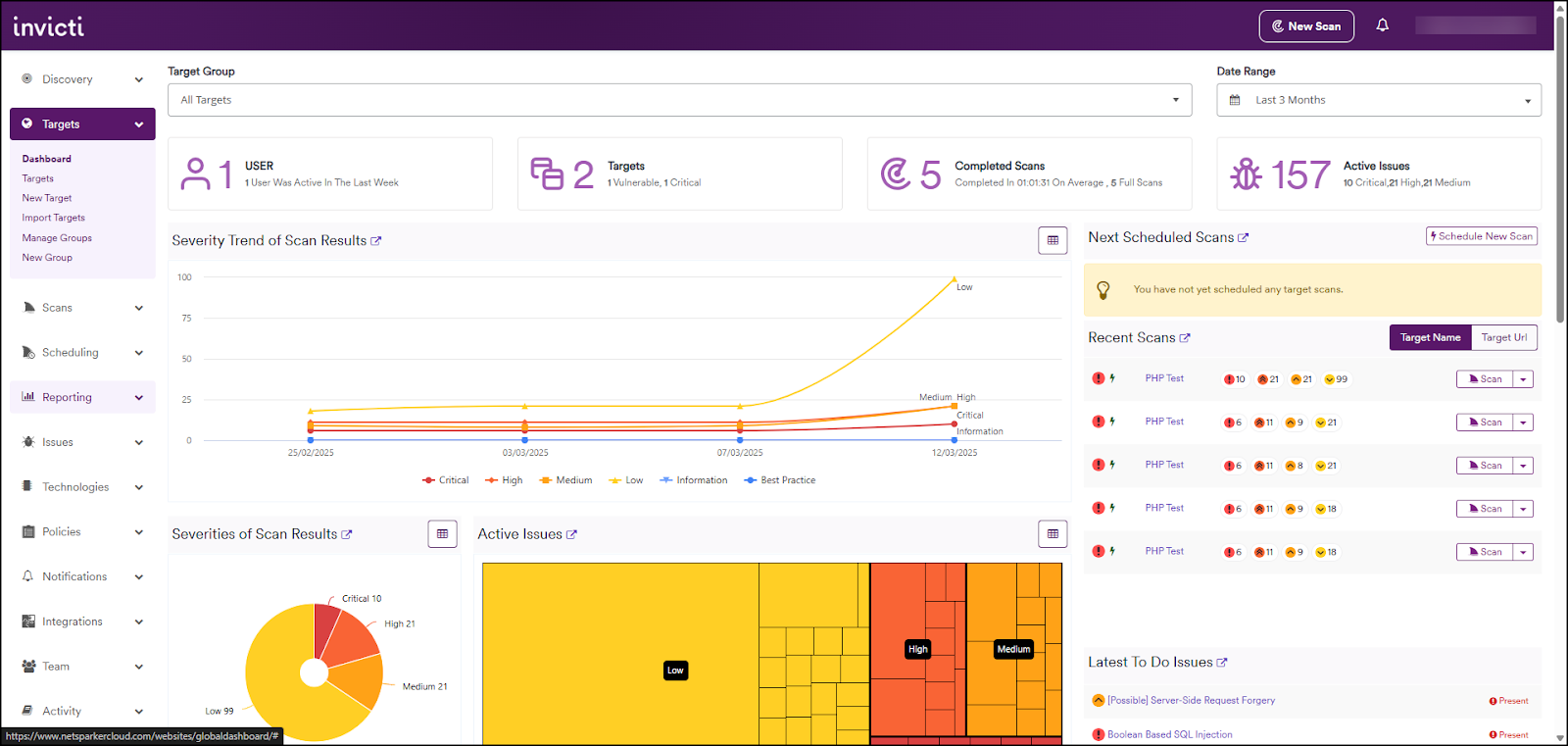
Invicti approaches API discovery through four layers that are correlated into a single inventory. It mines source code repositories, extracts endpoints observed during web application scans, pulls definitions from API gateways, and analyzes network traffic.
Because the platform reconstructs schemas where documentation is missing, discovered APIs can be scanned without developers supplying specifications, tokens, or endpoint lists. Each API is then passed to the DAST engine for vulnerability testing.
Key features include:
- Source code repository mining: Connects to GitHub, GitLab, and Bitbucket to identify endpoints defined in code, locate specification files, and generate schemas where documentation is absent.
- Discovery during application scans: Crawls web applications with the DAST engine, observes the API calls the interface makes, and extracts those endpoints into the inventory automatically.
- API gateway integrations: Retrieves endpoints, schemas, and documentation from Kong, Apigee, AWS API Gateway, and Azure API Management to capture APIs already deployed in the infrastructure.
- Network traffic analysis: Observes requests and responses across F5, NGINX, Cloudflare, and Kubernetes environments to identify active endpoints and reconstruct their structures.
- Automatic schema reconstruction: Extracts or rebuilds API schemas from the discovery sources so testing can begin without manually uploaded OpenAPI or Swagger files.
- Authenticated API testing: Detects common authentication mechanisms including tokens, cookies, and OAuth, and uses them to test endpoints that sit behind authentication.
- Broad API type coverage: Discovers REST, GraphQL, mobile backend, service-to-service, headless, and undocumented shadow APIs across the environment.
Limitations (as reported by users on PeerSpot):
- Scan performance on large applications: Reviewers report that full scans can run for extended periods, with some describing multi-day scans on larger sites.
- Licensing model and cost: Users note that licensing is tied to the number of FQDNs and becomes expensive as the number of scanned targets grows.
- Reporting depth: Several reviewers ask for portfolio-level and enterprise-level reporting rather than repository-level detail.
- Interface and documentation: Some users describe the interface as cluttered and request more thorough documentation and support material.
Source: Invicti
Runtime and Traffic-Based API Security Platforms
4. Salt Security

Best for: Enterprises building a continuous inventory from live API traffic
Strengths: Continuous discovery with risk scoring and posture governance
Things to consider: Implementation can be complex in non-standard environments
Salt Security discovers internal, external, and third-party APIs continuously and without relying on gateway registration or OpenAPI documentation. The platform captures details for each endpoint, including parameters, usage patterns, risk scores, and where sensitive data resides.
Discovery output feeds a posture governance engine that turns inventory insights into policies. The platform separately tracks shadow and zombie APIs, and compares what it finds against existing documentation so specifications can be kept current.
Key features include:
- Continuous multi-source discovery: Identifies internal, external, and third-party APIs on an ongoing basis, including endpoints absent from API gateways and from OpenAPI specifications.
- Endpoint-level risk detail: Records parameters, usage patterns, authentication methods, risk scores, and sensitive data exposure for each discovered API to support attack surface assessment.
- Shadow and zombie API identification: Separates deprecated, unknown, and undocumented endpoints from the known inventory and flags where they expose personal or regulated data.
- Posture governance engine: Converts discovery findings into customizable posture policies that define acceptable API behavior and access controls across the estate.
- Compliance mapping: Assesses discovered APIs against GDPR, HIPAA, and PCI DSS requirements as part of the risk evaluation process.
- Documentation drift checks: Compares the discovered inventory against current documentation so gaps between what is documented and what is running remain visible.
- Modular platform components: Salt Surface maps external exposure, Salt Connect pulls APIs from cloud accounts, Salt Collect analyzes live traffic, and Salt Protect handles runtime blocking.
Limitations (as reported by users on PeerSpot):
- Implementation complexity: Reviewers describe implementations as lengthy, particularly where the environment differs from standard deployment patterns.
- Learning curve: Users report a ramp-up period before teams are comfortable working through the API data in depth.
- Cost of expanding coverage: One reviewer notes that the initial setup cost was acceptable but that adding further APIs proved expensive.
- Alert tuning effort: Reviewers mention that tuning alerts takes time in high-volume environments and that some findings require internal validation before action.
- Fit for smaller environments: Users indicate the platform suits large estates better than smaller deployments.
5. Akamai API Security

Best for: Large multi-cloud estates needing vendor-neutral API visibility
Strengths: Discovery across traffic, code, specs, gateways, and external exposure
Things to consider: Policy tuning and configuration take time to get right
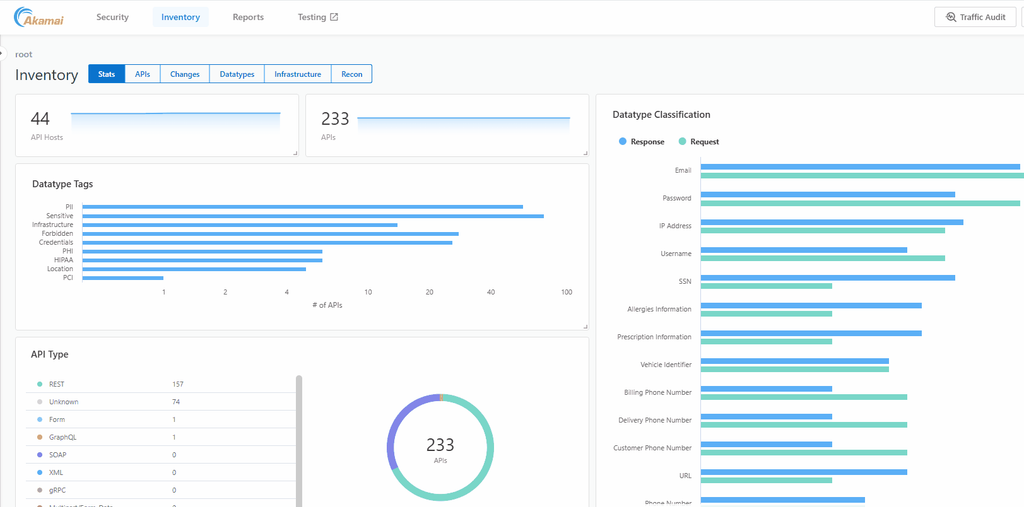
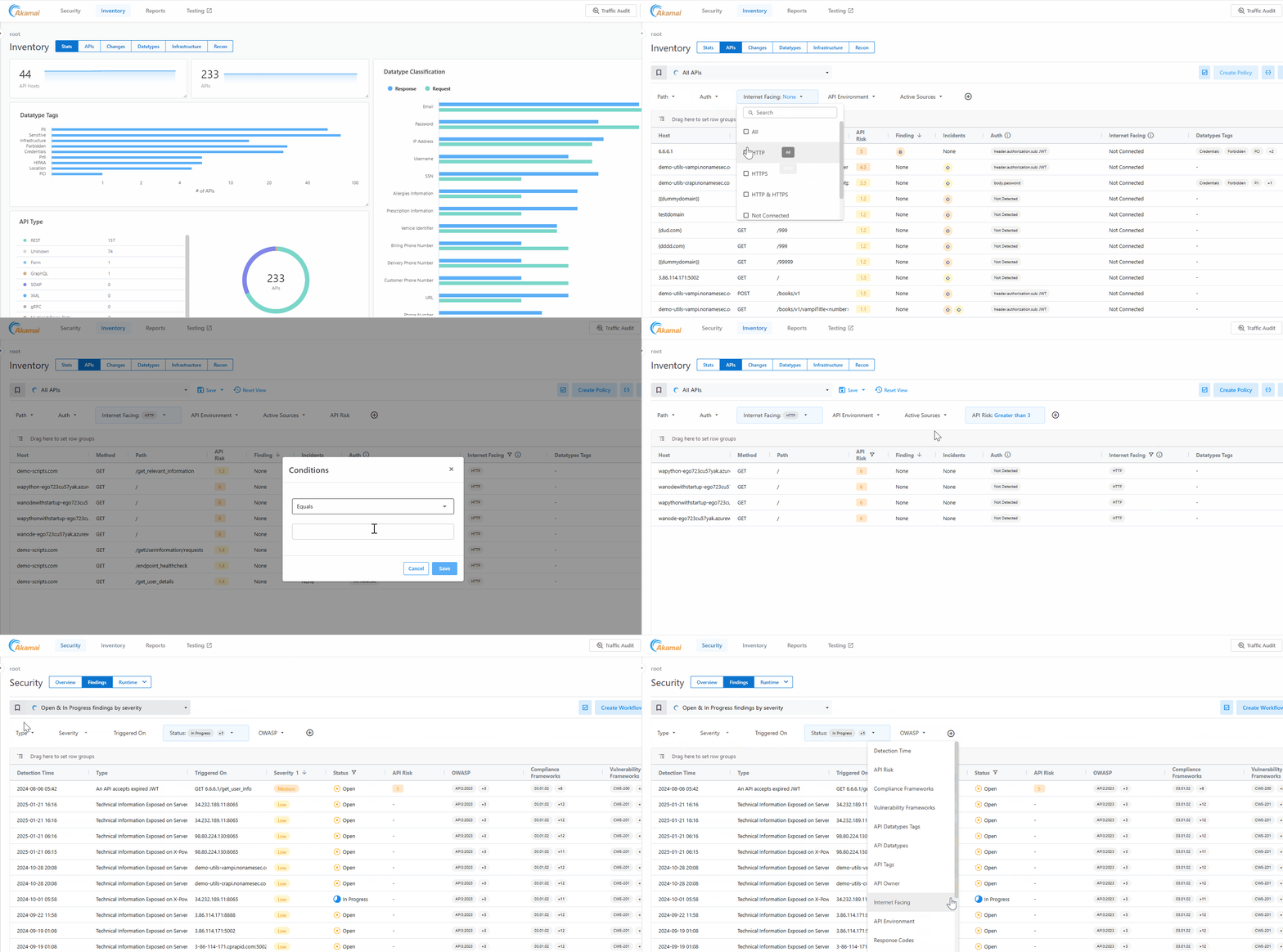
Akamai API Security, built on the technology Akamai acquired with Noname Security, discovers APIs across runtime traffic, code repositories, specifications, gateways, cloud environments, and external exposure points. The product is vendor neutral and does not require other Akamai services.
Discovered endpoints are assessed for posture, sensitive data exposure, and compliance gaps, and findings are mapped back to owners and code context. The platform also identifies APIs connected to GenAI applications, LLM services, and MCP servers.
Key features include:
- Multi-source API discovery: Builds a continuously updated inventory from traffic, code, specifications, gateways, cloud environments, and external exposure points, covering shadow, zombie, and unmanaged endpoints.
- AI-linked API identification: Detects and tags APIs connected to GenAI applications, LLM services, AI workflows, and MCP servers so those endpoints are governed alongside the rest of the estate.
- Posture assessment and prioritization: Evaluates API posture, sensitive data exposure, compliance gaps, and runtime behavior to rank which endpoints carry the highest risk.
- Compliance framework mapping: Maps findings to OWASP API Security Top 10, PCI DSS, HIPAA, ISO 27001, GDPR, HITRUST, and NIST, and tracks posture gaps and remediation progress over time.
- Code-to-runtime mapping: Links discovered APIs to owners, repositories, file paths, and last committers where that context is available, so findings reach the right team.
- Runtime behavioral analysis: Analyzes API activity to detect abnormal usage, business logic abuse, data scraping, tampering, and sensitive data exposure.
- Pre-release testing: Runs over 200 dynamic tests inside CI/CD and pre-production workflows, including tests aligned to the OWASP API Security Top 10.
Limitations (as reported by users on PeerSpot):
- Policy tuning complexity: Reviewers ask for simplified policy tuning and configuration, describing the current process as involved.
- Adoption timeline: Users report that learning and configuring the platform takes time before it becomes fully productive.
- Pricing: Several reviewers place the product at the higher end of the market, particularly when it is bundled with content delivery services.
- Support consistency: One reviewer notes that back-end changes to the SaaS platform are not always communicated in advance, which has caused incidents.
- Integration breadth: Users request deeper integration with API gateways and with SIEM and SOAR platforms for automated incident response.
Source: Akamai
6. Wallarm

Best for: Runtime API inventory built from observed production traffic
Strengths: Traffic-derived specs, sensitive data tracking, and drift alerts
Things to consider: Configuration and tuning take time for teams new to the tool
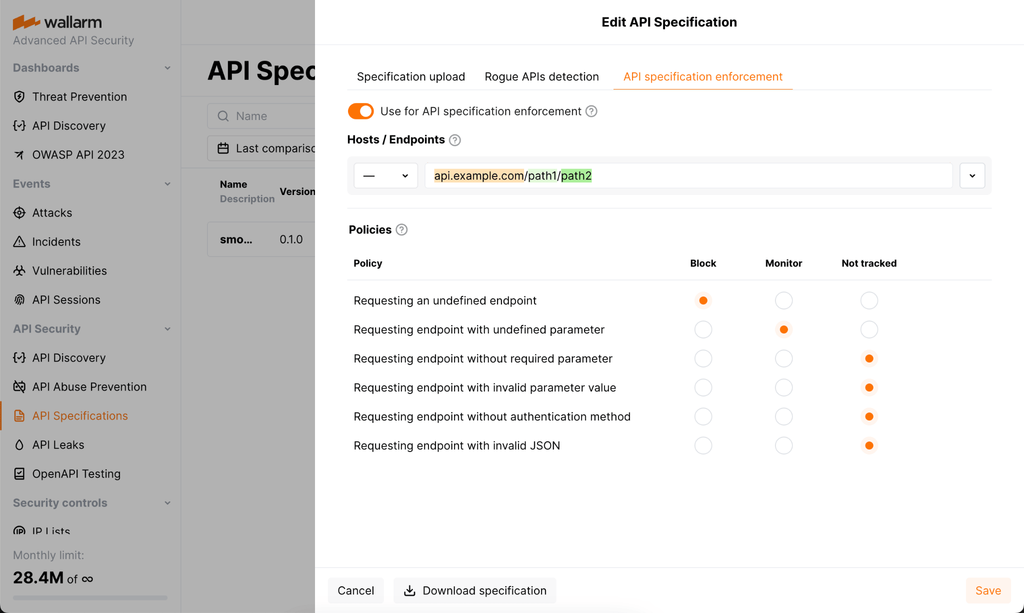
Wallarm API Discovery builds a runtime view of the API portfolio from observed traffic rather than from documentation. It inventories endpoints, tracks how they change, and highlights the ones that carry risk based on real usage and any OpenAPI specifications available.
The module distinguishes public-facing from internal assets and new from legacy endpoints, which allows security effort to be concentrated where it matters. It also covers AI-related endpoints reached through direct API calls, AI proxies, and AI agents.
Key features include:
- Runtime portfolio discovery: Identifies APIs from actual user traffic, covering shadow, zombie, rogue, deprecated, and legacy endpoints alongside documented services.
- AI endpoint detection: Discovers AI-related endpoints across direct API calls, AI proxies, and AI agents, and includes GenAI applications in the inventory.
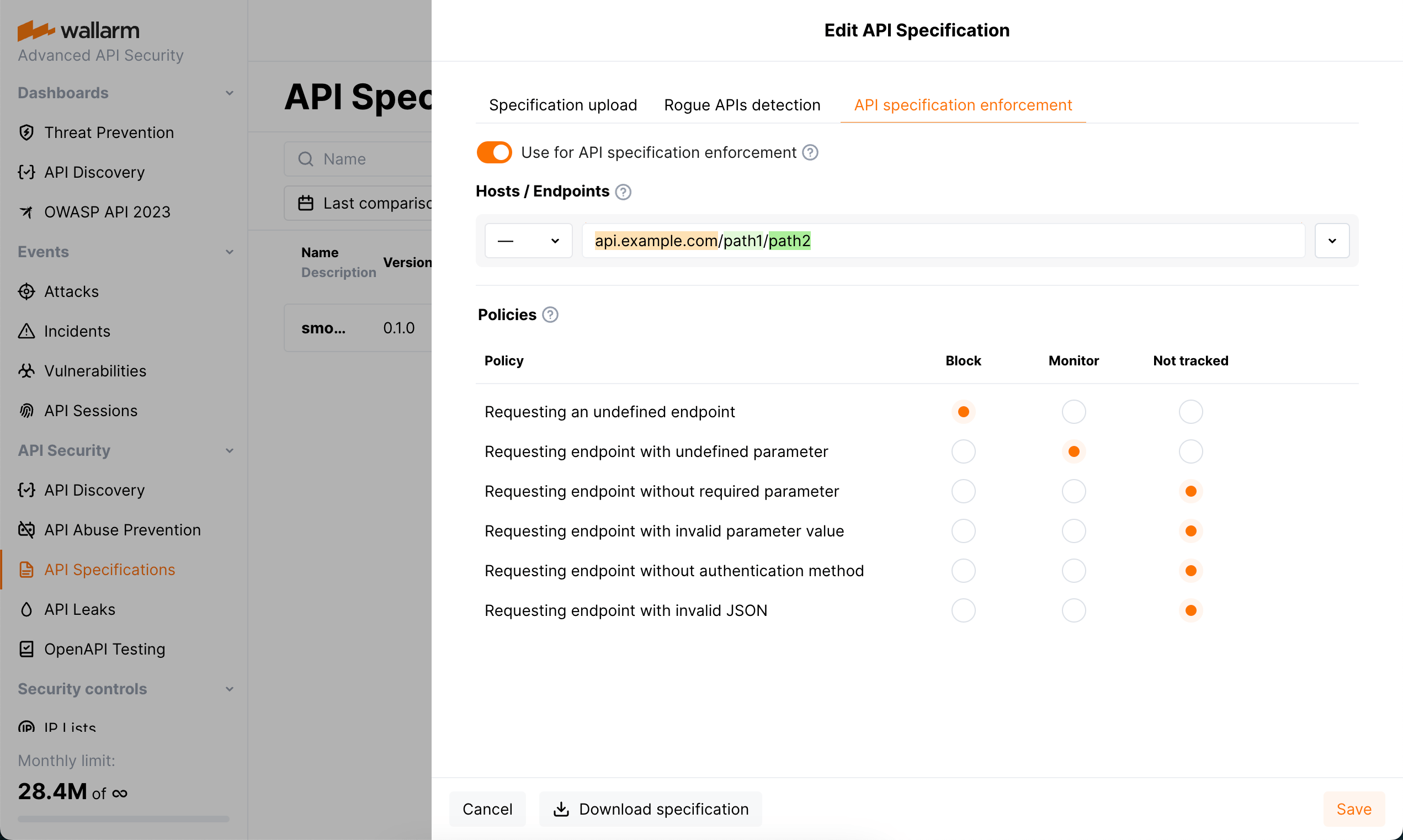
- Specification generation and comparison: Builds OpenAPI and Swagger specifications from observed traffic and compares actual endpoint behavior against the planned definition.
- Sensitive data tracking: Detects PII, financial and health data, credentials, tokens, and API keys passing through endpoints for compliance and exposure assessment.
- API segmentation: Differentiates public-facing from internal assets and new from older endpoints so security programs can be tailored per segment.
- Business flow tagging: Automatically identifies and tags endpoints belonging to critical business flows such as billing, authentication, and AI.
- Change and drift monitoring: Alerts when new APIs appear or existing ones change, and surfaces threats such as newly published CVEs and CWEs affecting the inventory.
Limitations (as reported by users on G2):
- Configuration effort: Reviewers describe configuration and tuning as complex and time-consuming, particularly for teams without prior experience.
- False positive management: Users report a period of rule building to reduce false positives before switching to full blocking mode.
- Pricing transparency: Some reviewers note that pricing is not disclosed during the free trial, and that cost scales with request volume.
- Documentation depth: Several users ask for more best practice guidance and configuration examples in the documentation.
- Deployment across environments: Reviewers mention that installing modules across different operating systems and web server versions can require extra work.
Source: Wallarm
7. Cequence Security

Best for: Combining external attack surface and runtime API discovery
Strengths: Attacker-view discovery plus runtime inventory with risk scoring
Things to consider: Initial setup and policy tuning need networking expertise
Cequence approaches discovery from two directions. Attack surface discovery probes public-facing resources from the outside to find external API hosts and unauthorized hosting providers, while runtime discovery identifies endpoints from live traffic.
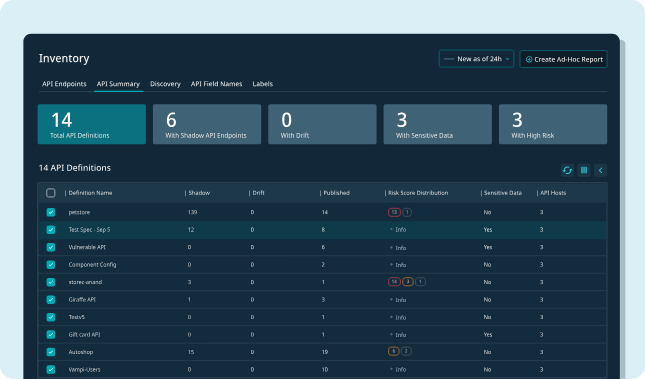
Discovered APIs are inventoried and assessed for risk relating to access control, sensitive data leakage, and conformance with the published specification. Where specifications are missing, the platform generates them automatically.
Key features include:
- External attack surface discovery: Probes public-facing resources from an attacker’s perspective to identify external API hosts, unauthorized hosting providers, and API-specific security issues.
- Runtime API discovery: Identifies documented, undocumented, third-party, and shadow endpoints from live traffic to build a runtime API catalog.
- API risk prioritization: Assesses each discovered API for access control weaknesses, sensitive data leakage, and compliance with the published API specification.
- Automatic specification generation: Creates API specifications where none exist, so endpoints can be tested and governed without waiting on development teams.
- Specification drift detection: Flags endpoints whose observed characteristics deviate from the definition they are supposed to follow.
- Inventory scope classification: Records whether each API is internal, external, or third-party, along with data sensitivity, hosts, endpoints, and data flows between components.
- Native threat prevention: Applies bot detection to block scraping and automated abuse against discovered endpoints without handing findings to a separate protection tool.
Limitations (as reported by users on G2):
- Initial setup and tuning: Reviewers describe onboarding large or complex environments as time-consuming, with a baseline of networking and DNS knowledge required.
- Learning curve: Users report that analytics and policy configuration take time to understand, and ask for simplified workflows and documentation.
- Dashboard performance: Several reviewers note lag when running large data queries, which slows investigation work.
- Alert noise: Users mention false positives that require additional tuning to keep traffic management clean.
- Reporting customization: Reviewers say that tailoring dashboards and executive summary reports takes extra effort.
Source: Cequence

8. Harness API Discovery (formerly Traceable)

Best for: Discovering east-west APIs across distributed microservices
Strengths: eBPF and gateway-based discovery with sensitive data classification
Things to consider: Some reporting and query saving functions remain limited
Harness acquired Traceable in 2025 and now offers its API discovery capability as part of the Harness web application and API protection portfolio. The module builds a continuously updated catalog of internal and external APIs across all environments.
Discovery works at the edge, in line with API gateway integrations, and through eBPF agents deployed to distributed workloads. Each endpoint is analyzed for the data it handles, and sensitive data is classified so controls can be matched to actual exposure.
Key features include:
- Continuous API cataloging: Maintains a data-rich inventory of first-party and third-party APIs across all environments to support audit readiness and API governance.
- Distributed discovery methods: Identifies APIs at the edge, in line with API gateway integrations, and through eBPF agents placed in distributed workloads.
- Shadow and zombie API detection: Surfaces unknown and abandoned endpoints that result from rapid prototyping, acquisitions, and missing documentation.
- Sensitive data classification: Analyzes API data flows to identify what data each endpoint handles and classifies which sensitive data is exposed.
- Policy violation categorization: Categorizes findings against OWASP API Security Top 10 risks, industry standards, and regulations including GDPR, HIPAA, and PCI DSS.
- Automated risk prioritization: Ranks API issues by risk severity, exposure, and business impact rather than presenting findings as a flat list.
- Access control gap identification: Uses data flow analysis to flag endpoints that handle sensitive data where authentication or authorization is lacking.
- Remediation workflow integration: Connects to Harness IDP, Jira, and ServiceNow so findings can be tracked through to resolution.
Limitations (as reported by users on G2):
- Feature completeness: Reviewers note that the breadth of configuration options is wide but that several areas are not yet fully developed.
- Saved queries and views: Users ask for the ability to save queries, views, and filters, and for the interface to retain layout preferences.
- False positive removal: Several reviewers describe removing false positives as difficult, which complicates threat management.
- Documentation: Users report that documentation is thin for complex deployments and integrations, requiring additional vendor support.
- Reporting and historical data: Reviewers ask for better reporting functionality and improved access to historical data.
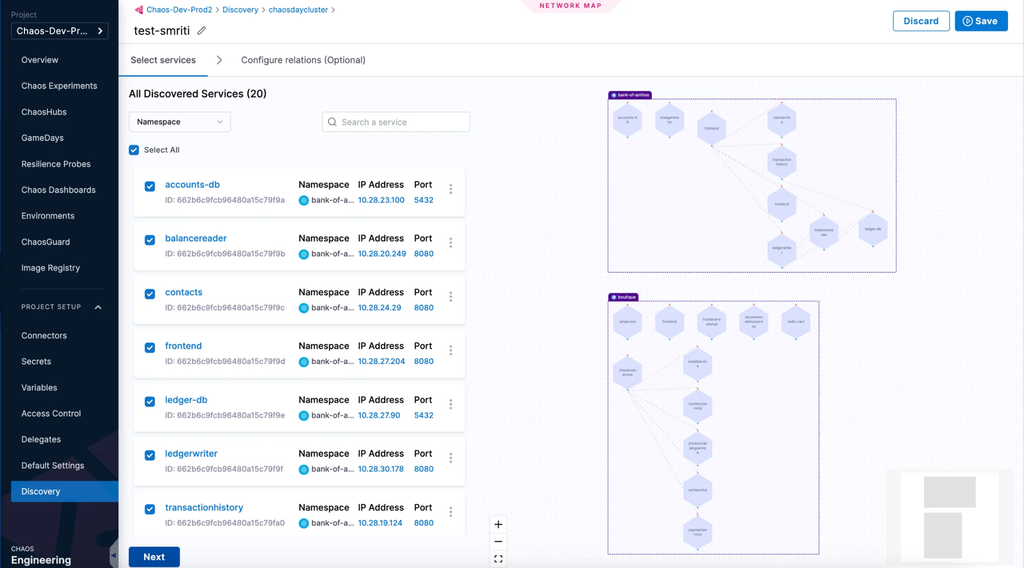
Source: Harness

How to Choose Automated API Discovery and Risk Classification Providers
Consider the following when choosing an automated API discovery and risk classification provider:
- Discovery coverage: Evaluate where the solution discovers APIs. Look for coverage across source code, API documentation, and dynamic testing rather than relying exclusively on gateways or observed network traffic. Source-level discovery can expose undocumented shadow APIs and abandoned zombie APIs that may otherwise remain invisible.
- Continuous, centralized inventory: Choose a provider that maintains an automatically updated inventory as APIs are created or modified. The inventory should make it easy to see endpoints across applications and projects, including when an API was discovered or last changed.
- Shadow and zombie API identification: Verify that the solution can compare APIs detected in code with API specifications or documentation to highlight undocumented, obsolete, or unexpected endpoints. Simply cataloging documented APIs leaves important portions of the attack surface unaddressed.
- Risk context and prioritization: Discovery should connect directly to security findings. Look for solutions that prioritize API vulnerabilities according to factors such as sensitive data, authentication status, exposure, exploitability, and overall business risk so teams can focus remediation efforts where they have the greatest impact.
- Sensitive data and authentication visibility: A useful inventory should show more than endpoint names. Providers should help identify APIs that process sensitive information and flag endpoints with missing or inadequate authentication, since these factors materially change the consequences of a vulnerability.
- Specification-to-code comparison: Look for automatic analysis of formats such as OpenAPI, Swagger, or Postman collections and comparison with APIs actually detected in applications. This can expose undocumented endpoints, documentation gaps, and discrepancies between intended and implemented API behavior.
- Static and dynamic security correlation: Consider whether the provider can combine findings from development-time analysis with dynamic testing. Correlating static API findings with runtime test results can help validate which vulnerabilities are exploitable and improve remediation prioritization.
- Early integration into the SDLC: Favor solutions that discover and assess APIs as developers commit or scan code rather than waiting until production. Earlier detection gives development teams an opportunity to address undocumented APIs, vulnerabilities, and configuration problems before release.
- Lifecycle and change tracking: APIs change frequently, so point-in-time discovery is not enough. Capabilities that track API changes over time can help teams determine when an endpoint or associated risk was introduced and provide developers with better context for remediation.
- Developer and AppSec workflow integration: Finally, assess how well API findings fit into the organization’s broader application security program. A provider that connects API discovery, vulnerability information, prioritization, and remediation within existing development workflows can reduce tool fragmentation and make it easier for security and engineering teams to act on findings consistently.
Conclusion
Combining automated API discovery with continuous risk classification allows organizations to maintain complete visibility over their evolving attack surface. By automatically identifying undocumented endpoints and prioritizing risks based on exposure and data sensitivity, security teams can focus their remediation efforts where they matter most. This proactive approach eliminates blind spots, strengthens compliance, and ensures robust API security across dynamic enterprise environments.