
Summary
Snyk Code is a static application security testing (SAST) solution that identifies vulnerabilities in source code through analysis, IDE integrations, pull request checks, and CI/CD automation. It helps teams find and remediate security issues early, but organizations should also evaluate its governance, scalability, and broader application security coverage when comparing alternatives.
What Is Snyk Code?
Snyk Code is a static application security testing (SAST) tool that helps developers identify and fix security vulnerabilities in their source code. Unlike traditional SAST tools that can be slow and cumbersome, Snyk Code provides rapid feedback during development. It analyzes code in real time, giving developers insights as they write, review, or commit code. This early detection helps teams address issues before they reach production, reducing the risk of security breaches and saving time on remediation.
Snyk Code supports multiple programming languages and frameworks, making it suitable for diverse development environments. It integrates with integrated development environments (IDEs), source code management (SCM) systems, and CI/CD pipelines. By embedding security into the development workflow, Snyk Code allows developers to take ownership of code security and improve software quality.
Snyk Code is one component of the broader Snyk application security platform, which also includes products for software composition analysis (Snyk Open Source), container security (Snyk Container), infrastructure as code scanning (Snyk Infrastructure as Code), API security, and application risk management.
2. IDE Integrations
Snyk Code integrates with popular IDEs, enabling developers to identify and fix vulnerabilities during the coding process. Security findings appear within the editor, making it easier to address issues before code is committed or shared with other team members.
The IDE experience includes contextual explanations and remediation guidance for discovered vulnerabilities. Developers can review security details, understand the root cause of issues, and apply suggested fixes within their workflow, reducing context switching.
3. SCM and Pull Request Checks
The Snyk code checker function integrates with source code management platforms and scans repositories and pull requests. Each pull request can be evaluated for security issues, providing status reports that help teams assess, prioritize, and resolve vulnerabilities before changes are merged.
The tool delivers scan results within pull request workflows, allowing developers and reviewers to identify security concerns alongside code changes. This approach helps teams catch vulnerabilities early and maintain secure coding practices throughout the review process.
4. CI/CD Pipeline Integration
Snyk Code can be integrated into CI/CD pipelines to automate security testing as part of the software delivery process. Vulnerability scans and pull request checks can be included in build and deployment workflows, helping organizations enforce security requirements before code reaches production.
By embedding security controls into CI/CD processes, teams can evaluate code for vulnerabilities while maintaining development velocity. Automated scanning ensures that security assessments occur consistently across projects and releases.
5. Fix Recommendations and Remediation Guidance
Snyk improves code quality by providing remediation guidance for developers. When vulnerabilities are detected, the tool offers explanations that help users understand the issue, its potential impact, and how it can be resolved.
The platform also delivers fix recommendations based on a knowledge base of vulnerabilities and remediation techniques. For supported issues, developers can apply automatic fixes with a single click, reducing the effort required to resolve security findings and shortening remediation timelines.
How Snyk Code Fits Into Developer Workflows
Local Scanning
Snyk previously offered Snyk Code Local Engine (SCLE), a self-hosted deployment option for organizations with strict data residency requirements. As of 2026, Snyk has deprecated SCLE and is not onboarding new Local Engine deployments – new customers evaluating Snyk Code are directed to its standard cloud-based deployment options instead.
Configuration and Policy Controls
Before Snyk Code can analyze repositories, organizations must enable the feature, connect their source code management platform, and import the repositories they want to scan. This setup determines which repositories are analyzed and allows teams to apply scanning policies before code analysis begins.
How it works:
- Enable Snyk Code: An organization administrator activates Snyk Code in the organization’s settings within the Snyk web interface.
- Connect source repositories: Users authorize supported Git-based SCM platforms so Snyk can access repository contents for analysis.
- Import repositories: Only repositories imported after Snyk Code is enabled are analyzed, so previously imported repositories must be re-imported.
- Configure exclusions: Teams can exclude files or directories from analysis using a .snyk configuration file before importing repositories.
- Start code analysis: Imported repositories are scanned, with findings available through the Snyk platform, IDEs, CLI, APIs, and other integrations.
Managing Code Vulnerabilities Across IDE, SCM, and CI Workflows
The Snyk code checker tracks vulnerabilities throughout the development lifecycle by continuously analyzing repository snapshots and presenting findings through developer tools and the Snyk platform. Centralized project views and filtering capabilities help teams prioritize remediation and monitor security improvements over time.
How it works:
- Creates repository snapshots: Each scan analyzes the current repository state and consolidates findings into a single Code Analysis project.
- Organizes vulnerabilities: Findings can be grouped by file or vulnerability type to simplify investigation across large codebases.
- Prioritizes remediation: Teams can filter and sort issues by severity, priority score, status, language, or vulnerability category.
- Supports rescanning: Repositories can be retested manually or on a recurring schedule to identify newly introduced vulnerabilities.
- Maintains scan history: Previous scan results remain available for comparing snapshots and tracking remediation progress over time.
Who Is Snyk Code Best Suited For?
Snyk Code is designed for organizations that want to integrate static application security testing into everyday development. It is particularly well suited for teams that prioritize developer adoption, early vulnerability detection, and security workflows embedded across IDEs, repositories, pull requests, and CI/CD pipelines.
- Developer-first teams: Supports developers with security findings directly in IDEs, repositories, pull requests, and CI/CD workflows, making it easier to identify and remediate vulnerabilities without relying on late-stage security reviews.
- Teams prioritizing fast inline feedback: Provides real-time security checks during development, helping developers detect and fix vulnerabilities before code is merged while reducing remediation time and context switching.
- Organizations invested in the Snyk ecosystem: Extends existing Snyk deployments by adding source code analysis alongside dependency, container, and infrastructure security through the same integrations, workflows, and reporting.
- Teams embedding security into development workflows: Integrates code scanning across local development, pull requests, repositories, CLI, and CI/CD pipelines, enabling continuous security checks throughout the software development lifecycle.
Key Snyk Code Limitations
While Snyk Code is a respected solution, there are several important limitations to be aware of.
Areas Where Teams May Need Broader Platform Coverage
Snyk Code focuses on static analysis of source code, so teams may need additional coverage for risks outside custom code. Broader application security programs often require scanning across dependencies, containers, infrastructure as code, APIs, malicious packages, and runtime-related risks. These areas may require other tools or additional Snyk products rather than Snyk Code alone.
This matters when teams need a unified view of risk across the full application stack. If findings come from multiple engines or tools, security teams may need stronger correlation, prioritization, and reporting to understand which issues matter most. Without that broader context, developers can receive isolated findings that do not fully reflect application-level risk.
Scalability, Governance, and Enterprise Considerations
Snyk Code is strong in developer workflows, especially IDE and SCM-based scanning, but larger organizations may need to consider how those workflows are governed at scale. IDE scanning can be difficult to enforce consistently across many teams, tools, geographies, and repositories. Security teams also need ways to measure whether developers are using the tools, fixing issues, and meeting policy requirements.
Enterprise teams may also need robust reporting, role-based access control, policy enforcement, and metrics such as mean time to remediate. The source notes concerns around reporting, large enterprise complexity, scan result tracking, and governance when scans happen mainly in developer environments. These tradeoffs are important for organizations that need centralized oversight, auditability, and consistent security controls across many applications.
Cases Where Alternatives May Be a Better Fit
Alternatives may be a better fit when an organization needs deeper enterprise governance, broader language coverage, or stronger multi-engine correlation across SAST, SCA, supply chain security, IaC, API security, and container security. Teams with large or complex applications may also need more control over scan customization, presets, exclusions, and triage workflows.
Other tools may also be preferable when teams need advanced prioritization across exploitable paths, proactive malicious package detection, or application-level risk reporting across a broader set of security engines. Snyk Code focuses specifically on custom-code analysis; many teams require dependency, container security, IaC security, and API security correlated within the same AppSec platform, and in these cases, a consolidated solution reduces tool sprawl.
Organizations that specifically require an on-premises or self-hosted deployment should also note that Snyk has deprecated its local-engine option and is not onboarding new customers to it – a real constraint for teams with strict data-residency requirements.
However, if the main goal is a developer-friendly SAST workflow, Snyk Code can be a good fit.

Need coverage beyond custom code?
Checkmarx One Application Security Platform
The unified AI-powered application security platform – every surface, one correlated risk view.
How to Choose Snyk Code Alternatives
When evaluating alternatives, organizations should look beyond basic vulnerability detection and assess how well a solution fits their development processes, technology stack, and security requirements. The goal is to find a tool that delivers accurate results, supports the languages and frameworks used by the organization, and integrates into existing workflows without creating excessive noise for developers.
Key considerations include:
- Detection accuracy and false positive rates: Evaluate how accurately the tool identifies vulnerabilities. High false-positive rates can create alert fatigue and reduce developer trust in scan results.
- Programming language and framework coverage: Ensure the solution supports the languages, frameworks, and technologies used across the organization.
- Quality of remediation guidance: Look for tools that provide clear explanations and fix recommendations that help teams resolve issues.
- Developer workflow integration: Consider support for IDEs, source code management platforms, pull requests, and CI/CD pipelines.
- Scalability for large environments: Assess whether the platform can handle large codebases, numerous repositories, and growing development teams.
- Support for AI-generated code: Verify that the solution can analyze and secure AI-generated code alongside manually written code.
- Flexible deployment options: Organizations with strict compliance or data residency requirements may need self-hosted or hybrid deployment models in addition to cloud-based offerings.
- Signal-to-noise ratio: Evaluate how well the tool prioritizes findings and reduces unnecessary alerts.
- Application security platform capabilities: Consider whether the solution is limited to SAST or includes capabilities such as software composition analysis (SCA), dynamic testing (DAST), infrastructure-as-code scanning, API security, or container security.
- Reporting and visibility: Review dashboards, reporting capabilities, historical tracking, and filtering options.
- Total cost of ownership: Compare licensing models, infrastructure requirements, implementation effort, and long-term operational costs.
- Vendor support and services: Evaluate the quality of technical support, training resources, onboarding assistance, and professional services.
Related content: Read our guide to Snyk alternatives
Conclusion
Snyk Code is a strong option for organizations looking to embed static application security testing directly into developer workflows. Its real-time feedback, IDE integrations, and support for pull request and CI/CD scanning help teams identify and remediate vulnerabilities early in the software development lifecycle.
However, the right choice depends on factors beyond developer experience, including programming language support, deployment requirements, governance capabilities, reporting, and the level of application security coverage needed across the organization. Teams should evaluate whether a solution aligns with both their current workflows and their long-term security strategy.
Checkmarx AI SAST: A Platform Alternative to Snyk Code
For larger organizations with complex application portfolios, holistic application security platforms such as Checkmarx One may be a better fit than Snyk. In addition to static code analysis, Checkmarx provides integrated capabilities for software composition analysis, API security, infrastructure as code scanning, container security, and supply chain security. This broader platform approach enables security teams to correlate findings across multiple testing methods, enforce consistent policies, and prioritize risk across a large portfolio of applications and multiple development teams.
Checkmarx’s software composition analysis (SCA) capability also includes proactive malicious package protection from its dedicated security research team, which often identifies compromised open-source packages before they appear in public vulnerability feeds.
Checkmarx NG SAST is the next-generation static application security testing engine at the heart of the Checkmarx One platform. It runs a deterministic rules-based engine and an LLM-based engine concurrently, then applies a Findings Analysis Engine to filter out low-confidence results, reducing the false-positive noise that’s one of the most common frustrations with traditional SAST tools, while extending detection to AI-generated code.
Integrated deeply into IDEs, CI/CD pipelines, and ASPM, Checkmarx SAST supports inner, middle, and outer loop Agentic AI use cases so enterprises can scale secure coding without sacrificing velocity. This industry-leading tool (named a Leader in The Forrester Wave™: Static Application Security Testing, Q3 2025) is a core component of the Checkmarx One platform.
Key features include:
- Detect vulnerabilities at the code level: Identify security flaws such as injection, XSS, insecure auth, and data exposure across languages and frameworks.
- Shift security left into developer workflows: Run fast SAST checks in the IDE and CI so issues are caught before merge or release.
- Support compliance and secure SDLC requirements: Provide evidence of secure coding practices for regulators, auditors, and customers.
- Accelerate remediation with AI-driven guidance: Help developers understand and fix issues quickly using Checkmarx Agentic AI assistants.
- Customize detection with CxQL: Write and tailor custom queries across 35+ core languages to match your organization’s specific risk profile and coding standards, rather than relying only on out-of-the-box rules.
Learn more about Checkmarx AI SAST
AI SAST: Checkmarx One Platform Alternative to Snyk Code
For larger organizations with complex application portfolios, holistic application security platforms such as Checkmarx One may be a better fit than Snyk. In addition to static code analysis, Checkmarx provides integrated capabilities for software composition analysis, API security, infrastructure as code scanning, container security, and supply chain security. This broader platform approach enables security teams to correlate findings across multiple testing methods, enforce consistent policies, and prioritize risk across a large portfolio of applications and multiple development teams.
Checkmarx’s software composition analysis (SCA) capability also includes proactive malicious package protection from its dedicated security research team, which often identifies compromised open-source packages before they appear in public vulnerability feeds.
Checkmarx NG SAST is the next-generation static application security testing engine at the heart of the Checkmarx One platform. It runs a deterministic rules-based engine and an LLM-based engine concurrently, then applies a Findings Analysis Engine to filter out low-confidence results, reducing the false-positive noise that’s one of the most common frustrations with traditional SAST tools, while extending detection to AI-generated code.
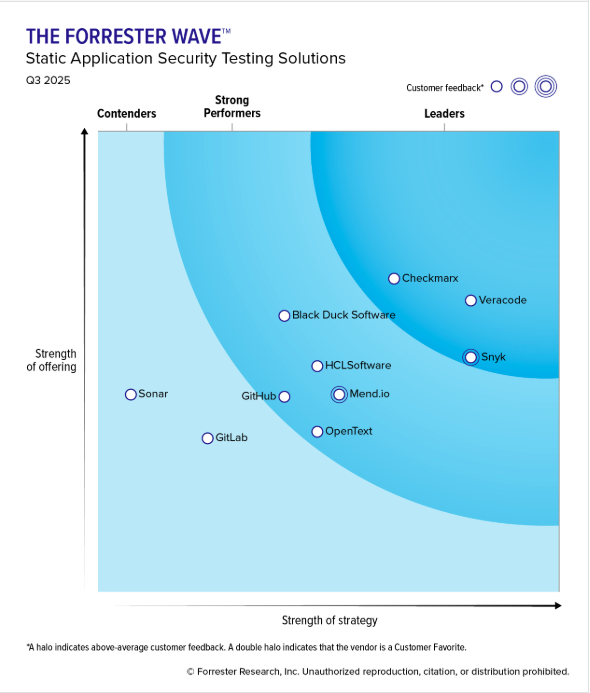
Integrated deeply into IDEs, CI/CD pipelines, and ASPM, Checkmarx SAST supports inner, middle, and outer loop Agentic AI use cases so enterprises can scale secure coding without sacrificing velocity. This industry-leading tool (named a Leader in The Forrester Wave™: Static Application Security Testing, Q3 2025) is a core component of the Checkmarx One platform.
Key features include:
- Detect vulnerabilities at the code level: Identify security flaws such as injection, XSS, insecure auth, and data exposure across languages and frameworks.
- Shift security left into developer workflows: Run fast SAST checks in the IDE and CI so issues are caught before merge or release.
- Support compliance and secure SDLC requirements: Provide evidence of secure coding practices for regulators, auditors, and customers.
- Accelerate remediation with AI-driven guidance: Help developers understand and fix issues quickly using Checkmarx Agentic AI assistants.
- Customize detection with CxQL: Write and tailor custom queries across 35+ core languages to match your organization’s specific risk profile and coding standards, rather than relying only on out-of-the-box rules.
Learn more about Checkmarx AI SAST