
Summary
Automated risk correlation connects development and cloud findings so teams can see which weaknesses combine into a real attack path. Checkmarx One ASPM is best for code-to-cloud AppSec correlation, Apiiro for graph-based risk context, Wiz for cloud attack path analysis, and Orca Security for agentless correlation across the SDLC.
Top 8 Vendors Offering Risk Correlation Across Dev and Cloud
TL;DR: Automated risk correlation connects development and cloud findings so teams can see which weaknesses combine into a real attack path. Checkmarx One ASPM is best for code-to-cloud AppSec correlation, Apiiro for graph-based risk context, Wiz for cloud attack path analysis, and Orca Security for agentless correlation across the SDLC.
What Is Automated Risk Correlation and Why Is It Important to Correlate Across Dev and Cloud?
Automated risk correlation is the process of connecting security findings from development pipelines, source code, cloud infrastructure, identities, and runtime environments. Instead of treating each vulnerability or misconfiguration as an isolated issue, correlation identifies relationships between them. This provides context about how an attacker could combine multiple weaknesses to reach sensitive systems or data.
Two main types of security platforms perform automated risk correlation across development and cloud environments. Application security posture management (ASPM) platforms focus on consolidating findings from application security tools and linking them to repositories, developers, pipelines, and deployed workloads. Cloud-native application protection platforms (CNAPPs) approach correlation from the cloud side, combining vulnerabilities with cloud configurations, identities, network exposure, workloads, and data.
Correlating development and cloud environments closes the gap between where security issues are introduced and where they create risk. Development data shows the vulnerable code, dependency, or configuration and who owns it, while cloud data shows whether it reaches production, is exposed, and can access sensitive resources. Connecting these views helps teams prioritize issues based on deployed impact and route fixes to the code or configuration that caused them.
How automated risk correlation works:
- Collecting security findings across tools: Automated correlation ingests findings and metadata from development, cloud, identity, runtime, and security tools.
- Normalizing risk data: Vulnerabilities, misconfigurations, secrets, permissions, exposures, and asset identifiers are standardized into a common model.
- Mapping software to cloud assets: Repositories, commits, builds, images, and deployed workloads are linked using metadata such as digests, labels, and build IDs.
- Building asset relationships: Applications, services, identities, networks, databases, and storage resources are modeled as connected entities, often in a graph.
- Correlating vulnerabilities with runtime exposure: Findings are checked against deployed, running, reachable, or externally exposed workloads to assess real exploitability.
- Identifying attack paths: The system detects chained risks such as exposed vulnerable workloads, excessive permissions, secrets, and sensitive data access.
- Prioritizing by context: Risks are ranked using exploitability, reachability, privilege, data sensitivity, environment, and business criticality.
- Mapping risks to owners: Cloud findings are traced back to repositories, source files, dependencies, IaC, CI/CD records, and responsible development teams.
This is part of a series of articles about Cloud security.
Automated Risk Correlation Platforms at a Glance
The table below summarizes the key differences between the platforms covered in this guide, including where each one fits and what to weigh before adopting it. We explore each platform in more detail in the sections that follow.
| Category | Solution | Best For | Key Strengths | Things to Consider |
| ASPM platforms with code-to-cloud correlation | Checkmarx One ASPM | Correlating AppSec signals with cloud runtime exposure | Risk Orchestration, Cloud Insights, context-enriched scoring | Scan duration and depth of externally shared reports |
| ASPM platforms with code-to-cloud correlation | Apiiro | Graph-based risk correlation from code to runtime | Risk Graph, toxic combination detection, ownership mapping | Report loading slows across large repository sets |
| ASPM platforms with code-to-cloud correlation | Cycode | Combining native scanners with third-party findings | Context Intelligence Graph, ConnectorX, deduplication | Cloud service coverage and manual re-scan steps |
| ASPM platforms with code-to-cloud correlation | Legit Security | Consolidating scanner findings and fixing root causes | Root cause remediation, contextual scoring, material change | Some integrations need manual workarounds |
| CNAPP platforms with code-to-cloud correlation | Wiz | Graph-based correlation across cloud, code and runtime | Security Graph, attack path analysis, code-to-cloud mapping | Learning curve and reporting customization |
| CNAPP platforms with code-to-cloud correlation | Cortex Cloud | Unifying AppSec, cloud posture and SOC workflows | SmartGrouping, SmartScore, third-party ingestion | Platform complexity, cost and product renaming |
| CNAPP platforms with code-to-cloud correlation | Orca Security | Agentless correlation of cloud risk with code origins | Unified data model, attack path analysis, Missions | Initial scans surface high alert volumes |
| CNAPP platforms with code-to-cloud correlation | Microsoft Defender for Cloud | Correlating multicloud posture with pipeline findings | Attack path analysis, DevOps security, contextual scoring | Licensing complexity and configuration effort |
Why Is Cross-Environment Risk Correlation Important?
Cross-environment risk correlation is important because it connects security findings across the SDLC and cloud into a single risk view. By linking code, pipelines, images, cloud resources, identities, and runtime context, teams can understand which issues are related, which pose real risk, and where fixes should be applied.
- Security data is fragmented across the SDLC and cloud: Findings from code, dependencies, CI/CD, containers, cloud, identities, and runtime often live in separate tools. Correlation maps them to shared applications, resources, and deployments.
- Vulnerability severity alone does not reflect real-world risk: Severity scores lack deployment context. Correlation adds exposure, exploitability, runtime use, asset criticality, and permissions to prioritize issues with realistic impact.
- Development context helps identify the source of cloud risk: Cloud issues often originate in code, IaC, images, or pipelines. Correlation links runtime findings back to their source so teams can fix the root cause.
How Does Automated Risk Correlation Work?
Collecting Security Findings Across Development and Cloud Tools
Correlation starts by ingesting findings and metadata from tools across the software lifecycle. Sources can include source control, software composition analysis, ci/cd systems, container registries, cloud security tools, identity systems, and runtime sensors.
The collected data usually includes vulnerabilities, misconfigurations, secrets, permissions, network exposure, deployment metadata, and asset identifiers. Normalizing this information into a common model allows findings from different tools to be compared and linked.
Mapping Code, Repositories, Dependencies, Images, and Cloud Assets
The system maps artifacts as software moves from development into production. It can connect a repository and commit to a build, the build to a container image, and the image to a workload running in a cloud account or cluster.
Metadata such as image digests, package versions, repository URLs, build identifiers, labels, and deployment records supports this mapping. Accurate mappings make it possible to trace a production risk back through the software supply chain.
Building Application and Asset Relationships
Individual assets become more useful when their relationships are represented explicitly. Correlation systems can model connections among applications, services, workloads, identities, networks, databases, storage resources, and development artifacts.
These relationships are commonly represented as a graph. Graph traversal can reveal which resources communicate, which identities can access them, and which development artifacts produced them. This provides the structural context needed to evaluate security findings together.
Correlating Vulnerabilities With Runtime Exposure
A vulnerability found during development does not necessarily create an exploitable production condition. Correlation checks whether the affected package or component is present in a deployed workload and whether that workload is running, reachable, and exposed to potential attackers.
Runtime signals can add further context, such as whether a vulnerable package is loaded or whether the affected service is externally accessible. This reduces priority for dormant or unreachable findings while highlighting vulnerabilities that are part of active attack surfaces.
Identifying Attack Paths and Toxic Risk Combinations
Attack paths occur when several conditions can be chained to move from an entry point toward a valuable target. For example, an internet-facing vulnerable workload might use an overprivileged identity that can access sensitive storage.
Automated correlation searches asset relationships for these combinations. It can connect vulnerabilities, exposed services, weak configurations, excessive permissions, secrets, and sensitive data access. These combinations are often more important than any individual finding viewed in isolation.
Prioritizing Risks Based on Exploitability and Business Context
Correlation engines can rank findings using technical and organizational context rather than severity alone. Relevant factors include known exploitation, network reachability, runtime presence, privilege level, data sensitivity, environment, and asset criticality.
A vulnerability affecting a production payment service may therefore rank above a higher-severity issue in an isolated test workload. This approach directs remediation toward conditions with both a plausible attack route and meaningful potential impact.
Mapping Cloud Findings Back to Developers and Code Owners
Once a cloud risk is identified, deployment and source control metadata can trace the affected resource back to the team responsible for it. Repository ownership files, commit history, service catalogs, infrastructure-as-code definitions, and ci/cd records can help determine ownership.
The resulting issue can include the affected cloud asset, relevant source file, repository, vulnerable dependency, and responsible team. Developers receive enough context to fix the underlying code or configuration instead of applying only a temporary change to the deployed resource.
Key Capabilities to Look for in Automated Risk Correlation Platforms
Automated risk correlation platforms should connect findings across development, cloud, identity, and runtime environments rather than present them as separate alerts. The strongest platforms preserve enough context to show where a risk originated, whether it is exposed in production, how it could be exploited, and which team should fix it:
- Code-to-cloud traceability: Connect deployed workloads and cloud resources to the repositories, commits, images, packages, and infrastructure-as-code definitions that created them. Look for mappings based on identifiers such as image digests, commit hashes, package versions, and deployment metadata, with traceability in both directions.
- Application security posture management: Consolidate findings from static analysis, software composition analysis, secret scanning, infrastructure-as-code scanning, and other AppSec tools. Effective ASPM should normalize scanner output, deduplicate related findings, add ownership context, and connect application risks to deployed assets.
- Cloud-native application protection platform capabilities: Correlate cloud configuration, workload vulnerabilities, Kubernetes resources, identities, permissions, containers, and infrastructure-as-code. The platform should identify combinations of weaknesses, such as an exposed vulnerable workload running with excessive privileges, rather than reporting each condition separately.
- Runtime reachability and exploitability analysis: Determine whether a vulnerable component is actually deployed, running, reachable, or otherwise relevant to an attack. Useful context can include internet exposure, loaded packages, execution data, service behavior, and known exploit information.
- Attack path analysis: Model how an attacker could move through connected vulnerabilities, services, identities, permissions, secrets, networks, and sensitive resources. The platform should show the sequence of conditions that creates the path and identify remediation points that can break multiple paths at once.
- Vulnerability deduplication and consolidation: Recognize when the same underlying vulnerability appears in source scans, container images, registries, and running workloads. Consolidated findings should preserve deployment-specific context while avoiding duplicate tickets for the same root issue.
- Context-aware risk prioritization: Rank findings using severity together with factors such as internet exposure, runtime reachability, exploit availability, privilege, data sensitivity, production status, and application criticality. Risk scores should be explainable so teams can see why one issue ranks above another.
- Software supply chain visibility: Track dependencies, images, build artifacts, provenance, and software bills of materials from source repositories through CI/CD and registries into deployed environments. This helps teams determine which applications and workloads are affected by a vulnerable or compromised component.
- Automated root cause analysis: Trace deployed risks back to the source condition that introduced them, such as an infrastructure-as-code file, dependency declaration, container definition, or pipeline configuration. Fixing the source helps prevent the same issue from being recreated during the next deployment.
- Developer ownership and remediation routing: Map risks to responsible teams using repository ownership, service catalogs, commit history, deployment metadata, and organizational mappings. The platform should route consolidated issues into development workflows with enough code, cloud, and runtime context for developers to understand what is affected and where to make the fix.
Looking specifically for ASPM platforms rather than cross-environment correlation broadly?
See our full comparison of the best ASPM tools.
Notable Automated Risk Correlation Platforms
How we selected these platforms: We shortlisted platforms that correlate security findings across development and cloud environments based on code-to-cloud traceability, cross-tool finding consolidation, attack path and exploitability analysis, context-aware risk prioritization, and the ability to route issues back to the code owners responsible for them.
ASPM Platforms With Code-to-Cloud Correlation
1. Checkmarx One ASPM

Best for: Correlating AppSec signals with cloud runtime exposure
Strengths: Risk Orchestration, Cloud Insights, context-enriched risk scoring
Things to consider: Scan duration and detail in externally shared reports
Checkmarx One ASPM is the risk intelligence and governance layer of the Checkmarx One platform. Its Risk Orchestration capability correlates findings from SAST, SCA, IaC security, API security, secrets detection, container security, repository health and DAST, together with third-party signals, into a single view of application risk.

The platform consumes SARIF-based results, so findings from a range of other AppSec tools can be brought into the same model. Cloud Insights connects development findings to cloud posture and runtime signals through CNAPP integrations, separating issues with production exposure from those without.
Key features include:
- Risk Orchestration correlation: Correlates findings from SAST, SCA, IaC, API security, secrets, containers, repository health, DAST and third-party signals into one view, then scores them using exploitability, reachability, exposure and business criticality.
- Cloud Insights runtime correlation: Identifies risks with production exposure by correlating cloud posture and runtime signals with development findings through CNAPP integrations.
- Context-enriched risk scoring: Powered by Checkmarx Zero, blends exploitability, reachability, fixability and runtime exposure into a single aggregated risk score.
- Bring your own results: Ingests SARIF-based output from a wide range of third-party AppSec tools alongside native Checkmarx findings.
- Best-fix-location guidance in existing workflows: Integrates with cloud tools, ticketing systems and IDEs, carrying ASPM context and best-fix-location guidance into the tools teams already use.
- Independently validated maturity: Checkmarx was named a Leader in the 2025 IDC MarketScape for Application Security Posture Management, with IDC citing up to 40% noise reduction and real-time, in-IDE visibility into the top exploitable risks: direct, third-party validation in a category where maturity varies widely across vendors.
- Cross-engine triage: Provides a unified cross-engine view with in-context triage guidance, real-time state and severity updates, and filters for exploitable, fixable or malicious issues.
- Audit-ready reporting: Supports traceability across REST APIs and branches, with filtering, grouping, sorting and exportable CSV reports for posture monitoring and compliance.
Limitations (as reported by users on PeerSpot):
- Scan duration: Users report that scans can take longer than desired on larger codebases.
- False positive tuning: Some findings require manual triage or per-project tuning before results settle.
- Reports for external audiences: Reports shared outside the security team carry less detail than the results viewed directly in the platform.
2. Apiiro

Best for: Graph-based risk correlation from code through to runtime
Strengths: Risk Graph, toxic combination detection, code ownership mapping
Things to consider: Report loading slows across large repository sets
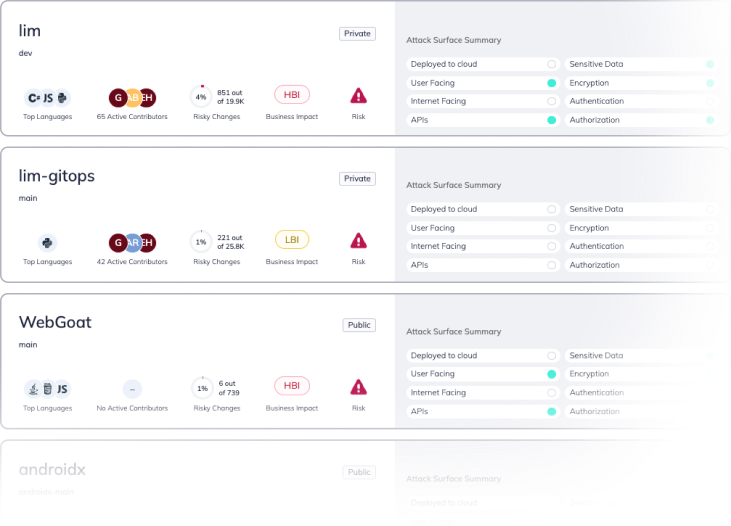
Apiiro delivers its ASPM capabilities through the Guardian Agent, built on an AppSec Data Fabric made up of a Software Graph and a Risk Graph. The graph-based risk engine correlates findings from first-party and third-party tools, maps them onto the software graph, detects toxic combinations and blast radius, and prioritizes business-specific risk.
The platform continuously assesses risk at several levels, including code modules, repositories, business applications, container artifacts and software releases. Each assessment uses software architecture context from code to runtime, covering code ownership, exposure, threat intelligence and business impact.
Key features include:
- Policy and risk engine: An open, graph-based engine that correlates findings from first-party and third-party tools, maps them to the software graph, and detects toxic combinations and blast radius.
- Software architecture graph: Visualizes the evolving architecture from code to runtime, including micro-services, APIs, open source dependencies, data flows, technologies, AI components and code ownership.
- Pipeline BOM: Discovers and maps CI/CD pipelines, build systems, artifacts, registries, deployment flows and the delivery paths that connect code to runtime.
- Third-party tool orchestration: Integrates with more than 100 third-party tools across SAST, SCA, secrets, API security, WAF, cloud security, container security, mobile testing and bug bounty programs.
- Unified risk view and prioritization: Unifies, correlates, de-duplicates and prioritizes AppSec risks across first-party and third-party tools using software graph and business risk context.
- API security in code with runtime context: Detects unauthenticated, shadow and risky APIs exposing sensitive data directly in code, with automatic correlation to runtime deployment and compensating controls.
- Code ownership mapping: Maps software components and risks to the right code owners using material change detection, enriched with organizational context from third-party tools.
- IaC misconfiguration detection: Detects misconfigurations and policy violations across IaC, Docker and Kubernetes configurations, correlated with the software graph from code to runtime.
Limitations (as reported by users on PeerSpot):
- Report loading times: Pulling reports across several hundred repositories is reported as slow and occasionally fails to complete.
- Access control granularity: Role-based access control is described as limited, with report access restricted to the application security team.
- Custom dashboard building: Users wanting to build their own BI dashboards had to seek access tokens rather than exporting directly.
Source: Apiiro

3. Cycode

Best for: Combining native scanners with third-party findings in one view
Strengths: Context Intelligence Graph, ConnectorX, correlation and deduplication
Things to consider: Cloud service coverage and manual re-scan steps
Cycode’s ASPM runs its own scanners and also ingests findings from tools already in use through ConnectorX, an integration layer with more than 100 connectors spanning source control, CI/CD, container registries and cloud platforms. Native coverage includes SAST, SCA, secrets detection, container security and IaC security.
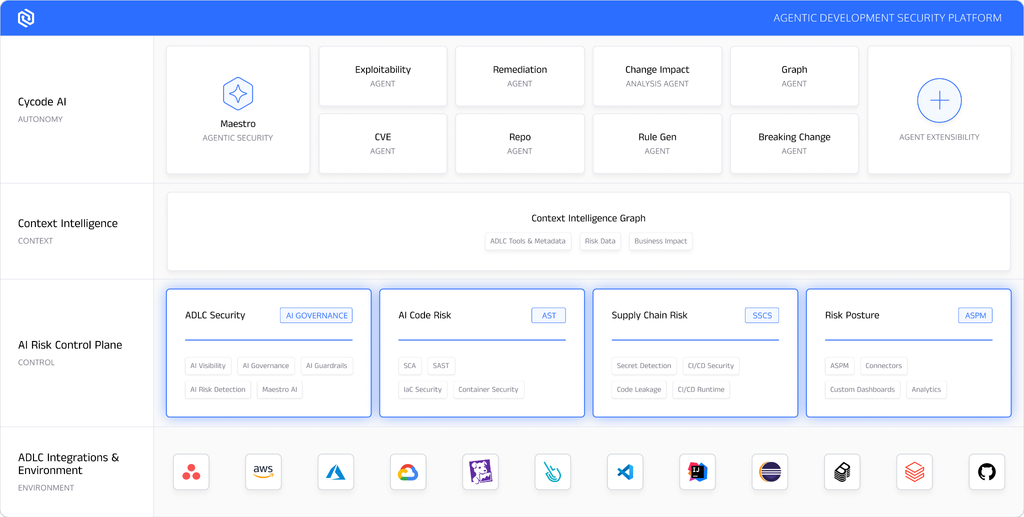
Its Context Intelligence Graph provides vulnerability traceability across the SDLC, covering application code, tool configurations, cloud infrastructure and ownership. Prioritization is applied against business risk, exploitability and severity, and findings are tied back to the owners responsible for them.
Key features include:
- Context Intelligence Graph: Provides vulnerability traceability across the SDLC, including application code, tool configurations, cloud infrastructure and ownership.
- ConnectorX integrations: More than 100 connectors ingest third-party findings from source control, CI/CD, container registries and cloud platforms into a single ASPM view.
- Code-to-cloud prioritization: Ranks vulnerabilities using business risk, exploitability and severity, and ties each one back to its owner.
- Correlation and deduplication: Correlates and de-duplicates critical alerts, and supports bulk remediation across multiple instances of the same issue.
- Native scanning coverage: Includes SAST, SCA, secrets detection, container security and IaC security, alongside pipeline security covering CI/CD, code leakage and build hardening.
- Enterprise-scale ingestion: Handles ingestion and normalization of findings from thousands of repositories and diverse security tools, with deployment options for cloud-native and on-premises assets.
- Reporting and compliance: Provides custom dashboards, reporting and analytics, compliance checks for standards such as NIST and SOC 2, and SBOM generation.
Limitations (as reported by users on G2):
- Cloud service coverage: Users note gaps in integrations with AWS services for tracking vulnerabilities in the systems hosting applications, rather than only in code and artifacts.
- Manual re-scan steps: Some violations require a manual re-scan before they clear.
- Query feedback: Error and progress messaging is reported as unclear while large knowledge graph queries are running.
- Depth of use: Working extensively across the platform is described as taking time to get comfortable with.
Source: Cycode

4. Legit Security

Best for: Consolidating scanner findings and remediating at the root cause
Strengths: Root cause remediation, contextual scoring, material change detection
Things to consider: Some integrations require manual workarounds
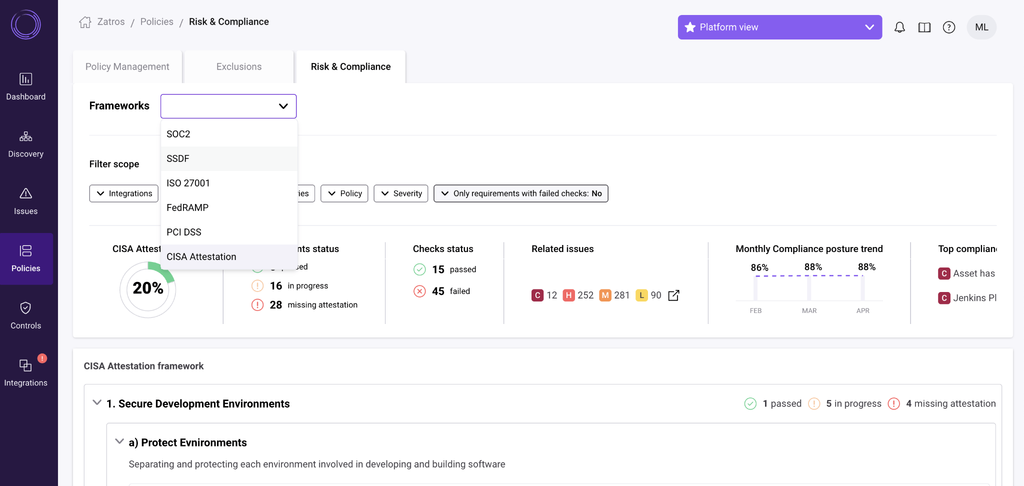
Legit Security’s ASPM platform discovers the software development environment and unifies AppSec findings across it. It orchestrates existing scanners, then correlates and de-duplicates their findings to identify where a single action contributes most to mitigating risk. Native SAST, SCA and secrets detection are also available.
Root cause remediation identifies chokepoints where one remediation action resolves multiple issues at once. Contextualized risk scoring combines business criticality, compliance requirements, GenAI usage, APIs and internet accessibility, so prioritization reflects business impact rather than finding counts.
Key features include:
- Code-to-cloud coverage: Integrates with systems and security testing tools across the development pipeline for a consolidated view of vulnerabilities, misconfigurations, GenAI usage, secrets and other risk areas.
- Security tool coordination and analysis: Orchestrates existing scanners, then correlates and de-duplicates findings to pinpoint where a single action contributes most to mitigating threats.
- Root cause remediation: Identifies chokepoints where one remediation action addresses multiple issues at once.
- Contextualized risk scoring: Combines business criticality, compliance, GenAI use, APIs and internet accessibility to prioritize fixes with real business impact.
- Material change detection: Continuously monitors the development environment and flags code changes that increase AppSec risk.
- Development pipeline mapping: Maps the development ecosystem and its connections, identifying unmonitored assets and updates that pose risk.
- API inventory and SBOM: Builds a centralized catalog of API endpoints and generates detailed software manifests for security and compliance requirements.
- Risk prevention guardrails: Automates enforcement of security guardrails and policies to support repeatable processes.
Limitations (as reported by users on Gartner Peer Insights):
- Consistency across workflows: Some workflows are described as more intuitive than others, with a few feeling less complete.
- Integration effort: Certain tool integrations were reported as difficult to complete through the standard integration menu, requiring manual uploads instead.
- Experience relative to positioning: One reviewer described the overall experience as mixed given the product’s price point and market positioning.
Source: Legit Security

CNAPP Platforms with Code-to-Cloud Correlation
The platforms below approach correlation primarily as cloud security posture management tools, extending CNAPP-style cloud posture and runtime analysis back to the development artifacts and teams that introduced the risk.
5. Wiz

Best for: Graph-based correlation across cloud, code and runtime
Strengths: Security Graph, attack path analysis, code-to-cloud correlation
Things to consider: Learning curve and reporting customization
Wiz connects code, cloud and runtime into a unified context graph. The Wiz Security Graph analyzes the relationships between technologies running in a cloud environment and surfaces the pathways that could lead to a breach, with graph visualization and querying across cloud and AI layers from a single console.
Attack path analysis produces a prioritized list of toxic combinations that have a high probability of exploitation and significant business impact. Code-to-cloud correlation automatically links running cloud resources back to the code, pipeline and developer that produced them.
Key features include:
- Security Graph: Analyzes relationships between technologies running in the cloud environment and surfaces the most critical pathways to a breach, with queries enriched by context.
- Attack path analysis: Produces a single prioritized list of toxic combinations of cloud and AI risk with a high probability of exploitation and significant business impact.
- Code-to-cloud correlation: Automatically correlates running cloud resources back to the code, pipeline and developer that created them, and generates a one-click fix as a pull request in version control.
- Cloud-to-code hardening: Uses cloud context and automated forensics collection to identify the root cause of an incident, tracing from detection to resource back to code.
- Agentless visibility: Connects via API across PaaS, virtual machines, containers, serverless functions, models, repositories and pipelines without ongoing maintenance.
- Runtime protection: The Wiz Sensor provides real-time threat detection with context, combined with agentless cloud telemetry.
- Ownership grouping: Projects and services group cloud and AI environments by ownership, with a role-based access control system modeling organizational structure.
- Workflow orchestration: A visual, no-code canvas chains triggers, logic, approvals and integrations into multi-step sequences powered by the Security Graph.
Limitations (as reported by users on G2):
- Learning curve: Users report that mastering the breadth of features takes time, and that the interface can feel overwhelming at first.
- Reporting and dashboards: Dashboard reporting and report customization are frequently cited as areas needing improvement.
- Query performance: Some users report laggy query responses in larger environments.
- Licensing: Licensing structure is described as complex and difficult to model for budgeting.
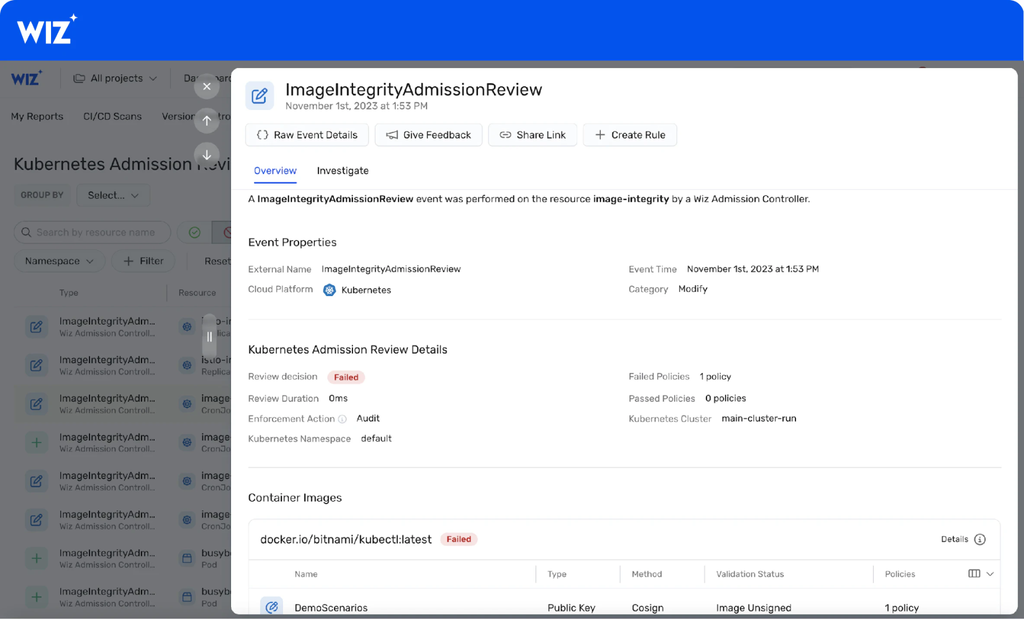
Source: Wiz

6. Cortex Cloud
Best for: Unifying application security, cloud posture and SOC workflows
Strengths: SmartGrouping, SmartScore, third-party scanner ingestion
Things to consider: Platform complexity, cost and product renaming
Cortex Cloud is the next version of Prisma Cloud from Palo Alto Networks, bringing CNAPP capabilities together with cloud detection and response on the Cortex platform. Its application security side centralizes visibility through ASPM, integrating native scanners and third-party tools across the application lifecycle.
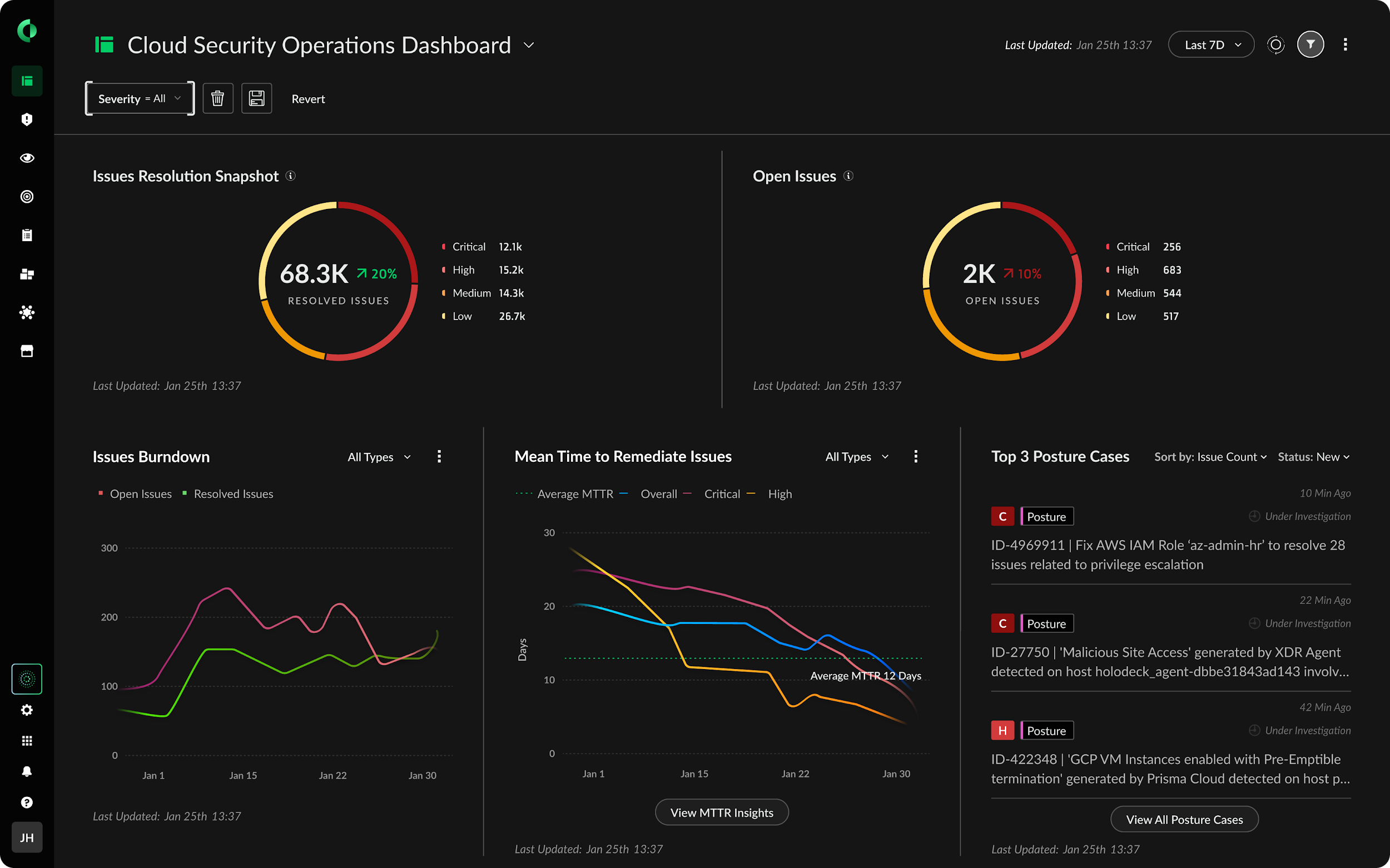
On the posture side, the platform applies code and runtime context to every finding rather than presenting inventory and misconfiguration lists. SmartGrouping consolidates disjointed signals into holistic cases, and SmartScore ranks them by real-world exposure and production behavior.
Key features include:
- ASPM risk, policy and automation engine: Consolidates AppSec visibility into a single risk, policy and automation engine, applying context-aware security policies across the application lifecycle.
- SmartGrouping and SmartScore: Consolidates disjointed signals into holistic cases and prioritizes them by real-world exposure and production behavior rather than alert volume.
- Third-party ingestion: Connects any AppSec tool for centralized visibility, prioritizing the ingested risk using runtime and application context.
- IaC security with runtime tracing: Provides developer-first infrastructure-as-code security with runtime tracing so misconfigurations can be fixed at the source.
- Software supply chain security: Gives visibility and control over the engineering ecosystem, governs pipeline tool usage and risk, and manages SBOMs and deployment integrity.
- Software composition analysis and secrets security: Addresses open source vulnerabilities and license compliance with context-aware prioritization, and detects and prioritizes credential exposure.
- Remediation automation: Triggers remediation playbooks to fix issues at the source at each stage of development.
- Cloud runtime security: A performance-optimized agent captures behavioral telemetry and integrates with SOC workflows for investigation and response.
Limitations (as reported by users on PeerSpot):
- Interface complexity: Consolidating XDR, XSOAR and cloud capabilities under one platform is reported as making the interface harder to navigate than the earlier separate modules.
- Product renaming: Frequent name changes across the Palo Alto Networks portfolio create adjustment work for technical teams.
- Cost: Pricing is described as premium relative to alternatives, which some users say makes ROI harder to justify during platform transitions.
- Feature gaps: Users note the absence of identity-based micro-segmentation and see room for improvement in behavioral analytics and anomaly detection.
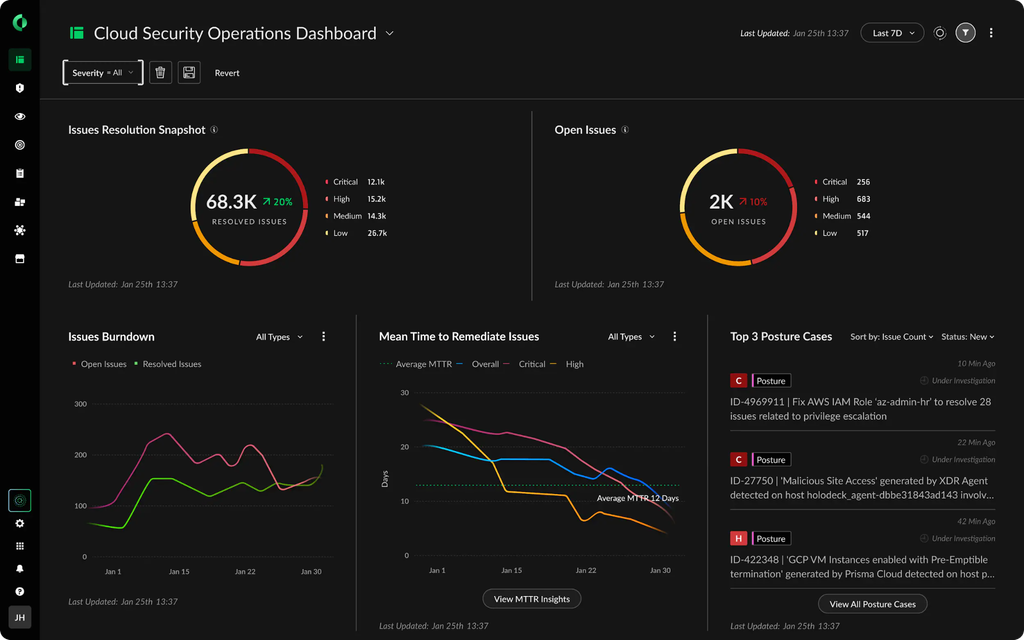
Source: Palo Alto Networks
7. Orca Security

Best for: Agentless correlation of cloud risk with its code origins
Strengths: Unified data model, attack path analysis, Missions grouping
Things to consider: Initial scans surface high alert volumes
Orca is an agentless-first CNAPP that consolidates point solutions including CSPM, CWPP, CIEM, DSPM and container security into a unified data model. It drives prioritization by analyzing attack paths through toxic combinations of risk across domains, rather than reporting each condition separately.
Orca also integrates into git repositories and CI/CD workflows, running compliance and security checks as part of the pipeline, including IaC template and container image scanning. Findings in the production environment are traced back to the application development artifacts that produced them.
Key features include:
- Attack path analysis: Analyzes toxic combinations of risk across domains, highlighting which risks endanger critical business assets and which appear in the most high-severity attack paths.
- Unified data model: Combines workload-deep intelligence with cloud security posture, identity and access management, and code scanning in a single model.
- Production-to-code tracing: Traces findings from the production environment back to their code origins so risks can be fixed at the source.
- Dynamic risk scoring: Scores every alert against several risk factors, including asset context, sensitive data at risk and attack paths.
- Missions: Groups alerts into focused workflows with ownership and deadlines, such as fixing the one Terraform resource that is the root cause of many alerts.
- SDLC integration: Integrates with git repositories and CI/CD workflows, running compliance and security checks including IaC template and container image scanning.
- Bi-directional ticketing integrations: Connects with Jira and ServiceNow to route findings into existing remediation workflows.
- Orca AI: Provides AI-generated code fixes for IaC and CLI, natural language asset search, an assistant and agents that carry out analysis and initiate workflows.
Limitations (as reported by users on G2):
- Initial alert volume: First scans of legacy or long-running environments surface large numbers of findings, including orphaned assets, which takes time to filter.
- Reporting customization: Out-of-the-box dashboards are described as rigid, and building tailored reports for non-technical stakeholders often means exporting data elsewhere.
- Detection timing: Some users report delays in surfacing certain vulnerabilities.
- False positives: A number of users report findings that require tuning before they reflect real exposure.
- Permissions configuration: Configuring nested role-based access for restricted, read-only dashboard views is reported as complex.
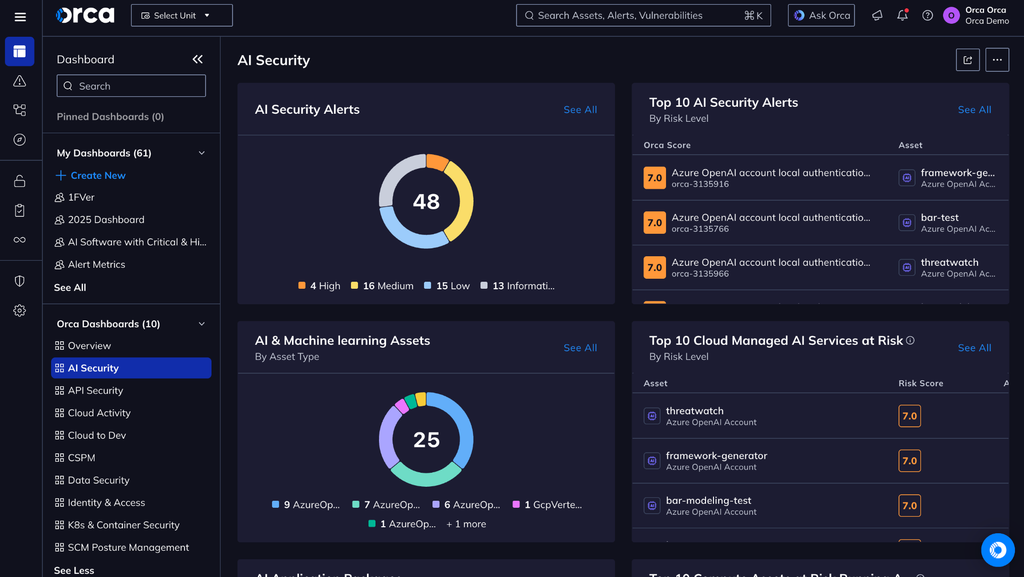
Source: Orca Security
8. Microsoft Defender for Cloud

Best for: Correlating multicloud posture with development pipeline findings
Strengths: Attack path analysis, DevOps security, contextual prioritization
Things to consider: Licensing complexity and configuration effort
Microsoft Defender for Cloud is a cloud-native application protection platform covering hybrid and multicloud environments across the full application lifecycle, from code to runtime. It provides end-to-end visibility, prioritizes critical risks using contextual insights, and supports remediation at scale through built-in workflows.
Its DevOps security capabilities unify security across multicloud and multi-pipeline environments, aiming to stop vulnerabilities, misconfigurations and secrets from reaching production. Attack path analysis and contextual risk prioritization extend across cloud infrastructure, AI workloads, agents, APIs and data stores.
Key features include:
- Attack path analysis with contextual prioritization: Identifies exploitable paths across cloud infrastructure, AI workloads, agents, APIs and data stores, and prioritizes them by context.
- Unified DevOps security: Streamlines collaboration between development and security teams across multicloud and multi-pipeline environments so issues are fixed at the source.
- Cloud security posture management: Provides end-to-end visibility across hybrid and multicloud environments with built-in remediation workflows.
- IaC and container image checks: Guards against risky misconfigurations reaching production through secure infrastructure-as-code templates and container images.
- Software supply chain security: Improves supply chain security by preventing vulnerabilities and secrets in code from progressing through the pipeline.
- Threat detection and response: Delivers cloud-native threat detection and response across infrastructure, apps and business data, integrated into the Microsoft Defender portal.
- Ecosystem integrations: Works with GitHub Advanced Security, Microsoft Security Exposure Management, Defender XDR, Sentinel, Security Copilot and Defender External Attack Surface Management.
Limitations (as reported by users on G2):
- Configuration complexity: Users report a steep learning curve given the breadth of features and options in the platform.
- Licensing and pricing: Licensing is described as difficult to comprehend, and costs can climb for smaller organizations if not managed carefully.
- Detection and policy delays: Some users report delays in surfacing threats and in generating and applying security policies.
- False positives: A number of users report legitimate items being flagged, adding triage work.
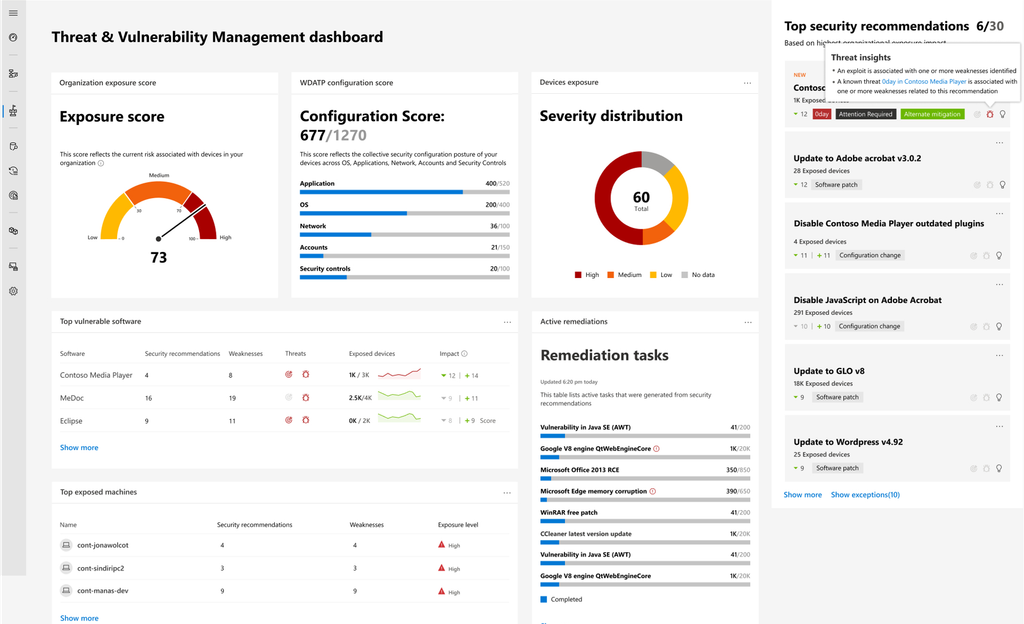
Source: Microsoft
Conclusion
Automated risk correlation across development and cloud environments bridges the gap between software creation and runtime operation. By unifying security signals across pipelines, configurations, and active workloads, security teams can gain actionable visibility into real-world exposure and toxic risk combinations. This holistic approach helps organizations prioritize high-impact vulnerabilities, eliminate security noise, and accelerate effective remediation at its root source.