
What Is a Supply Chain Attack?
A supply chain attack is a cyberattack that targets a trusted third-party vendor or supplier to infiltrate an organization, bypassing the traditional perimeter security. Instead of attacking a well-defended target directly, hackers exploit less secure vendors to compromise the final target, often via malware in software updates or compromised hardware components.
Supply chain attacks are a broad category of cyberattacks exploiting different points of trust in an organization’s ecosystem. These attacks are categorized by the stage of the supply chain they target, from the initial development of software and AI models to the operational access of third-party vendors and the physical integrity of hardware components.
The main types of supply chain attacks include:
- Software supply chain attacks: These focus on the development lifecycle, exploiting code dependencies, build processes (CI/CD), or open-source libraries through methods like dependency confusion or typosquatting, resulting in malicious code being distributed via legitimate software releases.
- AI software supply chain attacks: These specifically target machine learning systems by manipulating training data (data poisoning) or compromising model repositories and ML pipelines to introduce vulnerabilities or create hidden backdoors within AI models.
- Third-party vendor compromise: This involves breaching external providers like IT service or SaaS platforms who have legitimate, trusted access to the target organization’s systems, allowing the attacker to pivot into the customer network using API keys or remote tools (e.g., SolarWinds).
- Hardware or physical compromise: This occurs during manufacturing or distribution, involving tampering with physical components, such as implanting malicious chips or modifying firmware, which is a persistent, low-level threat difficult to detect or remove from devices.
This is part of a series of articles about software supply chain management.
Software Supply Chain Attacks vs. Broader Third-Party Attacks
Software supply chain attacks are a subset of broader third-party attacks, but they differ in how access is gained and how the attack spreads.
A software supply chain attack focuses on the development lifecycle. The attacker compromises code, dependencies, or build systems before the software reaches production. The malicious code is then distributed as part of legitimate releases. This means the attack scales automatically to every user who installs or updates the software. The trust is embedded in the code itself.
Broader third-party attacks focus on operational access rather than code distribution. The attacker compromises a vendor, contractor, or service provider that already has access to the target environment. This access may include credentials, APIs, remote management tools, or network connectivity. The attacker then uses this trusted relationship to move laterally into the target system.
Key Differences
- Primary target: Software attacks compromise the code itself (libraries, dependencies) before distribution, whereas broader third-party attacks compromise a vendor’s operational credentials or system access .
- Attack layer: Software attacks exploit inherent trust in the authenticity of the artifact, while broader third-party attacks exploit inherited network or API permissions.
- Propagation: Software supply chain attacks spread through software artifacts and updates, often affecting many organizations at once. Third-party attacks typically require direct interaction with each target, even if the initial entry point is shared.
- Detection and mitigation: Software supply chain risks require controls such as dependency scanning, artifact signing, and build pipeline security. Third-party risks require vendor access controls, monitoring of external integrations, and strict identity and access management.
Why Software Supply Chain Attacks Matter for Modern Dev Teams
Modern applications depend heavily on external code. A typical project may include hundreds of open-source libraries, each with its own dependencies. This creates a large and often poorly understood attack surface. A single compromised package can affect many applications at once.
Automation increases the risk. CI/CD pipelines continuously pull, build, and deploy code with minimal human review. If an attacker injects malicious code upstream, it can propagate quickly into production. Because the process is trusted and repeatable, the attack can scale across environments.
Detection is also harder. Malicious code often blends with legitimate dependencies and executes during normal operations. Traditional security tools focus on perimeter defense and may not inspect build pipelines or dependency trees. This makes prevention and integrity verification critical for development teams.
The Software Supply Chain Trust Path
To understand software supply chain attacks, it helps to follow the path of trust through a modern delivery pipeline:
- Source code: Internal codebases and repositories
- Dependencies: Open-source packages, libraries, and transitive components
- Build systems: CI/CD pipelines, package managers, and automation workflows
- Signing and artifact generation: Build outputs, signatures, and release packaging
- Distribution: Registries, update servers, package feeds, and deployment channels
- Deployment: Runtime environments, production systems, and downstream customer environments
A supply chain attack works by compromising one of these trusted stages and then using normal software delivery to spread malicious code, unsafe changes, or unauthorized access at scale. This is why prevention depends not just on perimeter security, but on controlling trust throughout the software delivery lifecycle.
Key Risks and Impacts of Supply Chain Attacks
Supply chain attacks are especially damaging because they spread through trusted relationships and standard delivery processes.
A single compromised update, package, vendor, or build system can affect many downstream organizations at once, turning one intrusion into a multi-environment, multi-customer incident.
Data Breaches
Supply chain attacks frequently lead to large-scale data breaches because attackers inherit the trusted access of the compromised supplier or software. This often allows them to bypass traditional security controls and move directly into sensitive systems. Once inside, they can exfiltrate customer records, authentication credentials, financial data, or intellectual property across multiple organizations simultaneously.
Real-world incidents show how severe this can be; for example, a single third-party compromise in healthcare exposed data for around 100 million individuals (later estimates go as high as 190 million), including medical and billing information. Because many organizations share data with vendors as part of normal operations, a breach in one link of the chain can cascade, exposing interconnected systems at scale rather than just a single environment.
Financial Losses
The financial impact of supply chain attacks extends far beyond immediate remediation. Organizations face direct costs such as incident response, system restoration, legal fees, and regulatory fines, but also indirect losses like revenue decline, customer churn, and long-term operational inefficiencies. On average, a data breach costs about $4.44 million globally, and significantly more in some regions.
Supply chain-related breaches often result in larger financial damage compared to isolated incidents, due to their broader scope and complexity. In large-scale attacks, financial damage can escalate into billions, particularly when production halts, services go offline, or entire partner ecosystems are affected. These cascading economic effects make supply chain attacks one of the most financially damaging categories of cyber incidents.
Operational Disruption
One of the most immediate and visible impacts of a supply chain attack is disruption to business operations. Compromised software updates, ransomware introduced via vendors, or infected dependencies can force organizations to shut down systems, halt manufacturing, or suspend critical services. In some cases, production lines stop entirely for weeks, causing delays across global supply networks and affecting thousands of downstream partners.
For example, in 2024 a ransomware attack impacted Change Healthcare, a major U.S. healthcare technology provider used for claims processing, payment flows, insurance eligibility checks, authorizations, and pharmacy transactions. Because hospitals, physicians, pharmacies, and insurers depended on Change Healthcare as a critical third-party service provider, the outage disrupted healthcare operations nationwide. Providers struggled to submit claims, receive payments, verify coverage, and process prescriptions
Reputational Damage
Supply chain attacks significantly erode trust, which is one of the most valuable assets organizations have. Even if the breach originates from a third party, customers and partners often hold the affected organization responsible for failing to secure its ecosystem. This can lead to negative media coverage, loss of customer confidence, and strained relationships with vendors and stakeholders.
A landmark example of the reputational impact of supply chain attacks was the SolarWinds Orion attack in 2020. Attackers inserted malicious code into software updates, and nearly 18,000 customers received compromised updates. The incident became closely associated with software supply chain risk, triggered emergency federal action to disconnect affected Orion products, and kept SolarWinds under public, regulatory, and legal scrutiny for years. The SEC charged SolarWinds and its CISO in 2023 over alleged cybersecurity disclosure failures; the case was finally dismissed in November 2025.
How Supply Chain Attacks Work
Let’s review the typical process of a supply chain attack.
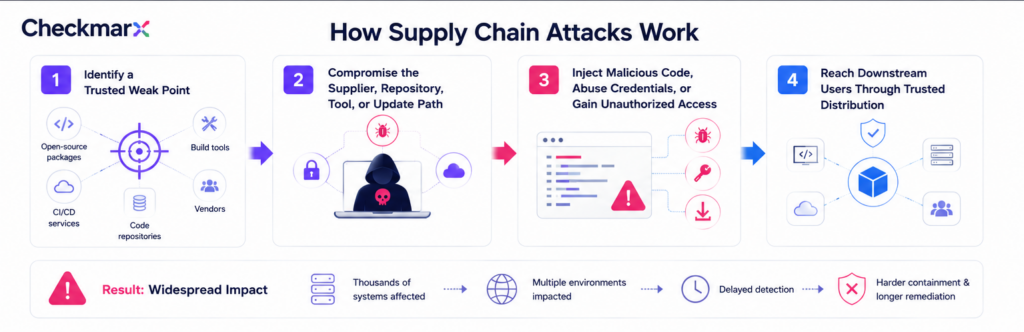
1. Identify a Trusted Weak Point
Attackers start by mapping the target’s dependencies and trust relationships. This includes open-source packages, build tools, CI/CD services, code repositories, and external vendors. Public manifests (e.g., package.json, requirements.txt) and metadata from registries help identify commonly used components.
They look for weak controls such as poorly maintained libraries, inactive maintainers, exposed credentials, or misconfigured infrastructure. The goal is to find an entry point that is trusted by the target but easier to compromise than the target itself.
2. Compromise the Supplier, Repository, Tool, or Update Path
Once a weak point is identified, the attacker gains control over it. This can involve hijacking maintainer accounts, exploiting vulnerabilities in build systems, or publishing malicious packages to public registries. In vendor scenarios, it may involve breaching the provider’s internal systems or stealing API keys.
Another common method is tampering with the update mechanism. If the attacker can modify how updates are delivered, such as a package registry or auto-update server, they can insert malicious content into otherwise legitimate distribution channels.
3. Inject Malicious code, Abuse Credentials, or Gain Unauthorized Access
After gaining access, the attacker introduces malicious logic into the trusted component. This may include backdoors, data exfiltration routines, or code that downloads additional payloads at runtime. The changes are often small and designed to blend in with legitimate code to avoid detection.
In some cases, attackers do not modify code directly but instead abuse credentials or access tokens obtained from the compromised system. This allows them to move laterally, access sensitive resources, or manipulate downstream systems without altering the software itself.
4. Reach Downstream Users Through Trusted Distribution
The final stage relies on normal distribution processes. Compromised packages are pulled into builds, updates are installed automatically, or vendor integrations sync data into customer environments. Because these processes are trusted and often automated, the malicious changes propagate without raising immediate alarms.
This step gives the attack its scale. A single compromised dependency or update path can affect thousands of systems. By the time the issue is detected, the malicious component may already be embedded across multiple environments, making containment and remediation more difficult.
Related content: Read our guide to software supply chain security (SSCS)
Common Supply Chain Attack Vectors
Here are some of the common vulnerabilities attackers exploit to carry out supply chain attacks.
1. Compromised Software Updates
Attackers target the update mechanism used to deliver software patches and new versions. If they gain access to the update server or signing process, they can distribute malicious code as part of a legitimate release. Because updates are expected and trusted, users install them without suspicion.
This vector is especially effective in environments with automatic updates. Once a poisoned update is published, it can propagate quickly across all systems that rely on that software. The SolarWinds incident is a well-known example, where a signed update carried malicious code to thousands of organizations.
2. Malicious or Hijacked Open-Source Packages
Open-source ecosystems rely on public registries where anyone can publish packages. Attackers exploit this by uploading malicious packages or taking over existing ones. Techniques include typosquatting, dependency confusion, and account takeover of maintainers.
Once included as a dependency, the malicious package executes during build or runtime. Because developers often trust popular libraries and automate dependency installation, the malicious code can spread widely with little visibility.
3. Build and CI/CD Pipeline Compromise
CI/CD systems automate building, testing, and deploying software. If attackers gain access to these systems, they can modify build scripts, inject code during compilation, or alter artifacts before release. The output may still be signed or appear valid, making the compromise hard to detect.
These environments often have high privileges, including access to secrets, signing keys, and production infrastructure. A single compromise can affect multiple applications and environments, making this a high-impact vector.
4. Third-Party Credentials and Access Abuse
Attackers steal or misuse credentials associated with external vendors, integrations, or service accounts. This includes API keys, OAuth tokens, SSH keys, or remote management access. With these credentials, attackers can access systems without needing to exploit software vulnerabilities.
Because this access is legitimate, it may bypass many security controls. Attackers can move laterally, extract data, or modify systems while appearing as an authorized user or service. Weak credential management and excessive permissions increase the risk.
5. Hardware Tampering
In some cases, attackers target physical components during manufacturing or distribution. This can include modified chips, altered firmware, or tampered devices. The malicious functionality operates at a low level, often below the operating system.
These attacks are harder to execute but can be very persistent. Once deployed, the compromised hardware may be difficult to inspect or replace at scale. Detection often requires specialized tools and supply chain validation processes.
6 Real-World Supply Chain Attack Examples
1. SolarWinds Orion Compromise
Attackers compromised the SolarWinds Orion software supply chain and inserted the SUNBURST backdoor into affected Orion Platform builds. The malicious code was then distributed through normal software updates, allowing it to reach customer environments through a trusted vendor channel rather than through direct attacks on each victim. SolarWinds confirmed that SUNBURST affected specific Orion Platform versions, and MITRE describes the campaign as malicious code injected into the Orion build process and later distributed through routine updates.
Once installed, the compromised update gave attackers a foothold inside sensitive enterprise and government networks. CISA responded by issuing Emergency Directive 21-01, which required federal civilian agencies to disconnect or power down affected SolarWinds Orion products because they were being actively exploited.
Lessons learned: This attack shows how trust in signed vendor software can become an attack path, how a single compromised update can scale across many customers, and how downstream impact can be severe when malicious code enters networks through normal maintenance activity.
2. Kaseya VSA Ransomware Attack
In July 2021, attackers exploited zero-day vulnerabilities in Kaseya VSA, a remote monitoring and management platform used by managed service providers. Kaseya said the attackers bypassed authentication and used standard VSA functionality to deploy ransomware to managed endpoints, rather than modifying the VSA codebase itself.
The attack scaled because MSP tools are designed to manage many customer environments from one platform. Kaseya reported fewer than 60 directly compromised customers, but because many of them served other companies, the total impact reached fewer than 1,500 downstream businesses; Zscaler similarly described the incident as affecting 1,000+ organizations downstream.
Lessons learned: This attack shows how trusted operational access can become a ransomware distribution path, how MSP platforms increase scale, and how downstream organizations can be disrupted even when they are not direct customers of the compromised vendor.
3. Polyfill.io Web Supply Chain Compromise
In 2024, the Polyfill.io JavaScript service became a major web supply chain attack after the domain and GitHub account were acquired by a new operator. Websites that continued loading scripts from cdn.polyfill.io began exposing users to malicious JavaScript, including code that redirected mobile visitors to scam or betting sites while using evasion techniques to avoid detection.
The scale came from how widely websites depended on the hosted JavaScript library. Sansec reported that more than 100,000 sites embedded the compromised service, and Censys later found 384,773 hosts still referencing Polyfill-related malicious domains, including sites tied to major brands and some government domains.
Lessons learned: This attack shows how trust in a third-party web dependency can expose users at scale, how a single hosted script can affect many unrelated websites, and how downstream impact can continue even after the malicious domain is suspended if sites do not remove the dependency.
4. Shai-Hulud NPM Worm
Shai-Hulud was a self-replicating NPM supply chain attack tracked by Checkmarx in September 2025. The malware used GitHub Actions to infect repositories that consumed previously infected packages, turning normal package installation and repository automation into a propagation mechanism.
The malware stole credentials, exposed private GitHub repositories, and used the stolen access to attempt further attacks against repositories and cloud infrastructure. Checkmarx reported that approximately 600 package versions were affected, covering nearly 200 unique package names.
Lessons learned: This attack shows how trust in open-source packages can be abused at machine speed, how package ecosystems allow rapid scale, and how downstream impact can move beyond one dependency into repositories, CI/CD systems, and cloud environments.
5. Malicious Open-Source Packages
Malicious open-source packages differ from ordinary software vulnerabilities because they often contain intentional malware that executes immediately when installed. Checkmarx notes that these packages can steal credentials, install backdoors, compromise build pipelines, and exfiltrate sensitive data before traditional application security tools begin scanning.
This makes developer workstations, CI/CD pipelines, and build systems especially exposed. Package managers are often trusted by default, and automated dependency installation can execute malicious code before a developer reviews the package or before the application is deployed.
Lessons learned: This attack pattern shows how trust in package registries can be exploited, how automated installs create scale, and how downstream impact can include stolen secrets, poisoned builds, and compromised internal development environments.
6. GitHub Search Manipulation Campaign
Checkmarx discovered a campaign in which attackers manipulated GitHub search results by creating malicious repositories with popular names and topics. They used automated updates and fake stars to make the repositories appear active, visible, and trustworthy to developers searching for code.
The malware was hidden in Visual Studio project files such as .csproj and .vcxproj, where it could execute automatically when the project was built. This allowed attackers to compromise developer machines without needing to breach an existing package or vendor first.
Lessons learned: This attack shows that attackers can manufacture trust signals instead of compromising an existing supplier, scale through developer search and copy-paste behavior, and create downstream impact through malware execution on developer machines and possible exposure of credentials, wallets, and project environments.
How to Prevent Supply Chain Attacks
Here are some important supply chain attack prevention techniques.
1. Verify and Govern Dependencies
Establish a clear policy for which dependencies can be used and how they are approved. Pin exact versions instead of using loose ranges to avoid pulling unexpected updates. Maintain an allowlist of trusted packages and registries, and restrict direct installs from unknown sources.
Use automated software composition analysis (SCA) tools to detect known vulnerabilities and license risks. Go beyond CVEs by flagging suspicious package behavior, such as install scripts or network calls. Regularly review and prune unused dependencies to reduce the attack surface.
In addition, track ownership and maintenance status of critical libraries. Dependencies with a single maintainer or long periods of inactivity present higher risk. For high-impact components, consider vendoring the code or maintaining an internal mirror to reduce exposure to upstream changes.
How Checkmarx helps:
Checkmarx provides software composition analysis (SCA) to inventory both direct and transitive dependencies across repositories and pipelines. It identifies vulnerabilities and enforces policies to block untrusted components before they are used. In addition, its malicious package protection detects threats such as typosquatting, dependency confusion, and poisoned packages at ingestion, preventing them from entering builds. This gives teams control over which components are allowed and reduces exposure to risky or unknown dependencies.
2. Secure Build Systems and CI/CD
Treat CI/CD systems as high-value targets. Isolate build environments, use ephemeral runners, and avoid reusing build artifacts across jobs. Ensure all pipeline configurations are version-controlled and protected from unauthorized changes.
Restrict access to pipeline configuration, secrets, and triggers. Enforce strong authentication and audit all changes. Monitor pipeline activity for anomalies such as unexpected dependency downloads, changes in build outputs, or unauthorized workflow executions.
Harden the build environment itself. Disable outbound network access where possible to prevent unauthorized downloads during builds. Use deterministic builds so that the same inputs always produce the same outputs, making tampering easier to detect.
How Checkmarx helps:
Checkmarx enforces policy controls across the software delivery lifecycle, including pipelines and repositories. Its repository health capabilities evaluate CI/CD configurations and surface risks related to insecure practices. By combining this with malicious package detection at build ingestion, teams can prevent unsafe components from entering pipelines and ensure builds align with approved security standards.
3. Code Signing and Artifact Integrity
Sign all build artifacts using secure, centrally managed keys. This ensures that only verified outputs are deployed and consumed. Store signing keys in hardened environments such as hardware security modules (HSMs) or managed key vaults.
Verify signatures at every stage of distribution and deployment. This prevents tampered artifacts from being introduced downstream. Combine signing with checksums and reproducible builds to ensure that outputs match expected inputs.
Also define clear trust policies for verification. For example, enforce that only artifacts signed by specific keys or roles are allowed in production. Automate signature verification in deployment pipelines to remove reliance on manual checks.
How Checkmarx helps:
Checkmarx ensures that only approved and trusted components move through the supply chain by enforcing policy checks and validating dependencies and container images. Its container security scans images for vulnerabilities, misconfigurations, and untrusted base images, helping ensure that what gets deployed matches what was reviewed and approved earlier in the lifecycle.
4. SBOM Visibility and Consumption
Generate a software bill of materials (SBOM) for every build. This provides a complete inventory of components, versions, and dependencies used in the application. Store SBOMs in a central system where they can be queried and audited.
Consume SBOM data during security analysis and incident response. When a new vulnerability is disclosed, teams can quickly identify affected systems. Integrate SBOM checks into deployment gates to prevent shipping software with known high-risk components.
Extend SBOM usage beyond internal visibility. Share SBOMs with customers or partners when required, and validate SBOMs received from vendors. This helps build end-to-end transparency across the entire software supply chain.
How Checkmarx helps:
Checkmarx automatically generates SBOMs as part of its SCA capabilities, providing a full inventory of components used in applications. These SBOMs cover dependencies across repositories and pipelines, enabling teams to track and audit what is in their software. This visibility supports faster vulnerability response and helps enforce compliance requirements across the supply chain.
5. Least Privilege for Pipelines and Developer Tooling
Limit permissions for CI/CD jobs, service accounts, and developer tools. Each component should only have access to the resources it needs. Avoid shared credentials and use short-lived tokens where possible.
Segment environments to prevent lateral movement. For example, build systems should not have direct access to production unless explicitly required. Regularly audit permissions and remove unused or excessive access.
Apply the same principles to developer workstations and local tooling. Developers should not have broad access to production secrets by default. Use just-in-time access and approval workflows for sensitive operations.
How Checkmarx helps:
Checkmarx applies policy enforcement across the supply chain, ensuring only trusted components and configurations are allowed. It provides visibility into repository health, including dependency hygiene and CI/CD setup, helping teams identify excessive access or risky configurations. These insights allow organizations to tighten controls and reduce unnecessary exposure across development and pipeline environments.
6. Continuous Monitoring of Packages and Upstream Changes
Track changes in dependencies over time, including new versions, maintainer updates, and unusual activity. Monitor package registries and repositories for signals such as sudden ownership changes or unexpected releases.
Use tools that analyze behavior, not just known vulnerabilities. Alert on indicators like obfuscated code, network access during install, or changes in package size. This helps detect malicious updates before they reach production.
Incorporate threat intelligence feeds and community signals. Security advisories, maintainer warnings, and ecosystem alerts often provide early indicators of compromise. Integrating these signals improves detection speed and coverage.
How Checkmarx helps:
Checkmarx continuously analyzes dependencies and repositories to detect risks over time. Its repository health feature scores projects based on security practices and maintenance health, while malicious package protection identifies suspicious or harmful packages early. This ongoing monitoring helps teams catch new risks, including malicious updates or untrusted components, before they propagate through the supply chain.
7. Rapid Remediation and Rollback Controls
Prepare for fast response when a compromise is detected. Maintain the ability to revoke or block specific package versions across all environments. Ensure deployments can be rolled back quickly to a known safe state.
Automate patching and rebuild processes so fixes can be applied consistently. Keep backups of previous artifacts and configurations. During an incident, prioritize containment by disabling affected pipelines, rotating credentials, and rebuilding from trusted sources.
Test rollback and recovery procedures regularly. Simulated incidents help ensure teams can respond quickly under pressure. Define clear ownership and runbooks so that remediation steps are executed consistently across teams.
How Checkmarx helps:
Checkmarx surfaces actionable findings across dependencies, repositories, and containers, enabling teams to quickly identify and remediate risks. By integrating into development workflows and IDEs, it helps developers fix vulnerable dependencies before they reach production. This early detection and centralized visibility support faster response and safer recovery when issues are discovered.
How to Choose Software Supply Chain Security Solutions
Software supply chain security should provide end-to-end control over the components, artifacts, and workflows that move from development into production. A strong solution helps teams reduce risk earlier, govern what enters the pipeline, and act quickly when vulnerable, malicious, or untrusted components are found.
- Coverage across code, dependencies, build, and release: Protect the full software delivery lifecycle, from source code and open-source packages to CI/CD pipelines, containers, and production-bound artifacts.
- Visibility into packages and artifacts: Maintain a complete, continuously updated view of open-source components, software packages, generated artifacts, and AI assets across the software supply chain. This includes SCA-driven dependency inventory, SBOM generation for transparency and compliance, and AI BOM capabilities to document models, AI libraries, SDKs, agents, MCP servers, and other AI-related components used across applications.
- Policy enforcement and governance: Apply consistent security and compliance rules across repositories and pipelines, including controls that can alert, block, or prevent untrusted components from progressing through the build and release process.
- Detection of malicious packages and risky changes: Identify suspicious or malicious open-source activity such as typosquatting, dependency confusion, poisoned packages, vulnerable components, misconfigurations, and unauthorized changes before they reach production.
- Prioritization and remediation support: Reduce developer workload by using AI-driven guidance to triage findings, prioritize the risks that matter most, and recommend context-aware fixes. This helps teams move beyond raw vulnerability lists toward faster, more actionable remediation across code, dependencies, and AI-related risks.
Conclusion
Software supply chain security depends on three core principles: visibility, integrity, and continuous control. Teams need full insight into what components they use, guarantees that artifacts have not been tampered with, and enforcement mechanisms that prevent untrusted changes from entering production. Without all three, trust becomes an unmonitored risk.
Checkmarx is uniquely suited for this challenge because it connects code analysis, supply chain visibility, and pipeline security into a unified platform. It goes beyond traditional SCA by detecting malicious packages, analyzing behavior, and enforcing policies across the development lifecycle. This integrated approach allows teams to secure not just what they build, but how they build and deliver it.
Preventing Supply Chain Attacks with Checkmarx Software Supply Chain Security (SSCS)
Checkmarx Software Supply Chain Security provides a comprehensive approach to securing the open-source, dependencies, repositories, and build systems that modern software relies on.
Built on the Checkmarx One platform, it combines SCA, Malicious Package Protection, Repository Health, Secrets detection, and container and IaC checks with agentic AI analytics to deliver a single, prioritized view of supply chain risk. This allows enterprises to prevent malicious dependency attacks, reduce OSS risk, and improve repository hygiene without slowing development velocity.
Checkmarx One helps you minimize the risk surface of your published applications by addressing every stage of the supply chain. Checkmarx is a member of the OASIS Open Supply Chain Information Modeling (OSIM) technical committee and is reviewing relevant standardized frameworks (such as SLSA) to standardize terminology and measurements.
Key capabilities of Checkmarx SSCS include:
- Reduce open-source and dependency risk: Identify vulnerable, outdated, and malicious packages across applications, services, and repos.
- Stop malicious packages early: Automatically detect and block typosquatted, backdoored, or suspicious packages before they are adopted.
- Improve repository hygiene: Continuously assess repository health, including protections, policies, and hygiene issues.
- Support SBOM and compliance needs: Produce and enrich SBOMs with risk information to meet regulatory and customer requirements.
- Unify supply chain signal: Correlate SCA, MPP, secrets, and repo findings for a single, risk-oriented picture instead of siloed reports.