
Summary
Vulnerability management is the continuous process of finding, prioritizing, and fixing security weaknesses before they can be exploited. A strong program combines risk-based remediation, continuous monitoring, and AppSec tools to reduce cyber risk across applications, infrastructure, and cloud environments.
What Is Vulnerability Management?
Vulnerability management is an ongoing, continuous process of identifying, prioritizing, and remediating security weaknesses across an organization’s digital attack surface. Its primary goal is to proactively reduce exploitable risks before malicious actors can leverage them to compromise systems or breach data.
Vulnerability management is practiced across infrastructure, IT systems and software, aiming to reduce the risk of exploitation and minimize the attack surface.
The vulnerability management lifecycle:
An effective program follows a structured, cyclical process:
- Reporting: Track vulnerability trends, remediation progress, compliance status, and overall security posture. Reporting provides stakeholders with visibility into risk reduction efforts and program effectiveness.
- Discovery: Identify and continuously inventory all assets across applications, infrastructure, cloud environments, APIs, containers, and endpoints. Accurate visibility ensures vulnerabilities are not missed in unmanaged or newly created systems.
- Vulnerability assessment: Scan assets for known vulnerabilities, misconfigurations, outdated software, and security weaknesses. Automated tools compare findings against CVE databases and provide severity and remediation guidance.
- Prioritization: Evaluate vulnerabilities based on severity, exploitability, asset criticality, exposure, and business impact. Risk-based prioritization helps teams focus remediation efforts on the most dangerous threats first.
- Remediation: Eliminate or reduce risk through patching, configuration changes, software updates, access controls, or compensating security measures. Remediation timelines are typically based on vulnerability severity.
- Verification: Confirm that remediation actions were successfully implemented through rescanning, testing, and validation. This step helps identify failed fixes, configuration drift, and remaining exposure.
Vulnerability vs. Threat vs. Risk
“Vulnerability”, “risk” and “threat” are often mixed up in cybersecurity discussions. Let’s break down each one to clarify their roles:
Vulnerability – A flaw, weakness, or gap in a system, software, or process that can be exploited by a threat actor. It is the “soft spot” in your defenses. Vulnerabilities make the system susceptible to unauthorized access, data leaks, or other malicious actions.
Examples:
- An unpatched software weakness in a web server.
- Weak or default passwords.
- Misconfigured security settings in cloud storage.
- Outdated or unprotected software libraries in applications.
Threat – Any event that can exploit a vulnerability to cause damage or disruption to an organization’s assets, data, or operations.
Examples:
- Employees misusing access privileges.
- Cybercriminals launching a phishing campaign.
- A flood damaging server hardware.
- Malware, ransomware and zero-day exploits.
Risk – The potential for loss or disruption when a threat exploits a vulnerability. It represents the probability and impact of a successful attack or event:
Risk = Threat x Vulnerability x Impact
| Term | Plain-English meaning | Role in security | Common examples |
| Vulnerability | A weakness or gap that could be exploited. | The “soft spot” in a system, application, or process. | Unpatched software; weak or default passwords; cloud misconfigurations; outdated libraries. |
| Threat | An event, actor, or condition that can exploit a vulnerability. | The force that turns a weakness into a possible incident. | Phishing; insider misuse; malware or ransomware; zero-day exploits; physical damage. |
| Risk | The potential for loss or disruption if a threat exploits a vulnerability. | The business consequence, based on likelihood and impact. | Data loss; service disruption; compliance exposure; operational downtime. |
Example: A critical server vulnerability can create high risk; the same flaw on an isolated, low-value system may be lower risk.
Why Vulnerability Management Matters for Organizations
Vulnerability management is a proactive defense mechanism that helps organizations safeguard their systems, data, and overall business operations from potential security breaches and attacks. Without this structured approach to identifying and addressing vulnerabilities, organizations expose themselves to significant risks that could result in financial loss, reputational damage, legal penalties and operational disruption.
With a vulnerability management system, organizations can:
- Reduce the Window of Exploitation – Vulnerability management helps minimize the time between identifying and remediating a security flaw. The longer a vulnerability remains unpatched, the greater the chance of it being discovered and exploited by attackers, resulting in data breaches and other forms of attack.
- Meet Regulatory Compliance – Many industries are subject to strict regulations (e.g., PCI-DSS, GDPR, HIPAA) that mandate regular vulnerability assessments and remediation. Failing to adhere to these standards can lead to fines, legal actions and loss of customer trust. A robust vulnerability management program helps meet these requirements.
- Ensure Continued Operations – Security incidents can disrupt operations, cause downtime and impact the availability of critical services. Proper vulnerability management addresses issues that could lead to system failure or compromise.
- Save Resources – The cost of remediating a vulnerability after a breach is exponentially higher than addressing it proactively, and includes recovery costs, legal fees, lost revenue and sometimes a ransom. Investing in vulnerability management reduces the potential financial impact of an incident.
- Make Better Security Decisions – Continuous vulnerability assessment and reporting provide valuable insights into the organization’s security posture. This enables security teams to make informed decisions on resource allocation, focusing on areas with the highest risk and impact.
The Vulnerability Management Lifecycle
Here’s a detailed look at each step in the vulnerability management lifecycle:
Discovery
The first step in vulnerability management is identifying all assets within the environment that could contain vulnerabilities. This includes servers, endpoints, cloud resources, containers, applications, databases, APIs, network devices and IoT systems. Organizations typically use asset discovery tools, configuration management databases (CMDBs) and cloud inventory tools to maintain visibility.
Without accurate asset discovery, vulnerabilities can remain undetected in unmanaged or forgotten systems. Shadow IT, abandoned virtual machines and untracked cloud services are common blind spots attackers exploit. Continuous discovery ensures the organization always has an up-to-date inventory of systems requiring protection.
Modern environments are highly dynamic, especially in cloud-native infrastructures where assets are constantly created and removed. Because of this, discovery is not a one-time activity. Organizations must continuously monitor their environments to detect new systems, software and services as they appear.
Vulnerability Assessment
Once assets are identified, organizations assess them for known vulnerabilities. This process typically involves automated vulnerability scanners that examine systems, applications, networks and cloud resources for missing patches, insecure configurations, outdated software and known security flaws.
Vulnerability scanners compare discovered assets against databases of known vulnerabilities such as Common Vulnerabilities and Exposures (CVEs). These tools identify weaknesses by analyzing software versions, exposed services, system configurations and application behavior. Many scanners also map findings to severity ratings and remediation guidance.
Assessment can be performed through authenticated or unauthenticated scanning. Authenticated scans use valid credentials to inspect systems internally and provide deeper visibility into installed software, local configurations and patch status. Unauthenticated scans simulate the perspective of an external attacker and help identify publicly exposed weaknesses.
Prioritization
Not all vulnerabilities pose the same level of risk. After vulnerabilities are identified, organizations must prioritize them based on factors such as severity, exploitability, asset criticality, exposure and potential business impact.
Many organizations use the Common Vulnerability Scoring System (CVSS) as a starting point. However, effective prioritization also considers contextual information such as whether the vulnerability is publicly exploitable, actively targeted by attackers, internet-facing, or located on a mission-critical system.
Risk-based prioritization helps security teams focus on vulnerabilities that present the highest likelihood of compromise and the greatest operational impact. This approach prevents teams from wasting time on low-risk issues while critical vulnerabilities remain unresolved.
Remediation
Remediation involves fixing or mitigating identified vulnerabilities to reduce the likelihood of exploitation. Common remediation methods include applying security patches, updating software versions, changing insecure configurations, disabling unnecessary services and implementing compensating controls.
In some cases, immediate patching may not be possible due to operational constraints or compatibility concerns. Organizations may then apply temporary mitigations such as network segmentation, access restrictions or web application firewall (WAF) rules until a permanent fix is available.
Effective remediation often requires collaboration between security, IT operations, development and infrastructure teams. Security teams identify and validate vulnerabilities, while operational teams implement the required changes in production environments.
Verification
After remediation actions are completed, organizations must verify that vulnerabilities have been properly addressed. This typically involves rescanning systems, validating configurations and confirming that mitigation controls are functioning as intended.
Verification is critical because remediation efforts can fail due to incomplete patches, configuration drift, deployment errors or overlooked assets. Without verification, organizations may incorrectly assume vulnerabilities have been resolved while systems remain exposed.
This stage also helps validate the effectiveness of the overall vulnerability management process and identifies recurring operational gaps. For example, repeated failures in patch deployment may indicate weaknesses in change management or asset visibility.
Reporting
Reporting provides visibility into the organization’s security posture and the effectiveness of the vulnerability management program. Reports typically include metrics such as vulnerability severity distribution, remediation timelines, outstanding risks, compliance status and trends over time.
Different stakeholders require different levels of reporting. Technical teams may need detailed remediation data, while executives focus on business risk, compliance exposure and overall risk reduction progress.
Consistent reporting supports informed decision-making, demonstrates regulatory compliance and helps organizations measure improvements in their security maturity over time.
Operational reports often focus on remediation progress, overdue vulnerabilities and affected assets. Security leadership may use dashboards to monitor key performance indicators (KPIs) such as mean time to remediate (MTTR), patch compliance rates and vulnerability trends.
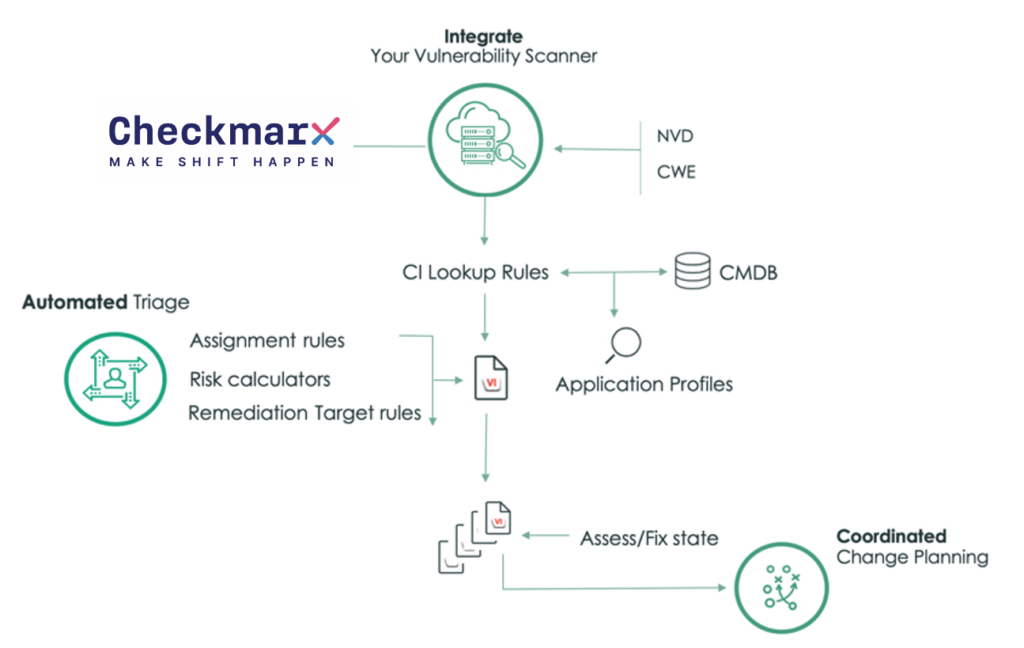
The following diagram shows how this lifecycle is implemented in the Checkmarx application vulnerability management process.
Common Types of Vulnerabilities
Organizations face vulnerabilities across applications, infrastructure, cloud environments, hardware, third-party services, and business processes. An effective vulnerability management program must identify and address weaknesses across all these areas to reduce overall cyber risk.
Infrastructure Vulnerabilities
Infrastructure vulnerabilities affect the systems, networks, devices, and identity services that support business operations. These weaknesses can provide attackers with initial access, privilege escalation opportunities, or pathways for lateral movement across environments.
Network and System Vulnerabilities
Network and system vulnerabilities arise from weaknesses in operating systems, servers, network devices, and security appliances. Unpatched software, outdated firmware, exposed services, and insecure network configurations can all increase the attack surface.
Examples include vulnerable VPN gateways, unsupported operating systems, exposed remote access services, insecure network segmentation, and misconfigured firewalls.
Endpoint Vulnerabilities
Endpoints such as laptops, desktops, servers, mobile devices, and virtual machines are frequent attack targets because they interact directly with users and external content.
Common endpoint vulnerabilities include missing security updates, unsupported operating systems, insecure configurations, disabled endpoint protection tools, and unauthorized software installations.
Identity and Access Management Vulnerabilities
Identity systems are often targeted because they control access to critical resources. Weak identity controls can allow attackers to bypass traditional security defenses without exploiting software vulnerabilities.
Examples include excessive user privileges, weak password policies, missing multi-factor authentication, orphaned accounts, privilege escalation paths, and poor access governance practices.
Software Vulnerabilities
Software vulnerabilities are security weaknesses found in applications, APIs, software components, and development environments. These vulnerabilities often arise from coding errors, insecure dependencies, misconfigurations, or exposed credentials, and remain one of the most common causes of security breaches.
Insecure Code Vulnerabilities
Insecure code vulnerabilities are security weaknesses introduced during software development through coding errors, insufficient input validation, flawed authentication logic, or unsafe handling of sensitive data. These flaws can allow attackers to compromise applications, access sensitive information, or gain unauthorized control of systems.
Common examples include SQL injection, cross-site scripting (XSS), buffer overflows, insecure deserialization, and remote code execution vulnerabilities. As applications become more complex and development cycles accelerate, coding mistakes can more easily reach production environments across web applications, APIs, mobile apps, and backend services.
Open-Source Vulnerabilities and Dependency Risks
Modern applications rely heavily on open-source libraries, frameworks, and third-party packages to accelerate development. While these components improve efficiency, they can also introduce security risks when vulnerable dependencies are included in software environments.
Managing dependency risk is challenging because applications often contain hundreds or thousands of direct and transitive dependencies. Vulnerabilities within these components can remain hidden for long periods, while software supply chain attacks increasingly target package repositories, maintainers, and build pipelines.
API Vulnerabilities
APIs expose application functionality, business logic, and data to external users, services, and systems. Because they often provide direct access to backend resources and sensitive operations, APIs represent a major attack surface in modern applications.
Common API vulnerabilities include broken authentication, excessive data exposure, insecure object references, and insufficient authorization controls. Weak rate limiting, insecure endpoint configurations, and poor token management can further increase the risk of unauthorized access and data compromise.
IaC and Cloud Configuration Vulnerabilities
Infrastructure as code (IaC) and cloud platforms enable organizations to deploy infrastructure quickly and at scale. However, insecure configurations remain one of the most common causes of cloud security incidents and data exposure.
Examples include misconfigured storage buckets, overly permissive IAM policies, exposed management interfaces, and publicly accessible databases. Because cloud environments change constantly, configuration drift, inconsistent policies, and insecure templates can create vulnerabilities across multiple environments simultaneously.
Secrets and Credential Exposure
Secrets and credentials such as passwords, API keys, access tokens, encryption keys, and certificates are critical for securing systems and applications. If exposed, they can provide attackers with immediate access to sensitive resources without requiring software exploitation.
Credential exposure often occurs through hardcoded secrets, public repositories, configuration files, CI/CD pipelines, or leaked environment variables. Weak password policies, credential reuse, and poor key management further increase the likelihood of account compromise, ransomware attacks, and lateral movement within enterprise networks.
Third-Party and Supply Chain Vulnerabilities
Organizations increasingly depend on vendors, cloud providers, SaaS platforms, contractors, and external software suppliers. Vulnerabilities introduced through these relationships can expose organizations to risks outside their direct control.
Examples include compromised software updates, insecure vendor integrations, vulnerable third-party applications, inadequate supplier security practices, and software supply chain attacks.
Hardware and Firmware Vulnerabilities
Not all vulnerabilities exist within software. Security weaknesses can also occur in physical devices, embedded systems, firmware, and processor architectures.
Examples include vulnerable BIOS and UEFI firmware, insecure IoT devices, outdated device firmware, hardware backdoors, and processor-level vulnerabilities that affect multiple systems simultaneously.
Operational and Human Vulnerabilities
Many successful attacks exploit weaknesses in business processes, governance, or human behavior rather than technical flaws alone.
Operational Vulnerabilities
Operational vulnerabilities result from weaknesses in security processes, asset management, change control, or organizational oversight.
Examples include incomplete asset inventories, poor patch management processes, weak incident response procedures, inadequate monitoring, and inconsistent security policies.
Human Vulnerabilities
Human vulnerabilities arise when employees, contractors, or users make mistakes or are manipulated by attackers.
Examples include phishing susceptibility, social engineering attacks, credential sharing, improper handling of sensitive data, and accidental exposure of confidential information.
Key Components of Vulnerability Management Solutions
General-Purpose Vulnerability Management
Asset Discovery
Asset discovery identifies and inventories systems, devices, applications, cloud resources and other assets across the environment. Accurate asset visibility is the foundation of vulnerability management because organizations cannot assess or remediate vulnerabilities on assets they do not know exist.
Asset discovery tools continuously monitor environments to identify new, unmanaged or unauthorized assets. This helps reduce blind spots, improve security coverage and ensure vulnerability assessments are performed across the entire attack surface.
Vulnerability Scanning
Vulnerability scanning automatically identifies known vulnerabilities, misconfigurations and missing patches across networks, endpoints, servers and cloud environments. Scanners compare discovered assets against vulnerability databases to detect security weaknesses that could be exploited by attackers.
Organizations typically perform both authenticated and unauthenticated scans to gain visibility into internal and external exposures. Continuous scanning helps security teams identify new vulnerabilities as systems change and threat landscapes evolve.
Risk-Based Prioritization
Risk-based prioritization helps organizations determine which vulnerabilities require immediate attention based on factors such as severity, exploitability, asset criticality and business impact. This allows security teams to focus resources on the vulnerabilities that present the highest overall risk.
Modern vulnerability management platforms often combine CVSS scores, threat intelligence, exploit availability and environmental context to improve prioritization accuracy and reduce remediation backlogs.
Patch Management
Patch management focuses on deploying security updates, software fixes and configuration changes to remediate identified vulnerabilities. Effective patch management helps reduce exposure by addressing security weaknesses before attackers can exploit them.
Many vulnerability management solutions integrate with patch management platforms to automate remediation workflows, track deployment progress and verify that vulnerabilities have been successfully resolved.
Threat Intelligence Integration
Threat intelligence integration enriches vulnerability data with information about active exploits, attacker activity and emerging threats. This additional context helps organizations understand which vulnerabilities are most likely to be targeted in real-world attacks.
By combining vulnerability findings with threat intelligence, security teams can improve prioritization decisions and respond more quickly to vulnerabilities associated with active exploitation campaigns.
Reporting and Compliance
Reporting and compliance capabilities provide visibility into vulnerability trends, remediation progress and overall security posture. These features help organizations track key metrics, demonstrate compliance with regulatory requirements and communicate risk to stakeholders.
Reports often include vulnerability severity distributions, remediation timelines, asset coverage, compliance status and performance indicators such as mean time to remediate (MTTR).
Application Vulnerability Management
Static Application Security Testing
Static application security testing (SAST) analyzes source code, bytecode or binaries for security vulnerabilities without executing the application. SAST tools examine code during development to identify insecure coding patterns, logic flaws and known weakness categories before software reaches production.
SAST is commonly used to detect vulnerabilities such as SQL injection, cross-site scripting (XSS), insecure cryptographic usage, hardcoded credentials and improper input validation. Because the analysis occurs early in the software development lifecycle, developers can address issues before deployment.
Dynamic Application Security Testing
Dynamic application security testing (DAST) analyzes running applications to identify security vulnerabilities during execution. Unlike SAST, which examines source code, DAST interacts with live applications from the outside by simulating attacker behavior against web interfaces, APIs and services.
DAST tools commonly detect vulnerabilities such as SQL injection, cross-site scripting (XSS), authentication weaknesses, insecure session handling, server misconfigurations and exposed sensitive data. Because testing occurs against deployed applications, DAST can identify issues that only appear during runtime.
Software Bill of Materials (SBOM)
A software bill of materials (SBOM) is a structured inventory of software components, libraries, dependencies and packages used within an application. SBOMs provide visibility into the software supply chain and help organizations understand what is included in their applications.
SBOMs typically contain details such as component names, versions, suppliers, licensing information and dependency relationships. Common formats include SPDX and CycloneDX, which standardize how software component data is shared across organizations and tools.
Software Composition Analysis
Software composition analysis (SCA) focuses on identifying security risks in open-source dependencies, third-party libraries and software components used within applications. Since modern applications heavily depend on external packages, SCA has become a core part of application security programs.
SCA tools analyze application dependencies and compare them against vulnerability databases containing known CVEs. These tools identify vulnerable packages, outdated versions, license risks and transitive dependencies that may introduce security exposure.
A major challenge in dependency management is visibility. Developers often import libraries indirectly through package managers, resulting in deeply nested dependency trees. SCA helps organizations understand exactly which components are present in their applications.
API Security
API security focuses on protecting APIs from vulnerabilities, abuse and unauthorized access. APIs are a critical component of modern applications because they expose backend functionality, business logic and sensitive data to external users and services.
API vulnerabilities often involve broken authentication, weak authorization controls, insecure tokens, excessive data exposure and insufficient input validation. Attackers commonly target APIs because they provide direct access to application functionality and are frequently exposed to the internet.
Infrastructure as Code Security
Infrastructure as code (IaC) security focuses on identifying vulnerabilities and misconfigurations in infrastructure definitions before cloud resources and environments are deployed.
IaC technologies such as Terraform, AWS CloudFormation, Kubernetes manifests and Ansible allow organizations to automate infrastructure provisioning. While this improves speed and consistency, insecure templates can rapidly introduce vulnerabilities at scale.
Container Security
Container security focuses on protecting containerized applications and the environments in which they run. Containers package applications together with their dependencies, making them portable and scalable, but insecure container images or configurations can introduce significant security risks.
Common container security issues include vulnerable base images, exposed secrets, excessive runtime privileges, insecure Kubernetes configurations and unpatched software packages inside containers. Attackers may also target container orchestration platforms to gain broader access to cloud environments.
Application Security Posture Management
Application security posture management (ASPM) provides centralized visibility into application security risks across development, cloud and production environments. ASPM platforms aggregate findings from multiple security tools and help organizations prioritize remediation efforts more effectively.
Modern AppSec programs often generate large volumes of security findings from SAST, DAST, SCA, IaC scanning, container security and cloud security tools. ASPM helps correlate these findings and reduce alert fatigue by identifying the vulnerabilities that represent the highest actual risk.
Vulnerability Management Challenges
When conducting vulnerability management, organizations must navigate a number of challenges. The most common ones include:
| Challenge Name | Description | Solution |
| Vulnerability Volume | Thousands of vulnerabilities are overwhelming to keep up with, creating desensitization among team members. | Prioritization based on exploitability and business impact can help calculate risk and allow remediating the most important ones. |
| Patch Management Complexity | Applying patches can be time-consuming, complex and risky, especially in environments with legacy systems or custom applications. | Automated patching tools can help streamline the process, along with regular patch testing, phased rollouts and fallback plans. |
| Lack of Visibility | Organizations often have limited visibility into their IT infrastructure, making it difficult to identify all assets and vulnerabilities. This issue is exacerbated by the rise of cloud environments. | Continuous monitoring and asset discovery tools can enhance visibility, especially when integrated with vulnerability solutions. |
| Coordination Between Teams | Poor communication or misaligned priorities between security and development, which can lead to delays in patching or remediating vulnerabilities. | Clear communication channels, formalized processes, as well as tools designed to build dev-sec trust, can help improve coordination. |
Follow these tips to create an effective vulnerability management plan.
What to Look for in Solutions
A reliable vendor should become a seamless part of your vulnerability management program. Here are some key criteria to consider when evaluating a vendor:
- Ensure the vendor can assess all types of code, including third-party libraries, with complete and accurate scans.
- Check if the vendor uses advanced threat intelligence to detect zero-day vulnerabilities and rapidly emerging threats.
- Choose a vendor that offers automated services to reduce the burden of manual updates and integrations and allow continuous scanning and monitoring.
- The tool should be designed for developer use, to build devsec trust and enhance security posture.
- The tool should be capable of conducting thorough scans without significantly impacting system performance or causing downtime.
- A reliable vendor should minimize false positives to streamline the remediation process.
- Opt for cloud solutions that allow flexible scheduling for assessments without complex installations.
- The tool should offer a risk-based scoring system, such as CVSS to prioritize vulnerabilities based on severity, asset criticality, and potential business impact.
- Ensure the solution can incorporate business context (e.g., asset value and location) to better prioritize remediation based on risk to the organization.
- The vendor should have a strong track record and expertise in vulnerability management, ensuring effective security solutions.
- Ensure the solution can scale to accommodate growth in your organization’s infrastructure, whether through cloud expansion, new data centers, or increased remote work endpoints.
- A well-designed dashboard with intuitive navigation and comprehensive reporting features makes vulnerability management more accessible to security teams.
- The solution should support detailed and customizable reports for different audiences (technical teams, management and compliance officers).
- The vendor should provide clear remediation guidance for each vulnerability and, if possible, support automated workflows to assign tasks and track remediation progress.
Checkmarx Vulnerability Assessments
Checkmarx provides automated vulnerability assessment services designed to enhance application security for enterprises. By combining static and dynamic code analysis with penetration testing, Checkmarx identifies and remediate vulnerabilities across all code, including third-party snippets.
Checkmarx’s cloud-based services are easily accessible, allowing organizations to perform assessments on their schedule without the complexities of local installations or constant updates. This comprehensive approach helps organizations secure their software development processes from code to cloud as part of their vulnerability management program, ensuring a higher level of protection against evolving threats.Ready to see how Checkmarx can enhance your vulnerability management program? Click here for a demo and take the first step toward securing your applications.