

Summary
AI component risk covers the models, agents, MCP servers, SDKs, and datasets entering enterprise applications without review. Checkmarx is best for teams governing AI components inside the development lifecycle, Snyk for AI-native application testing, Palo Alto Networks Prisma AIRS for runtime enforcement, and Wiz for cloud-side AI exposure.
What Is AI Component Risk and What Is the Role of AI Supply Chain Security?
AI component risk is the possibility that an AI model, agent, library, service, or integration introduces security, privacy, reliability, or compliance problems into an enterprise application. Unlike conventional software components, AI components can produce non-deterministic outputs and depend on external models, training data, prompts, retrieval systems, and third-party APIs. This makes their behavior harder to predict and test using traditional software controls alone.
AI supply chain security solutions help organizations discover, assess, and control the AI components used throughout application development and deployment. They extend software supply chain controls to models, AI libraries, SDKs, agents, MCP servers, and external AI services. Their role is to provide visibility into these dependencies, verify their provenance and integrity, identify vulnerabilities or malicious components, and enforce policies before risky components reach production. They can also monitor deployed components for changes, helping security teams manage AI risk across the full application lifecycle.
Regulatory frameworks already assume this inventory exists. The NIST AI Risk Management Framework, for example, organizes AI risk work into four functions that map directly to AI components:
Govern sets policies for which components teams may use;
Map inventories the models, agents, MCP servers, and SDKs in each application;
Measure assesses each component for vulnerabilities, unsafe code, and provenance gaps;
Manage applies controls, from blocking unapproved components to remediating findings.
Core enterprise AI risks include:
- Vulnerable or malicious AI models: Unverified models can contain vulnerabilities or harmful behavior; inventories, scanning, provenance checks, and policy gates help prevent risky models from reaching production.
- Poisoned or tampered model artifacts: Attackers can modify weights, tokenizers, or configuration files to introduce backdoors; integrity checks, provenance tracking, scanning, and version pinning help detect tampering.
- Malicious and compromised open-source packages: AI stacks inherit risks such as typosquatting, dependency confusion, malicious releases, and vulnerable transitive dependencies; package discovery, monitoring, and policy controls help manage them.
- MCP tool poisoning and malicious MCP servers: Compromised or malicious MCP servers can expose deceptive tools or unexpected capabilities; provenance checks, tool monitoring, discovery, and permission controls help constrain them.
- Prompt injection through connected components: Malicious instructions can enter through documents, websites, tools, or other retrieved content; runtime inspection, component mapping, tool policies, and action controls reduce exposure.
- Excessive agent and tool permissions: Broad permissions increase the impact of compromised tools, prompt injection, and agent errors; permission mapping, least privilege, action controls, and approvals limit potential damage.
- Secrets and credentials exposed to AI components: Credentials can leak through prompts, logs, context, configurations, or tool calls; secret detection, exposure monitoring, scoped identities, and pipeline controls help prevent disclosure.
This is part of a series of articles about AI security
AI Supply Chain Security Solutions at a Glance
The table below summarizes the main differences between the solutions covered in this guide. Each one is explored in more detail in the sections that follow.
| Category | Solution | Best For | Key Strengths | Things to Consider |
| AI-aware application security and supply chain | Checkmarx One AI Supply Chain Security | Governing AI components inside an existing AppSec platform | Deterministic AI discovery, AI-BOM, policy gates in CI/CD | Scans of very large codebases can take timeCovers pre-deployment AI supply chain risk, MCP and runtime AI behavior scanning coming soon |
| AI-aware application security and supply chain | Snyk AI Security Platform | Securing AI-native apps and the agents that build them | AI-BOM discovery, agent guardrails, continuous testing | Cost rises at scale, alert noise needs tuning |
| AI-aware application security and supply chain | Endor Labs | Governing coding agents, models, and MCP servers in the SDLC | Agent inventory, hook-level policy, reachability triage | Some capabilities are API-only; slower scans on big repos |
| AI-aware application security and supply chain | JFrog | Controlling which models and packages enter the pipeline | Model proxying, malicious model blocking, curation policy | Setup and permissions get complex at scale |
| AI model, agent, and runtime security | Palo Alto Networks Prisma AIRS | Enterprises securing the whole AI estate from one platform | Model scanning, agent identity controls, runtime enforcement | Newer modules need tuning and a learning curve |
| AI model, agent, and runtime security | HiddenLayer | Model-centric security from discovery through runtime | Model scanning, agent and MCP controls, agentless deployment | Deployment can require significant engineering effort |
| AI model, agent, and runtime security | Cisco AI Defense | Securing AI usage and development at the network layer | Asset discovery, algorithmic red teaming, in-network guardrails | Documentation and advanced setup can be hard to follow |
| AI model, agent, and runtime security | Wiz | Cloud teams tracking AI services and data exposure | Agentless AI-BOM, attack path analysis, data controls | Cloud-centric scope; code findings need validation |
Why AI Components Create New Application Security Risks
AI components create new application security risks because they add new dependencies, execution paths, data flows, and trust relationships that traditional application security programs may not fully cover. Models, agents, tools, and AI service providers should be treated as part of the application attack surface and governed with the same rigor as code, infrastructure, and third-party services.
This exposure is already close to universal. In Checkmarx’s Future of Application Security research, a March 2026 survey of 2,350 developers, CISOs, and AppSec managers, AI components were embedded in the applications of 96% of respondents.
- AI components bypass traditional review: Teams may add model APIs, SDKs, agent frameworks, plugins, or low-code AI tools during experimentation and leave them in production without normal security review.
- AI visibility gaps weaken controls: Security teams may not know which models are deployed, what data they process, which tools they use, or which external services receive application data.
- Models and agents can execute untrusted code: Model artifacts, custom definitions, serialized files, and agent tools may run code, call dependencies, or perform actions if their origin and behavior are not verified.
- AI dependencies expand supply chain risk: AI applications rely on model repositories, datasets, vector databases, embedding services, inference APIs, prompt registries, and tool frameworks that can be compromised or changed.
- Externally managed AI assets can change independently: Hosted models, APIs, datasets, or tools may update outside the application release cycle, requiring version tracking, provenance checks, and change detection.
- MCP servers expand trust boundaries: MCP servers can connect models to file systems, databases, SaaS platforms, developer tools, or internal services, extending application risk to the server and its permissions.
- MCP tools require strict governance: Organizations should inventory MCP servers and tools, restrict permissions, validate configurations, and monitor tool calls that cross sensitive security boundaries.
Key AI Component Risks in Enterprise Applications and How Supply Chain Security Can Help
Vulnerable or Malicious AI Models
AI models can contain vulnerabilities or intentionally harmful behavior that becomes part of the application using them. Risks are higher when teams download models from public repositories without verifying the publisher, provenance, version, or security history. A model can also behave safely during basic testing while producing unsafe results for specific inputs.
Organizations should treat models as software dependencies rather than trusted data files. Model inventories should record their source, version, owner, integrity information, and applications that use them. Models should also be evaluated before deployment and monitored for unexpected changes.
How to reduce this risk:
- Model discovery and inventory: Identify models used across applications and record their source, version, owner, and deployment locations.
- Model security scanning: Inspect model artifacts for known vulnerabilities, malicious code, unsafe behavior, and other indicators of compromise.
- Provenance enforcement: Restrict model use to approved repositories and providers with verified origins and documented ownership.
- Policy gates: Block unapproved or high-risk models from entering builds, deployment pipelines, or production environments.
Model Serialization and Unsafe Loading Risks
Some model formats use serialization mechanisms that can execute code when a model is loaded. Python pickle-based formats are a common example. If an attacker modifies such a file, loading the model can execute malicious commands with the privileges of the application or model-serving process.
Safer model formats can reduce this attack surface by separating model data from executable code. When unsafe serialization cannot be avoided, organizations should verify artifact integrity, restrict model sources, isolate loading environments, and run model services with minimal privileges.
How to reduce this risk:
- Unsafe format detection: Identify model artifacts that use pickle or other serialization formats capable of executing code during loading.
- Loader analysis: Detect dangerous loading functions, insecure deserialization patterns, and model-processing code that can trigger execution.
- Artifact policy enforcement: Block unsafe model formats or require approved loading methods before models can enter production.
- Integrity verification: Validate hashes, signatures, and provenance before serialized model files are loaded by trusted systems.
Poisoned or Tampered Model Artifacts
Attackers can modify model weights, configuration files, tokenizers, adapters, or other files associated with a model. Tampering can introduce backdoors, change model behavior, or exploit weaknesses in the software that processes the artifact. Poisoned models may behave normally except when particular inputs or triggers are present.
Integrity checks help detect modifications after an artifact has been approved. Organizations should also verify provenance and control where models can be downloaded from. Pinning approved versions prevents applications from silently consuming a newly modified upstream artifact.
How to reduce this risk:
- Artifact integrity checks: Compare hashes or signatures against approved versions to detect unauthorized changes to model files.
- Provenance tracking: Record where models originated, who approved them, and which versions applications are permitted to consume.
- Model scanning: Analyze weights, configurations, tokenizers, and related artifacts for malware, backdoors, and suspicious content.
- Version pinning: Require applications to use reviewed model versions instead of automatically consuming changed upstream artifacts.
For a detailed comparison of tools that detect tampered model files, see [Commercial Solutions for Detecting Tampering in AI Model Artifacts](URL once published).
Malicious and Compromised Open-Source Packages
AI applications commonly rely on open-source libraries for inference, orchestration, embeddings, vector search, and model processing. These packages inherit conventional software supply chain risks, including malicious releases, compromised maintainer accounts, dependency confusion, typosquatting, and vulnerable transitive dependencies.
Package controls should therefore extend to the entire AI software stack. Teams should pin dependencies, scan direct and transitive packages, verify trusted package sources, and monitor newly disclosed vulnerabilities. Runtime privileges should also limit the damage a compromised dependency can cause.
How to reduce this risk:
- Dependency discovery: Inventory direct and transitive packages used by AI frameworks, agents, model loaders, and supporting services.
- Malicious package detection: Flag typosquatting, dependency confusion, suspicious install scripts, obfuscation, and known malicious releases.
- Vulnerability monitoring: Continuously check dependencies for newly disclosed vulnerabilities and changes in package risk.
- Package policy enforcement: Restrict downloads to approved registries, versions, licenses, and packages that meet security requirements.
Unapproved AI Models, SDKs, and Services
Developers can integrate external AI services with a few lines of code or install new models and SDKs during experimentation. These components may reach production without security teams knowing what was added. This creates shadow AI dependencies that may bypass requirements for security, privacy, data residency, or vendor review.
Discovery is important because policy controls only work on components the organization knows about. Enterprises should identify AI models, APIs, SDKs, and services across source repositories and deployed applications, then compare them against approved component and provider policies.
How to reduce this risk:
- AI component discovery: Scan repositories and applications for models, SDKs, APIs, agent frameworks, and other AI dependencies.
- AI-BOM generation: Maintain an inventory showing which AI components are used, their versions, origins, and associated applications.
- Allowlist enforcement: Compare discovered components against approved models, providers, SDKs, and service policies.
- CI/CD controls: Flag or block newly introduced AI components before unreviewed dependencies reach production.
MCP Tool Poisoning and Malicious MCP Servers
MCP servers can expose tools that models or agents use to interact with external systems. A malicious server can provide deceptive tool descriptions, manipulate returned content, or expose capabilities that differ from what users and developers expect. A legitimate server can create similar risks if it is compromised after deployment.
MCP security therefore requires controls around both server identity and exposed capabilities. Organizations should approve server sources, inspect tool definitions, restrict server permissions, and monitor changes to tools and configurations. Sensitive operations should require stronger authorization than ordinary read-only requests.
How to reduce this risk:
- MCP discovery: Inventory MCP servers, clients, tools, and configurations used across applications and development environments.
- Server provenance checks: Restrict connections to approved MCP servers and verify their source, identity, and configuration.
- Tool definition monitoring: Detect changes to tool descriptions, capabilities, arguments, or configurations that alter expected behavior.
- Permission enforcement: Limit MCP tools to approved resources and operations and block unauthorized or high-risk actions.
For an architectural approach to these controls, see Building an MCP Security Architecture: 18 Key Security Controls.
Prompt Injection Through Connected Components
Prompt injection does not have to come directly from a user. An AI application can retrieve malicious instructions from websites, documents, emails, databases, MCP resources, or other content that the model processes. The model may interpret these instructions as commands instead of treating them solely as untrusted data.
This becomes more serious when a model can call tools or access sensitive information. Applications should separate untrusted content from trusted instructions, constrain available tools, validate tool arguments, and enforce authorization outside the model. The model itself should not be the final security boundary.
How to reduce this risk:
- Connected component inventory: Map retrieval sources, MCP tools, external services, and other components that can introduce untrusted content.
- Runtime guardrails: Monitor model interactions and tool calls in real time to detect and block malicious instructions, unauthorized actions, and attempts to bypass security policies.
- Tool policy enforcement: Restrict which tools can be invoked and validate arguments independently of instructions generated by the model.
- Sensitive action controls: Require deterministic authorization or approval before injected instructions can trigger high-impact operations.
Related content: Read our article about how AI runtime security works
Excessive Agent and Tool Permissions
Agents may receive access to databases, cloud resources, source repositories, file systems, or business applications. Broad permissions increase the impact of prompt injection, model errors, compromised tools, and incorrect agent decisions. An agent that only needs to read records, for example, should not automatically receive permission to modify or delete them.
Least-privilege controls should apply to every agent and tool integration. Permissions should be scoped by operation, resource, environment, and identity where possible. High-impact actions can also require deterministic validation or explicit approval before execution.
How to reduce this risk:
- Agent permission mapping: Inventory the systems, tools, resources, and operations available to each agent and integration.
- Least-privilege policies: Restrict agents to the minimum permissions required for their intended tasks and environments.
- Runtime guardrails: Monitor agent behavior and tool execution in real time to detect and block unauthorized operations, privilege escalation attempts, and actions that exceed defined permissions.
- Action-level enforcement: Block tool calls that exceed approved operations, resources, identities, or authorization boundaries.
- High-risk action controls: Require additional validation or human approval for destructive, privileged, or sensitive operations.
Secrets and Credentials Exposed to AI Components
AI components often need API keys, cloud credentials, database passwords, and service tokens to access external systems. Secrets can be exposed through prompts, logs, model context, configuration files, tool responses, or overly broad environment variables. An external model provider may also receive credentials accidentally included in application context.
Secrets should remain outside prompts and model-visible data whenever possible. Applications should use dedicated identities, short-lived credentials, secret-management systems, and narrowly scoped tokens. Logging and tracing systems also need controls to prevent credentials from being captured during AI requests and tool calls.
How to reduce this risk:
- Secret detection: Scan source code, configuration, prompts, and AI workflows for embedded credentials and other sensitive values.
- Credential exposure monitoring: Detect secrets passed into model context, tool calls, logs, or external AI services.
- Identity controls: Replace shared credentials with dedicated identities and narrowly scoped, short-lived tokens where possible.
- Pipeline enforcement: Block commits or deployments that introduce exposed secrets into AI components or their configurations.
Data Leakage Through Models, Agents, and External APIs
AI applications can send sensitive information to hosted models, embedding providers, observability platforms, MCP servers, and other external services. Agents may also retrieve more information than a user is authorized to access and include it in model context or responses. This can expose customer records, intellectual property, source code, or regulated data.
Data controls should cover the complete AI data flow rather than only the primary model API. Organizations need to identify what data each component receives, where that data is processed or stored, and which parties can access it. Filtering, access controls, data minimization, retention policies, and provider-specific restrictions can then be applied at the appropriate boundaries.
How to reduce this risk:
- AI data flow mapping: Identify which models, agents, APIs, MCP servers, and supporting services receive sensitive application data.
- Runtime guardrails: Inspect prompts, model responses, and tool interactions in real time to detect and prevent sensitive data from being exposed to unauthorized users, models, or external services.
- Sensitive data detection: Classify regulated, confidential, or proprietary information before it reaches external AI components.
- Provider policy enforcement: Restrict which models and services may process specific data types based on organizational requirements.
- Runtime data controls: Filter or block sensitive information in prompts, model responses, tool calls, and external service requests.
Notable AI Supply Chain Security Solutions for Managing AI Component Risk
How we selected these solutions: We shortlisted AI component risk solutions based on their ability to discover AI models, agents, MCP servers, and SDKs across applications, assess them for supply chain and configuration risk, enforce policy inside development workflows, and control AI behavior at runtime.
AI-Aware Application Security and Supply Chain Platforms
1. Checkmarx One AI Supply Chain Security

Best for: Governing AI components inside an existing AppSec platform
Strengths: Deterministic AI discovery, AI-BOM, and policy gates in CI/CD
Things to consider: Scans of very large codebases can take time to complete
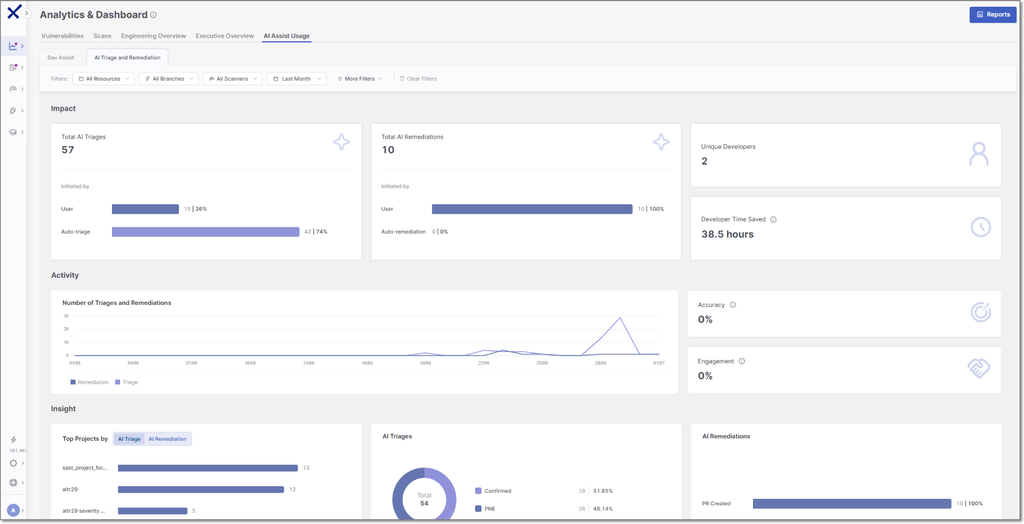
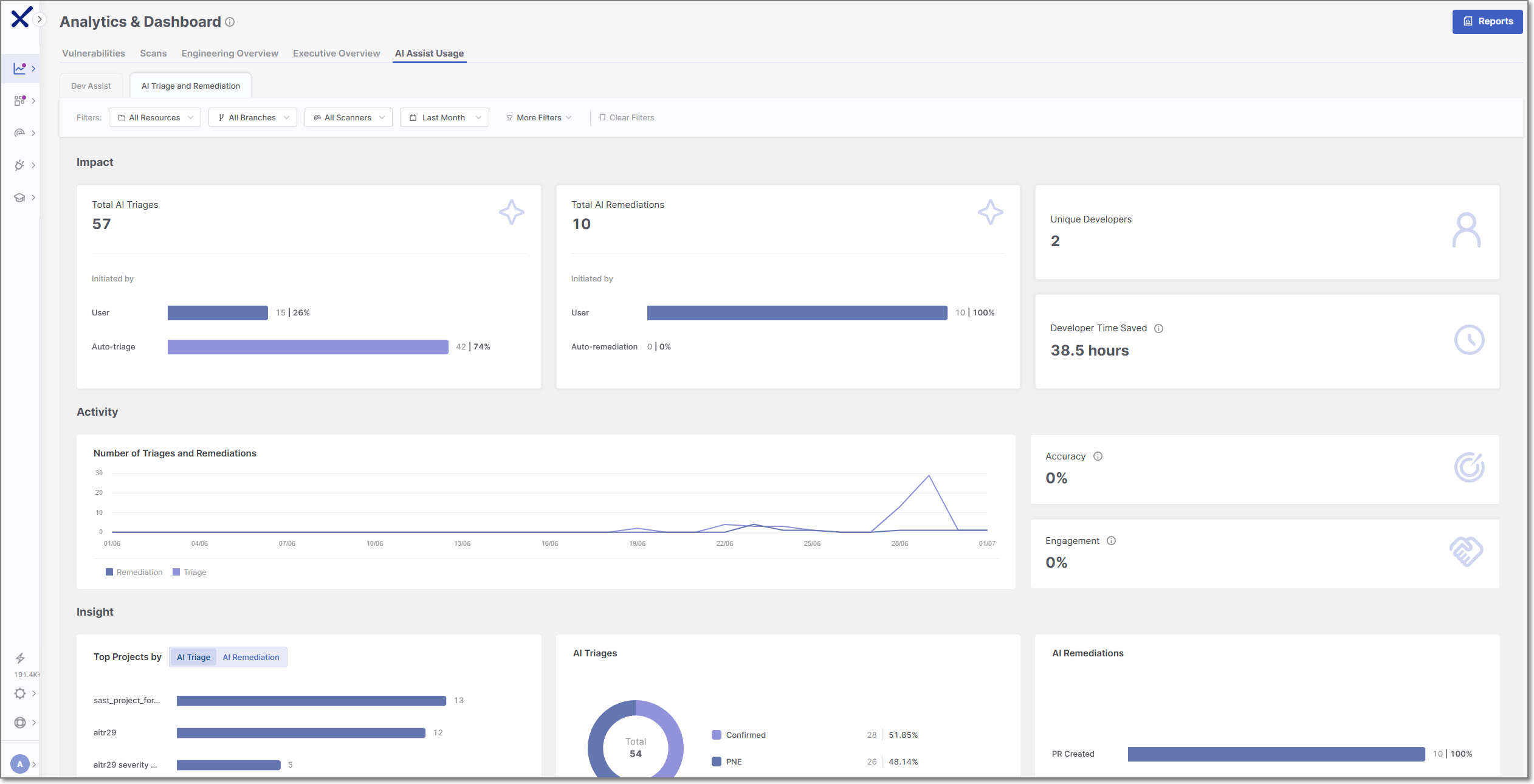
Checkmarx One AI Supply Chain Security discovers and governs AI components across the application development lifecycle. It identifies LLMs, AI SDKs, AI libraries, MCP servers, MCP clients, AI agents, agent frameworks, datasets, and prompts inside applications, then builds a centralized AI asset catalog spanning all repositories.
Discovery is deterministic rather than inference-based: the engine analyzes source code, dependency files, configuration manifests, and import statements, so each finding traces back to real code signals. The capability runs natively inside Checkmarx One alongside Fusion SAST, SCA, DAST, and malicious package detection, under one policy layer.
Key features include:
- Deterministic AI component discovery: Analyzes source code, dependency files, configuration manifests, and import statements to locate AI assets across every repository and application, with results that stay current on each commit.
- LLM Scanner: Scans the code and serialized artifacts bundled inside AI model packages, such as pickle-backed PyTorch files, for unsafe deserialization, command execution, and trust_remote_code risks before a model loads. It does not analyze model weights in isolation or runtime model behavior. MCP scanning is coming soon.
- AI supply chain threat detection: Goes beyond CVE matching to flag unverified model sources, risky model-loading patterns, and configuration weaknesses in the AI components discovered across applications.
- AI-BOM generation: Produces a continuously updated bill of materials for models, agents, MCP servers, and LLM SDKs, including origins, licenses, dependencies, and risk metadata, exportable on demand as a CycloneDX AI-BOM, from the global AI inventory or from an individual project’s scan results.
- Policy enforcement at the gate: Discovered AI assets feed the same risk model, ownership routing, and policy gates as the rest of Checkmarx One. Compliance-mapped allow/block rules decide which models, MCP servers, and agents are approved, so a component an AI assistant proposes is checked by independent policy before it enters the build.
- Compliance mapping and audit trails: Maps discovered AI assets to frameworks including the EU AI Act, NIST AI RMF, ISO/IEC 42001, and the OWASP LLM Top 10, producing audit-ready AI-BOM documentation such as the per-component origins and dependency data that EU AI Act transparency requirements call for.
- Related supply chain coverage on the same platform: Checkmarx One also includes Malicious Package Protection and Secrets Detection, which cover the open-source packages and API keys that AI components depend on.
Limitations:
- Pre-deployment focus: Discovers and assesses AI components in code and configuration; it does not secure AI behavior at runtime, such as prompt injection or agent actions.
- In-house components: Custom-built AI components such as private MCP servers or AI proxies are not covered.
- Organization-wide AI tool visibility: Visibility into every GenAI tool and agent used across the organization, beyond those referenced in code, is outside its scope.
Source: Checkmarx
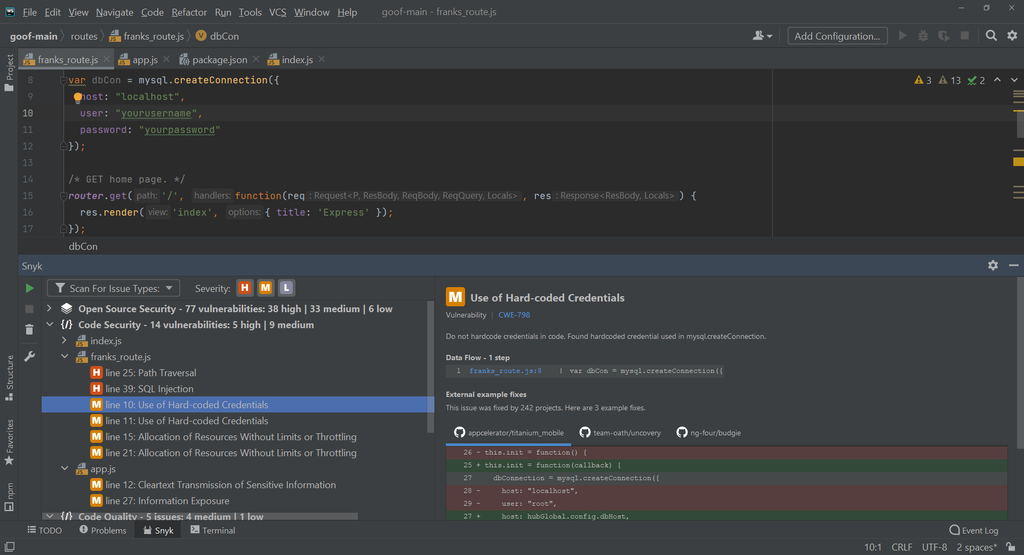
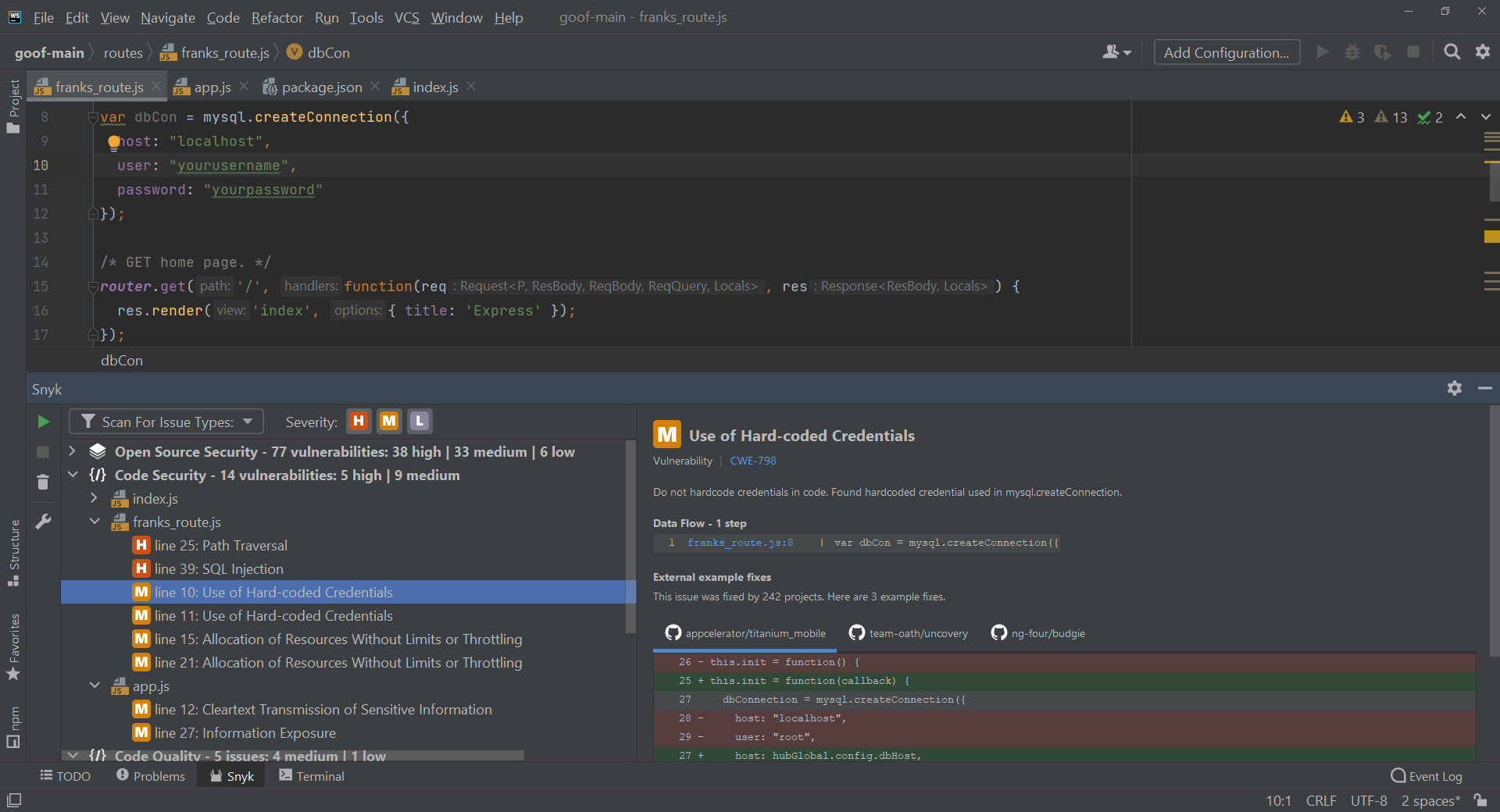
2. Snyk AI Security Platform
Best for: Securing AI-native apps and the agents that build them
Strengths: AI-BOM discovery, agent guardrails, and continuous testing
Things to consider: Cost rises at scale and alert noise needs tuning
Snyk positions its platform as an independent validation layer for AI-built software, separating the system that generates code from the system that checks it. Deterministic engines are paired with frontier-model reasoning to validate the code AI writes, the models and agents it runs, and the applications it builds.
Evo, the agentic layer, covers three areas: discovery and governance of AI assets, security controls over the agents used in development, and continuous offensive testing of applications and AI systems. The platform is aimed at security teams that need inventory, policy, and testing in one place.
Key features include:
- AI asset inventory and live AI-BOM: Evo AI-SPM identifies models, agents, MCP servers, datasets, and plugins across repositories and generates a continuously updated AI bill of materials.
- Risk context on discovered assets: Risk intelligence enriches inventoried AI components with security context so policy can be applied across development workflows.
- Agentic development security: Evaluates the tools and services agents rely on, applies guardrails to agent actions in real time, and checks AI-generated code before it reaches repositories, pipelines, or production.
- Continuous offensive security: Stress-tests applications and AI systems the way attackers would, running autonomously and continuously rather than at fixed pentest intervals.
- Independent exploitability validation: A dedicated validation model acts as a judge, confirming that a finding is exploitable before it surfaces to the team.
- Cross-role governance: Connects CISOs, heads of AI, engineering leaders, and security engineers around one set of AI policies enforced in development and CI/CD.
Limitations (as reported by users on G2):
- Cost at scale: Several reviewers describe the platform as expensive as teams grow, with steep jumps between tiers and some capabilities reserved for higher plans.
- Alert noise and false positives: Low-severity findings can accumulate, and tuning filters to match a team’s risk tolerance takes trial and error.
- Scan times on larger repositories: Scans of medium and large repositories, particularly mixed-language monorepos, can add minutes to pipelines.
- Uneven coverage across modules: Reviewers note that DAST sits in a separate interface and that secret detection is weaker than the dependency analysis.
Source: Snyk
3. Endor Labs

Best for: Governing coding agents, models, and MCP servers in the SDLC
Strengths: Agent inventory, hook-level policy, reachability-based triage
Things to consider: Some capabilities are API-only and scans slow on big repos
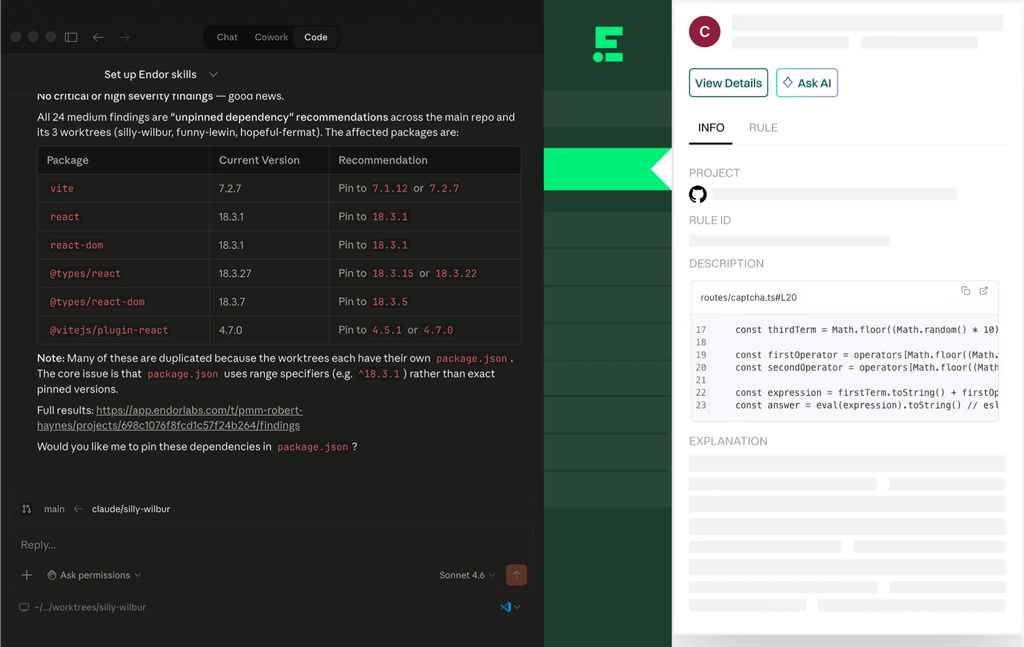
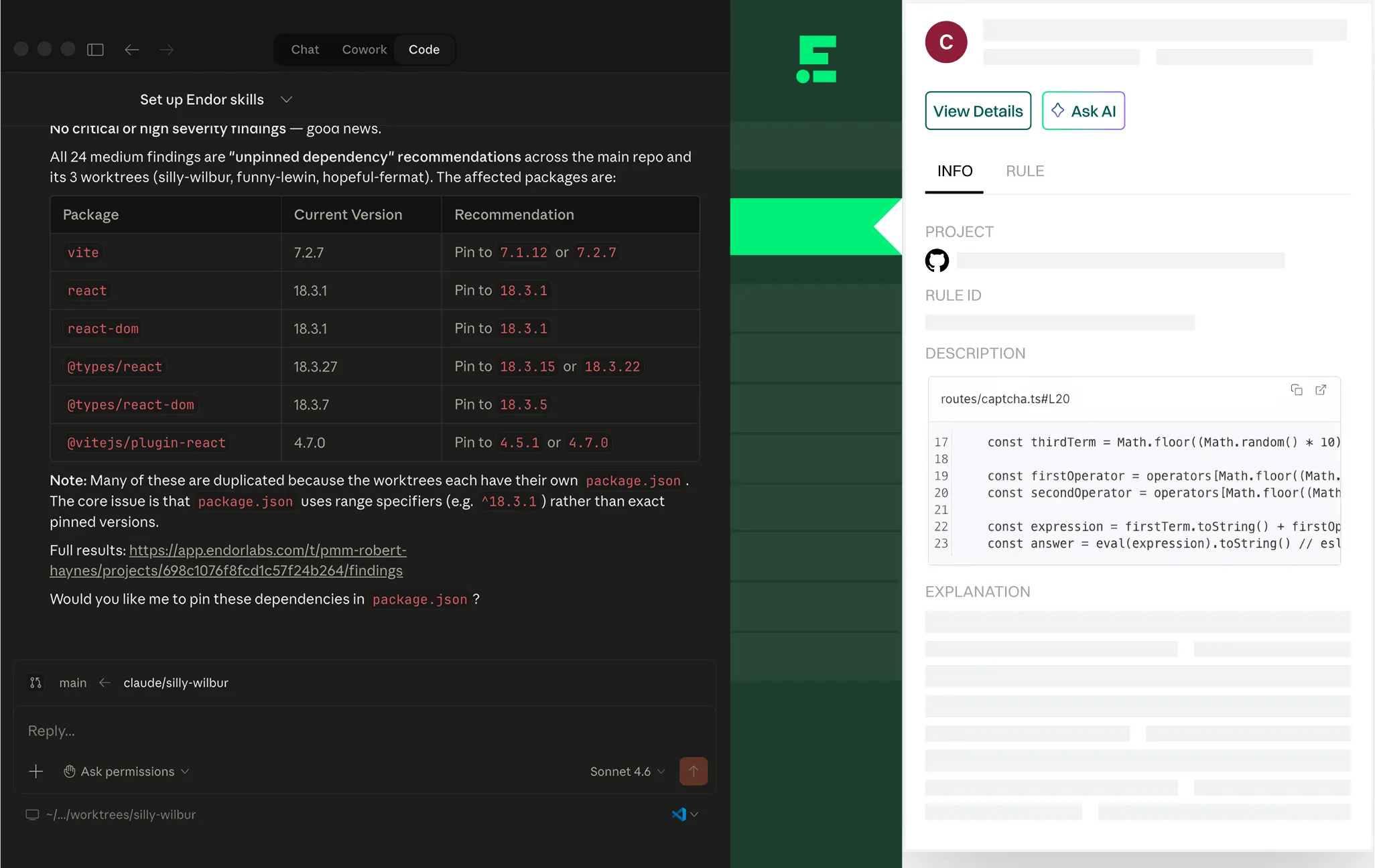
Endor Labs focuses on the security of agentic software development through AURI, its platform for governing coding agents and the code they produce. It inventories the agents, models, MCP servers, and skills running across developer workstations and cloud environments, and records how each one is used.
Policy is enforced deterministically at the hook layer rather than through per-IDE plugins or endpoint agents. The coding harness passes structured event data to Endor Labs, which evaluates it server-side and returns an allow, deny, or modify decision.
Key features include:
- AI component and agent inventory: Catalogs every AI coding agent, model, MCP server, and skill in use, along with sessions, usage, and risk scores tied to observed behavior.
- Hook-layer policy enforcement: Blocks destructive shell commands, credential reads, and risky tool calls using 29 default policies plus custom regex rules, evaluated server-side so they are not subject to prompt-based bypass.
- Central agent audit trail: Streams every prompt, tool call, file read, and shell command to one audit log that compliance teams can query.
- Malicious package detection: An LLM-native pipeline examines install scripts, obfuscation patterns, network calls, and exfiltration signals, catching typosquatting, dependency confusion, and hallucinated packages before an agent installs them.
- Full-stack reachability analysis: Traces data flow through first-party code, direct and transitive dependencies, and container image layers to separate reachable vulnerabilities from the rest.
- Secrets detection at commit: Blocks secrets at the pre-commit hook and validates whether each credential is live or already revoked.
- Broad harness coverage: Integrates with Cursor, Claude Code, Codex, VS Code, GitHub Copilot, Gemini CLI, and other MCP-compatible clients through a single MCP server.
Limitations (reported in the critical sections of 4 and 5 star reviews on G2):
- Capabilities available only via API: Reviewers ask for more of the platform’s API functionality to be exposed in the web interface.
- Interface details: Users authenticating through a custom identity provider can show as an unknown provider, and some settings such as the default monitored branch are only configurable from the CLI.
- Scan performance on large repositories: Results are described as accurate, but scan times on bigger projects could be faster.
- Setup and error messaging: When a project’s dependencies fail to analyze, error messages do not always explain how to resolve the problem.
Source: Endor Labs
4. JFrog
Best for: Controlling which models and packages enter the build pipeline
Strengths: Model proxying, malicious model blocking, policy at point of request
Things to consider: Large-scale setup and permissions management get complex
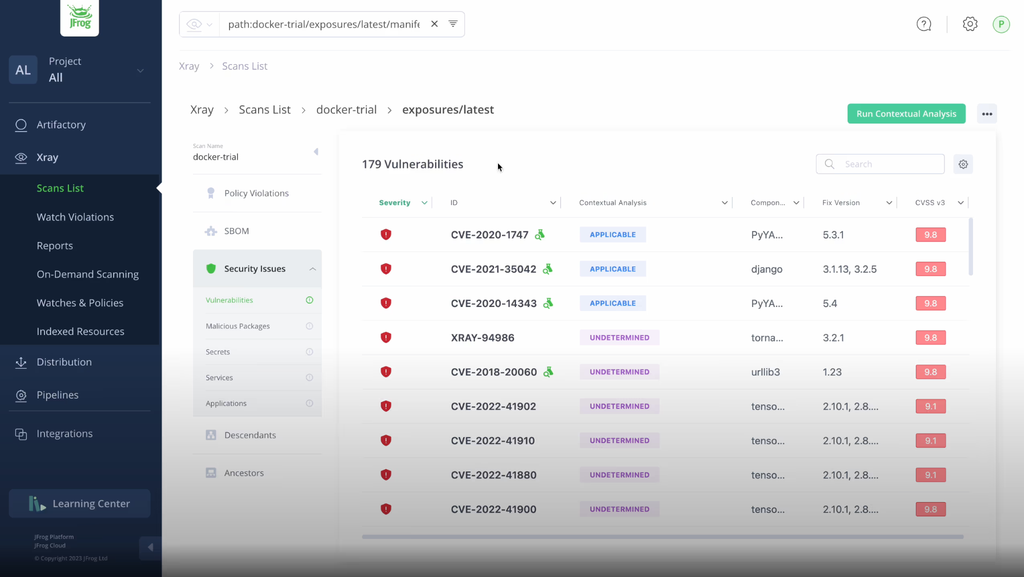
JFrog treats AI models as software artifacts inside the same platform that holds an organization’s other binaries. ML Model Management creates a single system of record for models: teams can store first-party and internally modified models and proxy Hugging Face through remote repositories for third-party models.
Curation governs what enters the environment in the first place. Every package, AI model, and IDE extension is vetted at the point of request against the organization’s policies, with risky components blocked before they reach developers, pipelines, or AI agents.
Key features include:
- Model registry and proxying: Stores proprietary and internally augmented models and proxies Hugging Face, so models remain available even if an upstream repository entry is deleted or modified.
- Malicious model detection and license compliance: Detects and blocks malicious models and models carrying non-compliant licenses, applying Xray’s scanning to model artifacts.
- Policy vetting at point of request: Evaluates packages, AI models, and extensions against policies covering severity, license, and package age, including an immaturity policy that holds new versions for 14 days.
- Compliant version substitution: When a component violates policy, Curation serves the highest compliant version instead across direct and transitive dependencies, so builds continue.
- Governance over AI agent requests: Agents pulling dependencies through JFrog’s MCP server are subject to the same Curation policies as developers, with every request vetted and logged.
- Waivers and audit records: Developers can request access from inside their workflow when no compliant version exists; waivers expire, and every request, block, and approval is logged.
- Release bundling and pipeline integration: Models can be stored alongside required data, files, and packages and bundled into immutable Release Bundles, with an Amazon SageMaker connection for traceable artifact flow.
- Global policy enforcement: Package Traffic Controller catches requests that bypass Artifactory, and Curation Federation applies one policy across sites and regions.
Limitations (as reported by users on G2):
- Learning curve: The breadth of the platform means new users take time to get oriented, and the interface carries many configuration options.
- Configuration in large environments: Reviewers describe setup and ongoing management as complicated in large estates with customized CI/CD workflows.
- Permission and repository management: Handling permissions and repository structure becomes more involved as the number of teams and repositories grows.
Source: JFrog
AI Model, Agent, and Runtime Security Platforms
5. Palo Alto Networks Prisma AIRS

Best for: Enterprises securing the whole AI estate from one platform
Strengths: Model scanning, agent identity controls, and runtime enforcement
Things to consider: Newer modules need tuning and a learning curve to operate
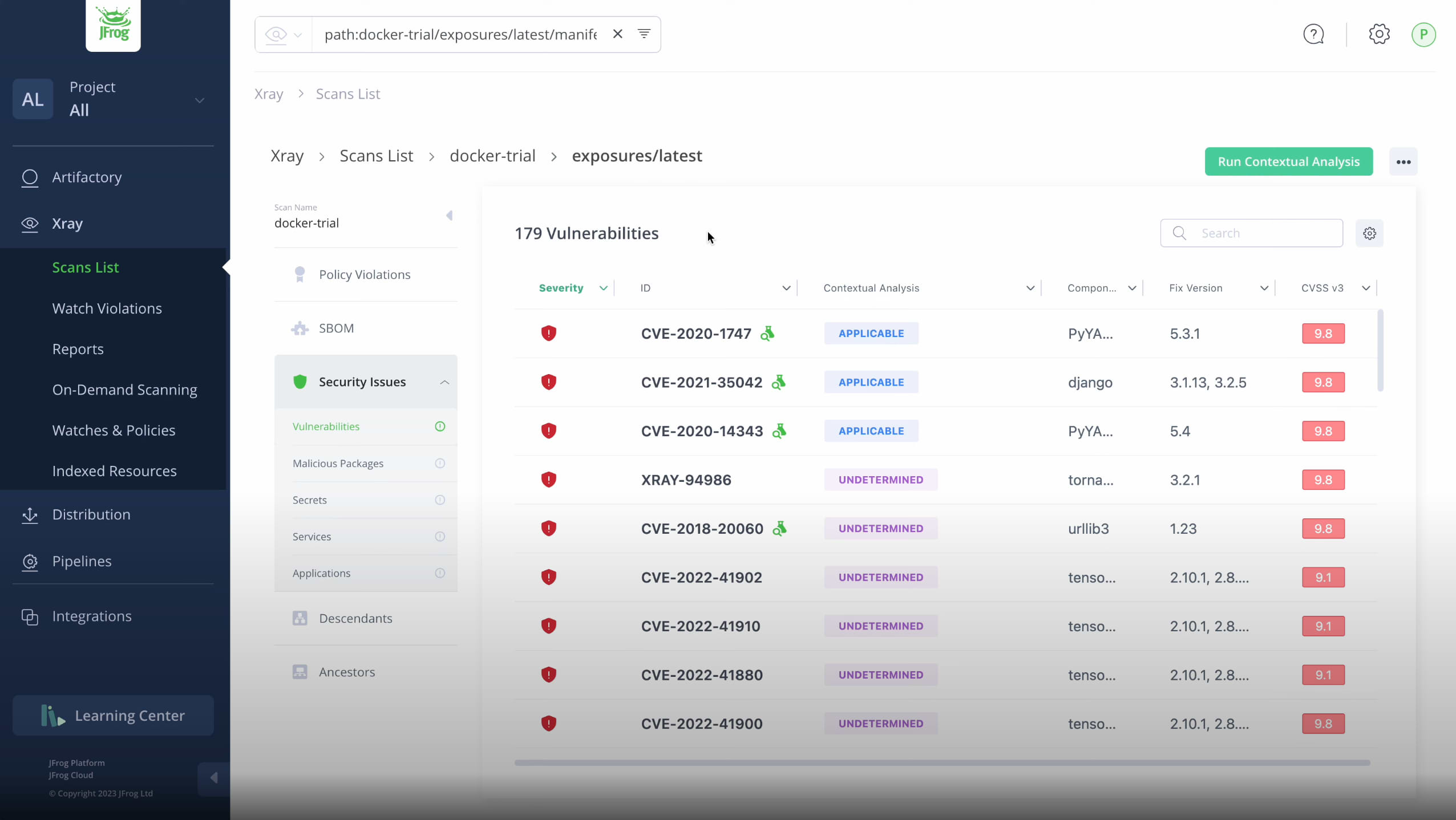
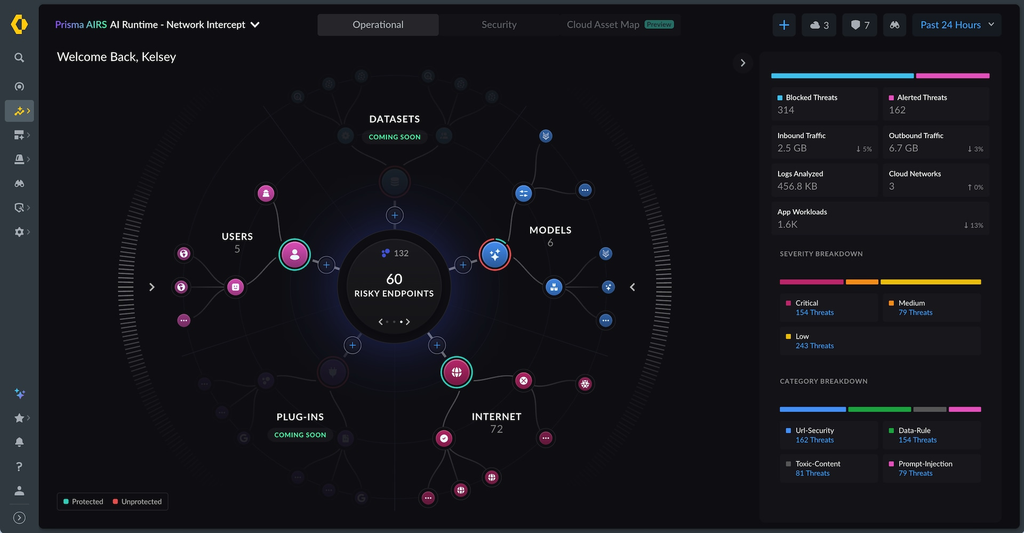
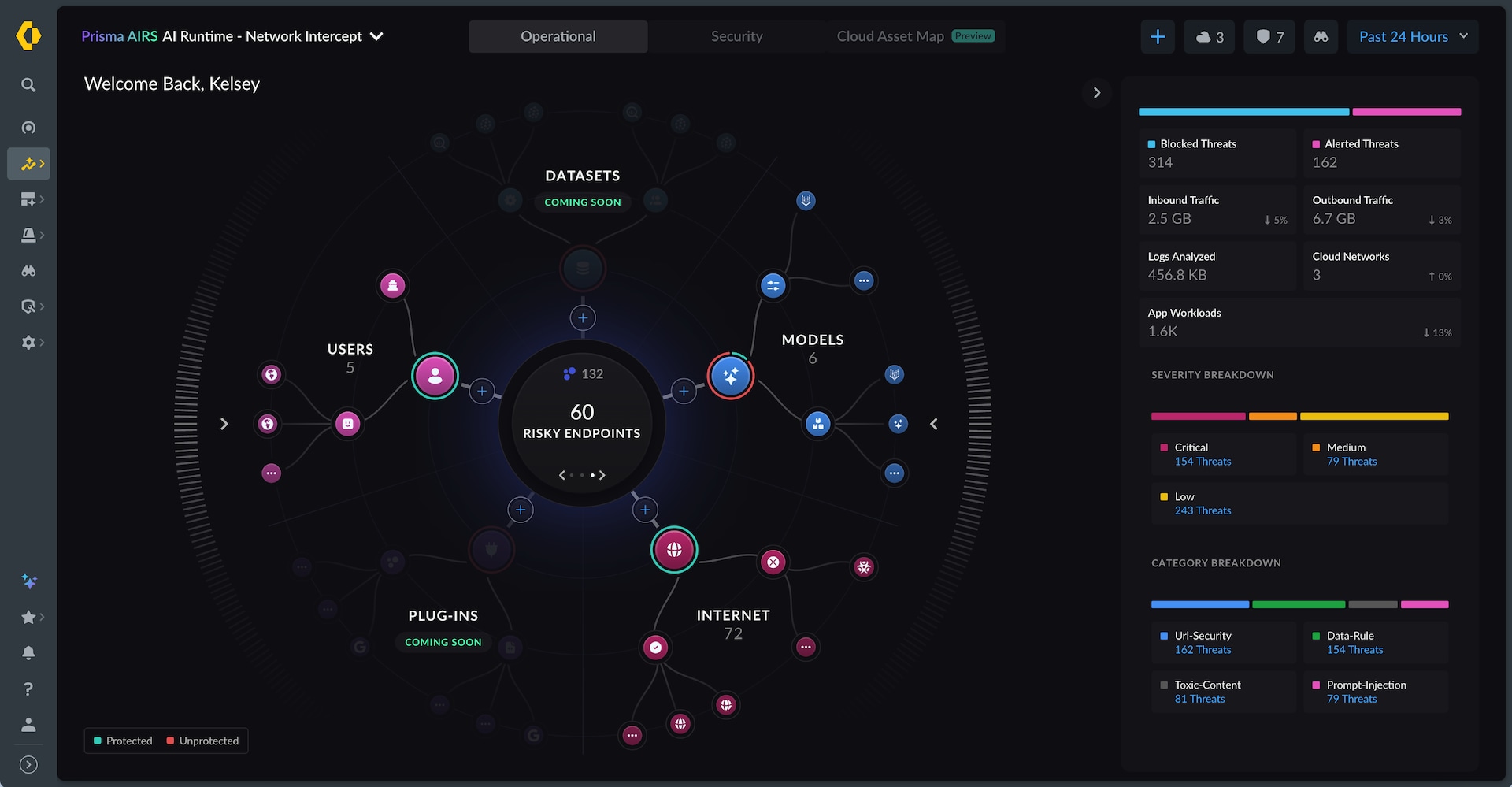
Prisma AIRS covers the AI lifecycle in three stages: discovering AI assets, assessing their risk, and protecting them during operation. It builds visibility into AI agents, applications, and models and shows how they connect across the environment.
The platform combines pre-deployment controls such as model scanning and red teaming with runtime enforcement over live AI interactions. Deployment options include Network Intercept and API Intercept modes, plus a managed runtime security service.
Key features include:
- Shadow AI discovery: Provides visibility into every AI agent, application, and model in the environment and maps how those components connect to one another.
- Third-party model scanning: Scans models for vulnerabilities including model tampering, malicious scripts, and deserialization attacks before they are adopted.
- AI posture management: Covers the data used for training or inference, the integrity of AI agents and applications, and access to deployed models.
- Agent identity and action controls: Verifies each agent’s identity and enforces controls in real time to stop unauthorized actions as agent deployments scale.
- AI red teaming: Simulates attacks against agents and applications, with support for multi-turn attacks and multi-agent systems, and profiles AI endpoints ahead of assessments.
- Runtime threat prevention: Monitors AI traffic for prompt injection, sensitive data exposure, malicious URLs, and toxic content, and blocks unsafe actions during live interactions.
- AI gateway controls: Acts as a control plane for discovering, governing, and securing AI activity across the enterprise.
Limitations (as reported by users on Gartner Peer Insights):
- Feature maturity: Some capabilities are described as early-stage or limited in scope compared with the rest of the platform.
- Learning curve: Reviewers note that getting full value from the platform takes time to understand.
- Tuning overhead: Certain alerts and reports need adjustment to fit a specific environment, which adds manual work.
Source: Palo Alto Networks
6. HiddenLayer

Best for: Model-centric security across discovery, scanning, and runtime
Strengths: Model scanning, agent and MCP controls, agentless deployment
Things to consider: Deployment can require meaningful ML and infrastructure effort
HiddenLayer is built specifically for threats against models, pipelines, and agentic systems rather than adapted from general-purpose security tooling. The platform is organized into four modules covering discovery, supply chain security, attack simulation, and runtime defense.
It is model-agnostic and agentless, and does not require training data, so it can be deployed without exposing weights, prompts, or customer data. Connectors link it to cloud platforms, CI/CD, data platforms, SIEM and SOAR tools, API gateways, and MLOps systems.
Key features include:
- AI asset discovery: Builds a living inventory of AI across the environment, including shadow AI deployments that were never registered with security teams.
- AI supply chain validation: Checks model integrity and supply chain provenance before models reach deployment.
- Model scanning: Analyzes models for malware, vulnerabilities, backdoors, and unknown components ahead of production use.
- Agentic and MCP security: Protects autonomous agents and MCP-based systems against prompt injection, unsafe tool use, and harmful autonomous actions.
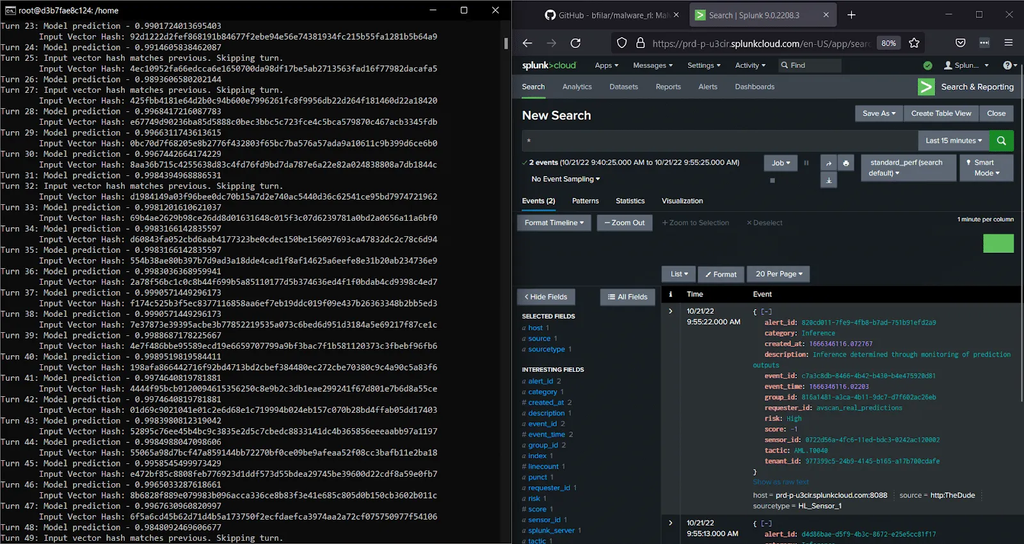
- AI guardrails: Enforces policies against prompt injection, data leakage, and unsafe model behavior while applications are running.
- Attack simulation and red teaming: Runs continuous adversarial simulations against AI systems to surface weaknesses before attackers find them.
- Agent harness security: Applies runtime visibility, threat detection, and inline enforcement to AI coding agents.
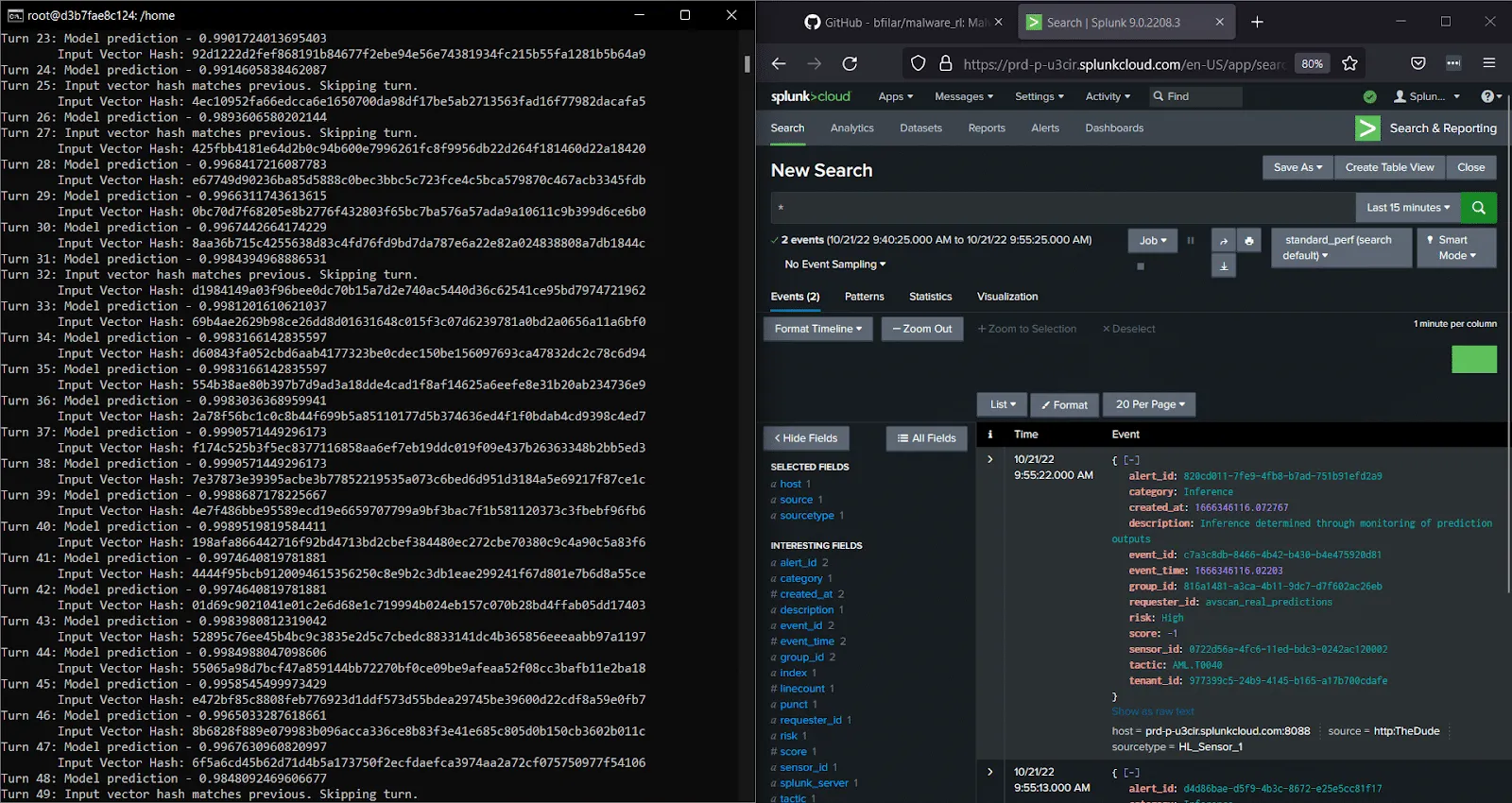
- Runtime detection and response: Detects and responds to attacks in production without affecting model performance.
Limitations (as reported by users on Gartner Peer Insights):
- Setup effort: Reviewers describe the initial deployment as demanding, even where the outcome met expectations.
- Engineering resources to maintain: Integration is reported as difficult to deploy and to require a sizeable team of ML and infrastructure engineers to keep running.
- Immature category definitions: Because AI and ML security is not yet standardized, defining what counts as an attack can be complex during rollout.
Source: HiddenLayer
7. Cisco AI Defense
Best for: Securing AI usage and development at the network layer
Strengths: Asset discovery, algorithmic red teaming, in-network guardrails
Things to consider: Documentation and advanced feature setup can be hard to follow
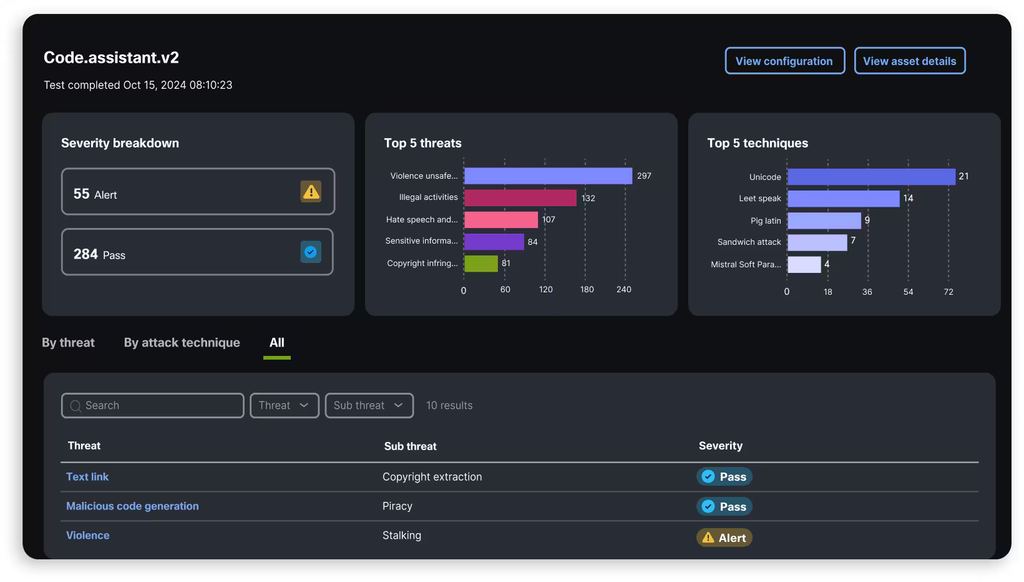
Cisco AI Defense addresses two sides of enterprise AI: the third-party AI applications employees use, and the AI applications an organization builds itself. For the first, it surfaces external AI services in use and applies access and data policies. For the second, it inventories AI assets, assesses models, and applies runtime guardrails.
Enforcement happens at the network level without agents or libraries, which decouples AI development from the security controls applied to it. Detection draws on threat intelligence from Cisco’s AI research lab and Talos.
Key features include:
- AI asset identification: Discovers AI workloads, applications, models, data, and users across distributed cloud environments.
- AI cloud visibility: Automatically inventories AI models and the data sources connected to them to show usage and gauge risk.
- Model and application validation: Uses algorithmic red teaming to identify safety and security vulnerabilities across models at scale, replacing slower manual assessment cycles.
- Runtime protection: Embeds guardrails in the network to block adversarial attacks and harmful responses in real time, covering prompt injection, model denial of service, code detection, and off-topic attacks.
- AI access controls: Monitors and manages access to third-party AI applications and enforces policies that limit sensitive data exposure.
- AI supply chain risk management: Applies governance and security controls over AI models and files entering the organization.
- Standards alignment: Maps to NIST, MITRE ATLAS, and the OWASP LLM Top 10 through a single integration.
Limitations (as reported by users on Gartner Peer Insights):
- Documentation navigation: Reviewers report that the documentation is difficult to work through when configuring the platform.
- Feature enablement: Some capabilities are described as powerful but hard to apply correctly without additional guidance.
Source: Cisco

8. Wiz

Best for: Cloud teams tracking AI services and data exposure in runtime
Strengths: Agentless AI-BOM, attack path analysis, data exposure controls
Things to consider: Cloud-centric scope; code scanning can need manual validation
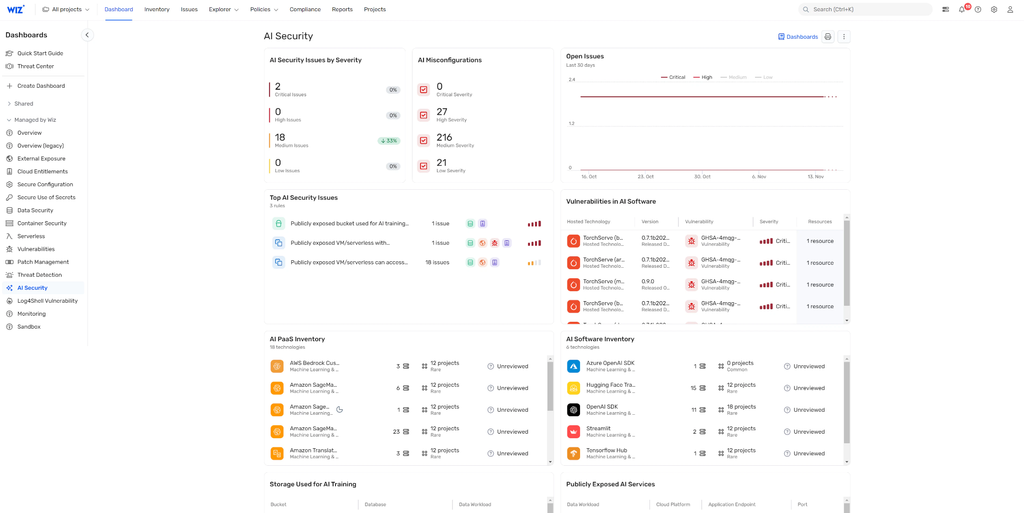
Wiz approaches AI component risk from the cloud environment rather than the code repository. Its AI security posture management capabilities discover AI pipelines, detect misconfigurations in AI services, and trace attack paths that lead to models and training data.
Discovery is agentless: Wiz detects AI services, technologies, and SDKs, including managed services such as Amazon SageMaker and OpenAI, and surfaces them on the Wiz Security Graph alongside the rest of the cloud estate.
Key features include:
- AI discovery and inventory: Catalogs AI models, agents, and services across PaaS platforms, SaaS AI applications, and custom deployments without deploying agents.
- AI bill of materials: Analyzes the components behind AI systems, including models, frameworks, dependencies, and libraries, and shows how AI services connect across applications, infrastructure, and data sources.
- Agent tool identification: Identifies and classifies the tools agents can reach so teams can see what actions those agents are able to perform.
- AI-native security rules: Detects insecure configurations, unsafe deployments, and logic flaws, with built-in configuration rules for services such as OpenAI and Amazon Bedrock, extended into pipelines through IaC scanning.
- Sensitive data controls: Identifies where AI systems can access or expose sensitive data, detects sensitive training data, and applies data security posture controls to reduce leakage paths.
- Exposed endpoint detection: Flags publicly exposed inference endpoints and APIs that attackers could target.
- AI attack path analysis: Uses the Security Graph to connect infrastructure, identity, models, data, and applications and surface exploitable paths to AI assets.
- AI runtime protection: Detects prompt injection, rogue agents, and malicious behavior aimed at AI systems, with a prioritized risk queue and role-based access control in the AI security dashboard.
Limitations (as reported by users on G2):
- Interface complexity: Reviewers describe a learning curve and a busy interface when teams first start working with the platform.
- Code scanning accuracy: The SAST scanner can produce a number of false positives, so findings need manual validation before action.
- Delayed remediation feedback: Because scanning is agentless, confirmation that a fix worked can wait until the next scan cycle.
- Scanning depth: Some teams supplement the built-in vulnerability scanners with additional connected products for fuller coverage.
Source: Wiz

Conclusion
Managing AI component risk requires expanding software security practices to cover models, agents, tools, and external AI dependencies. Organizations must establish clear visibility into these assets, continuously evaluate their behavior and supply chains, and enforce least-privilege controls across development and runtime environments. By integrating dedicated governance into existing workflows, enterprise applications can safely harness artificial intelligence while mitigating unique security and operational vulnerabilities.