

Intro
YAML (“YAML Ain’t Markup Language”) is a human‑readable data‑serialization format used widely for configuration files and data exchange. YAML favors readability via indentation to represent hierarchy and supports mappings (key–value), sequences (lists), and scalars (strings, numbers, booleans).
Why AppSec cares
YAML powers critical automation and infrastructure – Kubernetes manifests, Docker Compose, GitHub Actions, Helm charts, Ansible, and AWS CloudFormation – so securing YAML is essential to resilient CI/CD and cloud‑native pipelines.
YAML basics: structure & syntax
-
Mapping (object):
key: value -
Sequence (list):
- item(leading dashes) - Scalar: strings, numbers, booleans, nulls
- Indentation: spaces only; indentation defines nesting
-
Multi‑document:
---(start),...(optional end) -
Anchors & aliases: reuse blocks with
&nameand*name
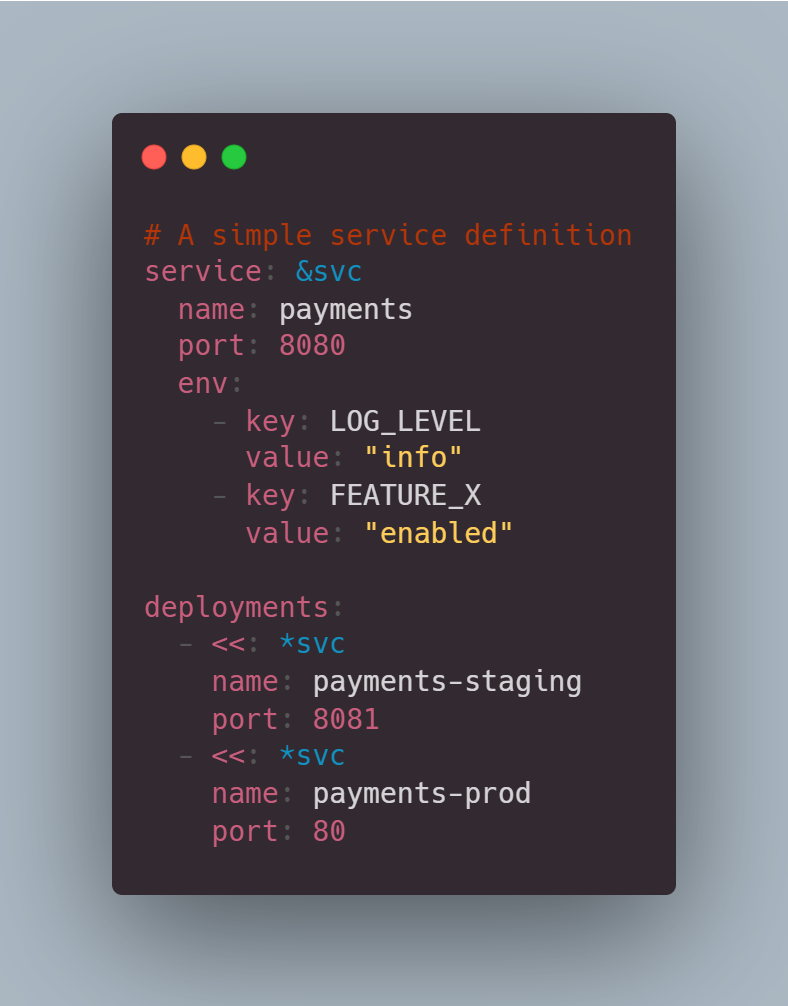
YAML Syntax Example
# A simple service definition
service: &svc
  name: payments
  port: 8080
  env:
    - key: LOG_LEVEL
      value: "info"
    - key: FEATURE_X
      value: "enabled"

deployments:
  - <<: *svc
    name: payments-staging
    port: 8081
  - <<: *svc
    name: payments-prod
    port: 80
Tip: Quote strings like “on”, “off”, “yes”, “no” when you intend them as strings – unquoted they may be parsed as booleans.
Where you’ll see YAML in modern stacks
- Kubernetes manifests for Pods, Deployments, RBAC, etc.
-
Docker Compose service definitions (
docker-compose.yml). -
GitHub Actions workflows (
.github/workflows/*.yml). - Helm charts (Kubernetes packaging).
- Ansible playbooks and inventories.
- AWS CloudFormation templates.
Scan YAML as code: Bring YAML into your AppSec program with IaC Security, KICS (open‑source), and Container Security so misconfigurations never make it to production.
YAML security risks & best practices
Common risks
- Unsafe deserialization: parsing untrusted YAML using unsafe loaders can enable code execution or DoS in some libraries.
- Secrets in plain text: credentials, tokens, or keys embedded in YAML or git history.
- Misconfigurations: overly permissive RBAC, insecure defaults, missing validations.
- Injection/overrides: unintended variable substitution or anchor/alias misuse.
How to secure YAML in CI/CD
- Use safe parsers: prefer “safe” constructors/loaders for untrusted content.
- Keep secrets out of YAML: store in a secret manager; add pre‑commit & pipeline checks with Secrets Detection.
- Lint & validate: enforce schemas/policies (e.g., Kubernetes) in CI.
- Scan as part of DevSecOps: add IaC Security or KICS; correlate with SCA and SAST.
- Least privilege: lock down actions, runners, service accounts, cluster roles.
- Repository hygiene: enforce branch protections and monitor with Repository Health.
YAML vs. JSON Comparison Table
| Aspect | YAML | JSON |
|---|---|---|
| Readability | Human‑friendly; supports comments | Concise; no comments by spec |
| Structure | Indentation defines hierarchy | Braces/brackets define hierarchy |
| Tooling | Great for configs & templating | Ubiquitous for APIs & services |
| Interoperability | Can embed JSON | Strict grammar; widely supported |
| Security | Beware unsafe loaders; lint & scan | Simpler parser surface |