
Summary
Code security protects software throughout the development lifecycle by identifying vulnerabilities, insecure dependencies, exposed secrets, and software supply chain risks before code reaches production. This guide explains the core code security practices, common risks, major categories of security tools, and highlights 12 leading solutions that help development teams build and ship secure software faster.
What Is Code Security?
Code security is the practice of protecting software throughout the development lifecycle. It focuses on finding and fixing security issues in application source code, third-party dependencies, version control repositories, build pipelines, and developer workflows before software reaches production. The goal is to reduce the risk of vulnerabilities, exposed secrets, insecure configurations, and unauthorized changes that could be exploited later.
In practice, code security combines automated scanning with development processes. It includes static application security testing (SAST), software composition analysis (SCA), secret scanning, infrastructure as code (IaC) scanning, container image scanning, and repository security checks. It also covers controls such as branch protection, code reviews, commit signing, and least-privilege access to development tools.
Code security best practices include:
- Integrate security early in the SDLC: Identify security requirements and vulnerabilities during design and development to reduce remediation costs.
- Scan open-source dependencies: Continuously monitor direct and transitive dependencies for known vulnerabilities and outdated packages.
- Prevent secrets from entering code repositories: Store credentials in secret management systems and block accidental commits with automated scanning.
- Validate inputs and encode outputs: Treat all external input as untrusted and encode output to prevent injection and XSS attacks.
- Secure APIs from the code level: Enforce authentication, authorization, input validation, and secure error handling in application code.
- Secure infrastructure as code: Scan IaC templates for insecure configurations before deploying infrastructure.
- Integrate security testing into CI/CD: Automate code security scans in build pipelines to detect issues before release.
- Train developers on secure coding: Build security knowledge through ongoing training, code security reviews, and practical exercises.
- Secure AI-generated code before merge: Review and scan AI-generated code to ensure it meets security standards.
Types of code security tools include:
- Static application security testing (SAST) tools: Analyze source code without execution to identify coding vulnerabilities early.
- Software composition analysis (SCA) tools: Detect vulnerable dependencies, license issues, and software supply chain risks.
- Secret detection tools: Find exposed credentials such as API keys, passwords, and tokens in code and repositories.
- Container and image security scanning tools: Scan container images for vulnerabilities, insecure configurations, and outdated packages.
- Code review and secure coding assistants: Help developers identify risky code patterns and apply secure coding practices.
- Code repository tools: Protect repositories with access controls, branch protections, audit logs, and change monitoring.
What Does Code Security Cover?
Code security applies across several connected surfaces:
- First-party source code: Application logic, authentication, authorization, data handling, APIs, and error management.
- Third-party components: Direct and transitive dependencies, open-source vulnerabilities, malicious packages, and license risk.
- Repositories and developer access: Branch protection, contributor permissions, exposed secrets, commit integrity, and code-review policies.
- Infrastructure and deployment code: Infrastructure-as-code templates, container definitions, and security-sensitive configuration.
- Build and delivery workflows: CI/CD permissions, automated security checks, policy gates, and artifact integrity.
- AI-generated code: Code, dependencies, configurations, and changes created or suggested by coding assistants and agents.
These surfaces overlap, but they require different controls. No single scan type can provide complete code security coverage.
Why Code Security Matters
Code security helps prevent vulnerabilities from becoming security incidents by identifying risks while software is still being developed. Addressing issues before deployment reduces the likelihood of data breaches, supply chain compromises, insecure APIs, and compliance failures, while making remediation faster and less costly.
- Prevent data breaches and credential leaks: Insecure code and exposed secrets such as API keys, passwords, and tokens can give attackers unauthorized access to systems and sensitive data. Secret scanning, secure credential management, and timely credential rotation reduce this risk.
- Reduce open-source and supply chain risk: Modern applications depend on third-party libraries that may contain vulnerabilities or malicious code. Dependency scanning, software bills of materials (SBOMs), and package integrity checks help identify and manage these risks before release.
- Secure APIs and business logic early: Weak authorization, unvalidated input, and business logic flaws are easier to identify and fix during development than after deployment. Code reviews and automated security testing help prevent these issues from reaching production.
- Support secure software delivery and compliance: Integrating security checks into CI/CD pipelines ensures every code change is validated before release. Consistent scanning, code review policies, and audit records also help organizations meet regulatory and industry compliance requirements.
How AI-Assisted Development Changes Code Security
AI coding assistants and coding agents can generate code, dependencies, tests, configurations, and infrastructure changes much faster than traditional manual workflows. This acceleration increases both productivity and the volume of code that teams must understand, review, and secure.
This isn’t a theoretical concern: Checkmarx’s 2026 Future of Application Security research found that 70% of developers say AI code generation created more vulnerabilities in their code in 2025, and AI-generated code is now responsible for 25% of breaches.
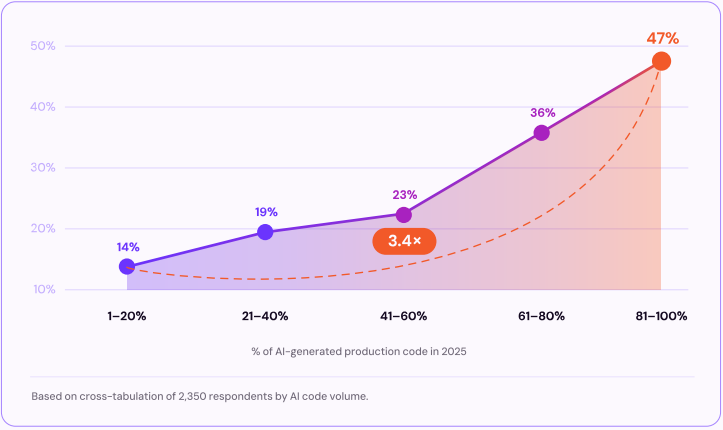
AI-generated code can contain the same vulnerabilities as human-written code, including injection flaws, weak access controls, exposed secrets, insecure dependencies, and unsafe configurations. It may also introduce additional review challenges because developers may accept code they did not design or fully understand.
Effective AI code security therefore requires:
- treating AI-generated code as untrusted until reviewed
- applying SAST, SCA, secret, and configuration checks before merge
- validating suggested dependencies and package sources
- preserving human approval for security-sensitive changes
- providing security guidance where developers use AI coding tools
- tracking and governing AI-assisted changes through normal repository and CI/CD controls
AI changes the speed of development, but it does not change the organization’s responsibility for the security of the resulting software.
Checkmarx Developer Assist
Guardrails for AI-assisted development
Bring self-healing security into AI-native development. Detect, fix, and verify issues as code is created,
with reviewable changes that keep risk out of the repo and backlog.
Code Security vs. Application Security
change the organization’s responsibility for the security of the resulting software.
Code security and application security overlap substantially, but they are not identical.
Application security is the broader discipline of reducing risk across the complete application lifecycle. It can include secure design, threat modeling, code analysis, dependency security, dynamic testing, API security, penetration testing, runtime controls, and application-security posture management.
Code security is the code-centric part of that discipline. It focuses on the source code, dependencies, repositories, configurations, and development workflows used to create software.
| Area | Code Security | Application Security |
| Primary focus | Code and development assets | Complete application lifecycle and attack surface |
| Main surfaces | Source, dependencies, repositories, IaC, build workflows | Design, code, APIs, deployed applications, runtime, cloud context |
| Common controls | Secure coding, SAST, SCA, secret scanning, code review | Code security controls plus DAST, penetration testing, API testing, runtime controls, ASPM |
| Primary users | Developers, AppSec engineers, platform teams | Developers, AppSec, security operations, cloud and risk teams |
Common Code Security Risks
Code security risks rarely occur in isolation. Most security incidents originate from a small number of underlying categories that affect how software is designed, written, configured, assembled, and delivered.
Understanding these broader risk groups helps development teams apply the right preventive controls instead of treating every vulnerability as a separate problem.
The following table summarizes the major categories of code security risk, the types of weaknesses they commonly include, and the controls that help reduce them. We explore each in more detail below.
| Risk Category | Typical Issues | Primary Security Controls |
| Insecure Data Handling & Injection | SQL Injection, Command Injection, Cross-Site Scripting (XSS), SSRF, insecure input handling | Input validation, output encoding, parameterized queries, secure frameworks, SAST, secure code review |
| Authentication & Authorization Weaknesses | Broken access control, IDOR, privilege escalation, weak session handling | Server-side authorization, least privilege, secure authentication, code review, API security testing |
| Secrets & Identity Exposure | Hardcoded passwords, API keys, tokens, certificates, cloud credentials | Secret detection, secret management, repository protection, credential rotation, least privilege |
| Dependency & Supply Chain Risk | Vulnerable packages, malicious packages, outdated libraries, dependency confusion, license risk | Software Composition Analysis (SCA), malicious package detection, SBOMs, dependency governance |
| Infrastructure & Configuration Risk | IaC misconfigurations, insecure containers, weak cloud permissions, exposed services | IaC scanning, container scanning, policy enforcement, secure configuration baselines |
| Secure Design & Business Logic Risk | Insecure workflows, weak authorization models, unsafe trust assumptions | Threat modeling, architecture review, secure design reviews, manual code review |
| AI-Generated Code Risk | Insecure generated code, unsafe dependencies, hidden logic flaws, insecure prompts | AI code review, SAST, SCA, secret detection, human approval before merge |
Injection Vulnerabilities
Injection vulnerabilities occur when an application treats untrusted input as part of a command or query executed by an interpreter. Common examples include SQL injection, OS command injection, and LDAP injection. By manipulating application inputs, attackers can execute unintended commands, access sensitive data, or alter application behavior. These vulnerabilities remain common because they often result from insecure input handling.
Impact: Injection attacks can lead to unauthorized data access, database manipulation, remote code execution, privilege escalation, and complete system compromise.
Mitigations
- Validate and sanitize all untrusted input using allowlists where possible.
- Use parameterized queries or prepared statements for database operations.
- Avoid concatenating user input into SQL queries, commands, or scripts.
- Apply the principle of least privilege to databases and service accounts.
- Perform regular code reviews and automated security testing to identify injection flaws.
Broken Access Control
Broken access control occurs when an application fails to correctly enforce authorization rules. As a result, users can access resources or perform actions beyond their intended permissions. Common issues include insecure direct object references (IDOR), privilege escalation, and missing server-side authorization checks. These flaws often arise when applications rely on client-side controls or inconsistent permission validation.
Impact: Attackers can access sensitive data, modify or delete unauthorized resources, escalate privileges, or take control of administrative functions.
Mitigations
- Enforce authorization checks on every server-side request.
- Apply least-privilege and deny-by-default access policies.
- Avoid relying on client-side validation for security decisions.
- Regularly test authorization logic using automated and manual penetration testing.
- Keep authentication and authorization frameworks properly configured and updated.
Hardcoded Secrets
Hardcoded secrets are credentials or cryptographic material embedded directly in source code or configuration files. These include passwords, API keys, access tokens, certificates, and encryption keys. Because source code is often shared through repositories and build systems, embedded secrets can be exposed long after they were intended to remain private.
Impact: Exposed secrets can allow attackers to access cloud services, databases, APIs, and internal systems without exploiting software vulnerabilities.
Mitigations
- Store secrets in dedicated secret management solutions instead of source code.
- Retrieve credentials securely at runtime.
- Scan repositories continuously for exposed secrets before and after commits.
- Rotate credentials immediately after suspected or confirmed exposure.
- Restrict access to secret management systems using least-privilege controls.
Insecure Dependencies
Insecure dependencies are third-party libraries, frameworks, or packages that contain known vulnerabilities or are no longer maintained. Since modern applications rely heavily on open-source software, vulnerable dependencies can introduce security risks even when internally developed code is secure. Attackers frequently target publicly disclosed vulnerabilities in widely used packages.
Impact: Vulnerable dependencies can expose applications to remote code execution, data breaches, denial-of-service attacks, and software supply chain compromises.
Mitigations
- Continuously monitor dependencies using Software Composition Analysis (SCA) tools.
- Apply security patches and version updates as soon as practical.
- Remove unsupported or unused libraries from projects.
- Track direct and transitive dependencies with a Software Bill of Materials (SBOM).
- Monitor vendor security advisories and prioritize remediation of high-risk vulnerabilities.
Cross-Site Scripting
Cross-site scripting (XSS) occurs when an application includes untrusted data in web pages without properly validating or encoding it. This allows attackers to inject malicious JavaScript that executes in another user’s browser. XSS commonly affects search fields, comment sections, message boards, and other areas that display user-generated content. The vulnerability remains one of the most common web application security issues because it often results from improper handling of user input.
Impact: XSS attacks can steal session cookies, hijack user accounts, modify page content, redirect users to malicious websites, or perform unauthorized actions using the victim’s authenticated session.
Mitigations
- Validate and sanitize all untrusted input before processing it.
- Encode output according to the context in which it is displayed (HTML, JavaScript, URL, or CSS).
- Use frameworks that automatically escape user input where possible.
- Implement a Content Security Policy (CSP) to limit script execution.
- Regularly test applications using automated scanners and manual security reviews.
Insecure Deserialization
Insecure deserialization occurs when an application accepts serialized data from an untrusted source and reconstructs it into objects without adequate validation. Attackers can manipulate serialized data to alter application behavior, bypass security controls, or trigger execution of malicious code. The vulnerability is commonly associated with object serialization mechanisms used in web services, APIs, and distributed applications.
Impact: Successful exploitation can result in remote code execution, privilege escalation, denial-of-service attacks, authentication bypass, or complete compromise of the affected application.
Mitigations
- Avoid deserializing data received from untrusted sources whenever possible.
- Validate the integrity and authenticity of serialized data before processing it.
- Restrict deserialization to approved classes using allowlists.
- Keep serialization libraries and frameworks updated with security patches.
- Review application code and conduct security testing to identify unsafe deserialization paths.
Security Misconfiguration
Security misconfiguration occurs when applications, frameworks, servers, or cloud services are deployed with insecure settings. Common examples include default credentials, excessive permissions, unnecessary services, verbose error messages, and missing security headers. Misconfigurations frequently arise from inconsistent deployment processes or overlooked security settings, making them one of the leading causes of exploitable vulnerabilities.
Impact: Attackers can exploit misconfigurations to gain unauthorized access, expose sensitive information, bypass security controls, or compromise application and infrastructure components.
Mitigations
- Replace default credentials and disable unnecessary features before deployment.
- Apply secure configuration baselines across servers, applications, and cloud resources.
- Enable secure HTTP headers and remove unnecessary error details from responses.
- Automate configuration management and regularly apply security updates.
- Perform routine configuration audits, vulnerability scans, and compliance assessments.
Code Security Best Practices
Effective code security is built on a combination of secure engineering practices, disciplined development workflows, and continuous automated validation. No individual security tool or scan type can protect every part of the software development lifecycle. Instead, organizations need a layered approach that combines secure coding, repository governance, dependency management, automated testing, and developer education.
The following best practices represent the core operational principles of an effective code security program. Together, they help development teams reduce vulnerabilities earlier, improve software quality, strengthen software supply chain integrity, and integrate security into everyday development rather than treating it as a separate activity performed before release.
The practices are intentionally organized around the natural software development workflow—from designing and writing secure code, through managing dependencies and repositories, to validating changes before deployment and continuously improving developer security awareness.
Integrate Security Early in the SDLC
Security should begin during planning and design, not after software has already been implemented. Threat modeling, architecture reviews, secure design decisions, and coding standards reduce vulnerabilities before they enter the codebase.
Early feedback is consistently less expensive than post-release remediation while allowing development teams to maintain delivery velocity.
Continuously Secure Open-Source Dependencies
Modern applications rely heavily on third-party software. Organizations should continuously inventory direct and transitive dependencies, monitor newly disclosed vulnerabilities, detect malicious packages, and maintain software bills of materials (SBOMs).
Dependency governance should become part of normal development rather than an occasional audit activity.
Prevent Secrets from Entering Source Code
Passwords, API keys, certificates, cloud credentials, and access tokens should never be committed to repositories.
Secrets should be stored in approved secret-management systems and automatically scanned before code is committed or merged.
When exposure occurs, credentials must be revoked and rotated immediately.
Validate Inputs and Encode Outputs
Every external input should be treated as untrusted.
Input validation, output encoding, parameterized queries, and secure framework defaults reduce injection vulnerabilities, cross-site scripting, and related attacks.
These controls should become part of coding standards rather than optional review items.
Secure APIs From the Code Level
API security begins in application code.
Developers should consistently implement authentication, authorization, rate limiting, input validation, and secure error handling while preventing excessive data exposure and business-logic abuse.
External API gateways complement – but do not replace – secure API implementation.
Secure Infrastructure as Code
Infrastructure definitions deserve the same review standards as application code.
Infrastructure-as-Code templates should be scanned continuously for excessive permissions, exposed resources, insecure defaults, and policy violations before deployment.
Integrate Security Testing into Developer Workflows
Security testing should operate where developers already work.
SAST, SCA, secret detection, IaC scanning, and repository controls should integrate into IDEs, pull requests, and CI/CD pipelines so issues are identified before deployment rather than after release.
Secure Source Code Repositories
Repositories represent one of the highest-value targets in modern software development.
Organizations should enforce:
- least-privilege access
- protected branches
- mandatory code review
- commit verification where appropriate
- repository monitoring
- audit logging
- approval workflows
Repository security reduces both insider risk and software supply chain compromise.
Perform Security-Focused Code Reviews
Automated scanning cannot replace thoughtful engineering review.
Developers and security engineers should review:
- authorization logic
- business workflows
- sensitive data handling
- architecture decisions
- AI-generated code
- high-risk changes
Manual review remains essential for identifying context-specific weaknesses that automated analysis may not fully understand.
Prioritize Remediation by Real Risk
Not every finding deserves immediate attention.
Development teams should prioritize issues using:
- exploitability
- reachability
- application criticality
- exposure
- business impact
- software ownership
Risk-based prioritization allows organizations to reduce meaningful risk instead of simply reducing vulnerability counts.
Secure AI-Generated Code Before Merge
AI-generated code should be treated like externally contributed code.
Organizations should:
- review generated code
- validate dependencies
- apply SAST, SCA, secrets, and IaC scanning
- verify architectural consistency
- require human approval before merge
AI accelerates development but does not eliminate the need for secure engineering practices.
Related content: Learn more about AI code security and how to keep AI-written code safe.
Types of Code Security Tools
Static Application Security Testing Tools
Static application security testing (SAST) tools analyze source code, bytecode, or compiled binaries without executing the application. They identify security vulnerabilities by examining code structure, data flows, and programming patterns before software is deployed. Because SAST runs during development, it helps developers fix security issues early, reducing remediation costs and preventing vulnerabilities from reaching production. These tools are commonly integrated into IDEs, pull requests, and CI/CD pipelines to provide continuous feedback.
Key capabilities:
- Detect coding vulnerabilities such as injection flaws, insecure authentication, and improper input validation
- Analyze source code, bytecode, and compiled binaries without executing the application
- Trace data flows to identify security weaknesses across the codebase
- Integrate with IDEs, version control systems, and CI/CD pipelines
- Prioritize findings and provide remediation guidance
- Support secure coding standards and compliance requirements
Software Composition Analysis Tools
Software composition analysis (SCA) tools identify and monitor the third-party libraries and open-source components used within an application. Since modern software relies heavily on external dependencies, these tools help organizations detect vulnerable packages, understand software supply chain risk, and maintain an accurate inventory of components. Continuous monitoring allows teams to respond quickly as new vulnerabilities are disclosed.
Key capabilities:
- Inventory direct and transitive software dependencies
- Detect known vulnerabilities in open-source components
- Monitor dependency versions and security advisories
- Identify software license and compliance issues
- Generate Software Bills of Materials (SBOMs)
- Recommend or automate dependency updates
Secret Detection Tools
Secret detection tools identify sensitive credentials that have been accidentally exposed in source code, configuration files, or version control systems. These credentials, including passwords, API keys, access tokens, and certificates, are a common target for attackers because they provide direct access to applications and infrastructure. Secret scanning helps prevent credential leaks before code reaches shared repositories or production environments.
Key capabilities:
- Detect passwords, API keys, tokens, certificates, and encryption keys
- Scan source code, repositories, and configuration files
- Prevent secrets from being committed through pre-commit and CI/CD integration
- Continuously monitor repositories for newly exposed credentials
- Validate and prioritize exposed secrets
- Support credential rotation and remediation workflows
Container and Image Security Scanning
Container and image security scanning tools analyze container images for vulnerabilities, insecure configurations, and outdated software packages before deployment. They help secure cloud-native applications by ensuring that containers are built from trusted components and comply with organizational security policies. Continuous scanning throughout the build pipeline reduces the risk of deploying vulnerable workloads.
Key capabilities:
- Detect vulnerabilities in container images and base images
- Identify outdated operating system packages and application dependencies
- Scan for insecure container configurations
- Verify compliance with security policies and benchmarks
- Integrate into container build and CI/CD pipelines
- Monitor container images throughout their lifecycle
Code Security Review and Secure Coding Assistants
Code review and secure coding assistants help developers identify security issues while writing or reviewing code. They analyze code changes, explain security risks, and recommend safer implementation patterns, complementing both automated scanning and manual peer review. Many modern solutions also provide AI-assisted remediation suggestions to speed up secure development.
Key capabilities:
- Analyze code changes for security issues
- Highlight insecure coding patterns and risky logic
- Recommend secure coding alternatives and fixes
- Explain vulnerabilities with contextual guidance
- Integrate into IDEs, pull requests, and code review workflows
- Support developer education and secure coding practices
Code Repository Tools
Code repository tools secure source code management platforms by controlling access, monitoring activity, and protecting the integrity of the codebase. They help organizations enforce development policies, prevent unauthorized changes, and maintain a complete audit trail throughout the software development lifecycle. Repository security is a key part of protecting the software supply chain.
Key capabilities:
- Enforce repository access controls and permissions
- Protect branches with merge and approval policies
- Monitor repository activity and audit code changes
- Verify commits and contributor identities
- Detect unauthorized or suspicious repository activity
- Support governance, compliance, and policy enforcement
Choosing the Right Code Security Capabilities
Rather than asking which single tool is “best,” organizations should determine whether their security capabilities collectively protect every important part of the development lifecycle.
An effective code security program should provide:
| Capability | Why It Matters |
| Source code analysis | Detect insecure implementation before deployment. |
| Dependency security | Reduce software supply chain risk. |
| Secret detection | Prevent credential exposure. |
| Repository governance | Protect development workflows and contributor integrity. |
| Infrastructure & container security | Prevent insecure deployments. |
| AI-generated code validation | Apply the same security standards to AI-generated code as human-written code. |
| Risk prioritization | Focus developers on issues that materially reduce risk. |
| Developer workflow integration | Deliver security guidance inside IDEs, pull requests, and CI/CD. |
| Central governance | Apply consistent policy, reporting, and compliance across teams. |
Organizations typically achieve these capabilities through integrated platforms rather than isolated point products.
For a detailed comparison of leading code security platforms and specialist tools, see:
Related article: Best Code Security Tools: Categories and Platform Comparison
How to Choose Code Security Tools
The effectiveness of a code security program depends heavily on the tools used throughout development. When evaluating code security tools, organizations should look beyond basic vulnerability detection and consider how well a solution fits into developer workflows, supports modern development practices, and helps teams remediate issues efficiently.
- Prioritize broad security coverage: Choose tools that can identify multiple types of risks, including coding vulnerabilities, insecure dependencies, exposed secrets, infrastructure-as-code misconfigurations, container security issues, and malicious packages. Broader coverage reduces security blind spots and provides a more complete view of risk.
- Look for early detection capabilities: Tools that identify issues while code is being written help prevent vulnerabilities from progressing further into the development lifecycle. Finding and fixing problems before code is committed is typically faster, less disruptive, and less expensive than remediation later in testing or production.
- Evaluate developer workflow integration: Security tools should integrate directly into the environments developers already use, such as IDEs and development platforms. Seamless integration increases adoption and allows developers to address issues without constantly switching between tools.
- Assess remediation support: Detection alone is not enough. Effective tools should help developers understand and fix issues by providing remediation guidance, code-level recommendations, or validated fixes. Strong remediation capabilities can significantly reduce the time required to resolve vulnerabilities.
- Consider signal-to-noise ratio: Excessive false positives can overwhelm development teams and reduce trust in security tools. Look for solutions that prioritize accuracy and provide mechanisms for validating findings so developers can focus on genuine security risks.
- Choose tools that support AI-assisted development: As AI coding assistants become more common, security tools should be capable of analyzing both human-written and AI-generated code. This helps ensure that vulnerabilities introduced through automated code generation are identified and addressed early.
- Look for clear explanations and context: Security findings should include understandable explanations of why an issue exists, the potential impact, and how the recommended fix addresses the problem. Context-rich feedback helps developers learn secure coding practices while resolving issues.
- Verify automation capabilities: Continuous scanning and automated security checks help maintain consistent protection across projects and development teams. Automation reduces reliance on manual reviews and ensures that security analysis occurs throughout the development process.
- Review privacy and data handling practices: Organizations should understand how security tools process source code and security data. Solutions that minimize code exposure and provide strong data protection controls can help reduce security and compliance concerns.
- Ensure scalability across teams: The chosen solution should be able to support different roles, including developers, security teams, and operations teams. Centralized visibility, policy enforcement, and consistent workflows help organizations scale code security practices as projects and teams grow.
- Evaluate governance and centralized policy enforcement: Organizations should be able to define and enforce consistent security policies across repositories, projects, and development teams from a central location. Look for tools that support policy-based enforcement for security scans, branch protections, pull request requirements, secret detection, and compliance controls. Centralized governance helps maintain consistent security standards, simplifies audits, and reduces the risk of individual teams applying different security practices.
Conclusion
Effective code security depends on combining secure development practices with automated controls throughout the software development lifecycle. Secure coding, code reviews, repository protections, dependency management, secret detection, and continuous security testing each address different sources of risk. Together, they help prevent vulnerabilities, exposed credentials, insecure configurations, and compromised dependencies from becoming production incidents. Applying these controls early also reduces remediation costs and gives developers faster feedback while code is still being written.
Modern development teams also benefit from developer-friendly security tools that integrate directly into IDEs, version control systems, and CI/CD pipelines. By providing accurate findings, clear remediation guidance, and automated policy enforcement, these tools make security part of the normal development workflow instead of a separate activity at the end of a project. Combining secure coding practices, repository hygiene, dependency governance, and integrated security tooling enables organizations to deliver software more quickly while reducing application and software supply chain risk before code reaches production.
Supporting Modern Code Security with Checkmarx One
Modern code security extends far beyond identifying vulnerabilities in source code. Organizations must protect proprietary code, open-source dependencies, repositories, infrastructure definitions, AI-generated code, and developer workflows while maintaining development velocity.
The problem is no longer tooling – it’s execution.
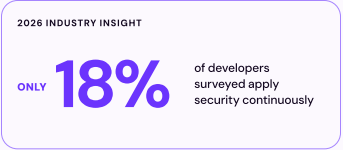
Checkmarx’s Future of Application Security research found that 96% of developers already have AI security tooling in their IDEs, and virtually all (99.6%) rate it effective, yet only 18% apply security continuously as code is written. The tools work, but organizations don’t know how to translate their output into effective decisions – and tool sprawl is now the #1 AppSec challenge, cited by 37% of respondents.
Checkmarx One addresses this gap directly: a unified application security platform that helps organizations identify, prioritize, govern, and remediate risk throughout the software development lifecycle – turning tool output into action instead of adding another disconnected scanner.
Core capabilities include:
- Static Application Security Testing (SAST): Detect vulnerabilities in proprietary code early with a Fusion hybrid engine that combines deterministic rules and AI-based analysis – reaching an F1 score of 0.64 against an industry average of roughly 0.20, with 60% fewer false positives than traditional SAST.
- Software Composition Analysis (SCA): Inventory direct and transitive dependencies, prioritize vulnerable components, detect malicious packages, and manage software supply chain risk.
- Secrets, Infrastructure, and Container Security: Identify exposed credentials, insecure infrastructure definitions, and vulnerable container images before deployment.
- Unified Risk Prioritization: Correlate findings across code, dependencies, repositories, infrastructure, and AI assets to focus developers on the issues that materially reduce risk.
- Developer Workflow Integration: Deliver security findings and remediation guidance inside IDEs, pull requests, and CI/CD pipelines to reduce friction and accelerate secure development.
- AI-Assisted Developer Guidance: Checkmarx Developer Assist brings contextual security guidance and review-ready remediation recommendations into developer workflows, helping teams secure both human-written and AI-generated code before merge.
- Centralized Governance: Apply consistent security policies, reporting, and application-security posture management across repositories, teams, and software portfolios.
Effective code security is not achieved through one scan or one tool. It requires coordinated security practices, integrated workflows, and continuous governance across every stage of software development.